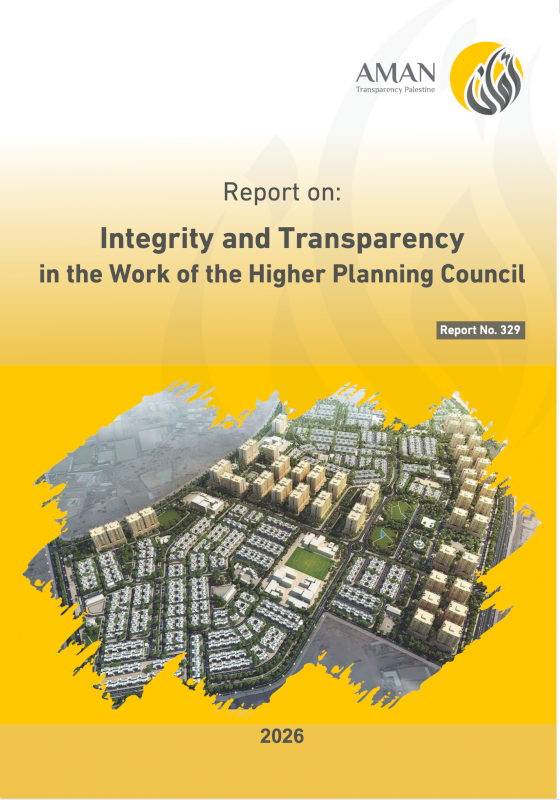
This report aims to assess the state of integrity values, transparency principles, and accountability systems within the work of the Higher Planning Council (HPC) in particular, and, on a preliminary level, within the planning committees. It does so through an examination of the legal, institutional, and procedural framework governing the HPC’s operations, identifying governance gaps and potential corruption risks, and ultimately formulating recommendations to strengthen the integrity system underpinning The HPC’s work.
The Higher Planning Council is the supreme regulatory authority responsible for urban and spatial planning and land-use regulation in Palestine. This report is produced within the broader efforts of AMAN Coalition (the Palestinian chapter of Transparency International) to promote the principles of good governance across local government institutions.
The study adopted a descriptive-analytical methodology, reviewing and analyzing the legal and institutional framework governing the work of the Higher Planning Council and the planning committees, and assessing the extent to which an enabling legal environment exists to regulate work procedures and the conduct of personnel, both in theory and in practice. The study relied on the collection and analysis of information from a variety of relevant sources, supplemented by qualitative interviews with official and professional stakeholders.
A review of the legal framework reveals that, despite its comprehensiveness in defining mandates and allocating powers, it continues to exhibit structural gaps that affect the very foundations of good governance. The applicable legislation, most notably the Cities, Villages and Buildings Planning Law No. (79) of 1966 and its amendments, together with the regulations issued thereunder, is primarily concerned with planning and regulatory procedures. However, it does not sufficiently establish a values-based governance framework capable of guiding and regulating the conduct of the actors operating within it.
The institutional framework governing the work of the Higher Planning Council is based on a distribution of roles across the local, regional, and central levels, reflecting the application of the principle of separation between decision-makers and implementers. It also reinforces a participatory approach among the relevant sectors involved in the management of the urban planning process.
The assessment of the integrity environment indicates that, although Council members are subject to the general legal frameworks governing conflicts of interest, there is no specialized written procedural framework for the Higher Planning Council that uniformly regulates the disclosure of interests, recusal procedures, and the documentation of conflict-of-interest situations. Nor is there a dedicated code of conduct tailored to the specific nature of The HPC’s mandate and decision-making functions.