AMAN Calls for Accountability for Failure to Enforce Judicial Rulings and the Establishment of a National Mechanism to Monitor Their Enforcement
Research Paper Discusses the Failure to Enforce Judicial Rulings and Cases That May Constitute Corruption Offenses and Abuse of Power
The Coalition for Accountability and Integrity (AMAN) held a discussion session on a research paper titled “The Crime of Corruption in Cases of Failure to Enforce Judicial Rulings – The Case of Palestine.” The session aimed to shed light on the legal and institutional challenges associated with the failure to enforce judicial rulings, examine the extent to which deliberate non-enforcement may constitute corruption offenses, and assess its implications for the rule of law, judicial independence, and the protection of rights and freedoms.
AMAN Executive Director Isam Haj Hussein opened the session, explaining that the paper was prepared as part of the Coalition's contribution to reform and anti-corruption efforts on a national level through identifying legal and institutional challenges and presenting practical recommendations to decision-makers to strengthen the rule of law and accountability.
Haj Hussein noted that the failure to enforce judicial rulings may, in some cases, be deliberate and driven by political or partisan interests. This calls for an examination of the legal liability arising from such practices and whether they constitute corruption offenses.
119 Cases of Non-Enforcement of Judicial Rulings and Decisions
Dr. Mahmoud Alawneh, the researcher who prepared the paper, presented its key findings. He explained that Article 106 of the Amended Palestinian Basic Law of 2003 establishes the binding nature of judicial rulings and criminalizes their non-enforcement or obstruction. However, actual practice reveals a gap between legal protections and institutional compliance.
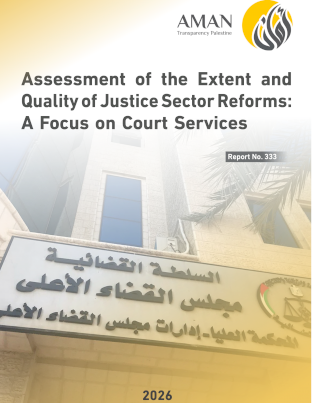
The paper showed that failure to enforce judicial rulings is not limited to outright refusal. It also includes unjustified delays, partial or merely formal enforcement, and attempts to circumvent judicial rulings, particularly release orders and rulings issued by administrative courts.
The paper emphasized the importance of distinguishing between the offense of failing to enforce judicial rulings, as stipulated in the Basic Law, and cases in which such failure may also constitute a corruption offense involving abuse of power under Article 1 of Palestinian Anti-Corruption Law No. 1 of 2005, as amended, provided that the necessary legal elements of the offense are established. It clarified that the absence of the elements constituting a corruption offense in a particular case does not necessarily rule out criminal liability for deliberately failing to enforce judicial rulings.
According to the rights data reviewed in the paper, the Civil Commission for the Independence of the Judiciary and the Rule of Law (ISTIQLAL) documented 164 cases of non-enforcement of judicial rulings and decisions, including 128 cases involving release orders and 36 involving administrative court rulings. Judicial rulings and decisions were enforced in 45 cases, while 119 remained unenforced, representing approximately 72.6% of the documented cases.
Participants' Contributions: Differing Legal Interpretations and Emphasis on the Need for Accountability
The session was attended by representatives of the Ministry of Justice, the Preventive Security Service, and several institutions, as well as academics and lawyers. Participants expressed differing views on whether failure to enforce judicial rulings should be classified as a corruption offense and whether the legal elements of abuse of power are present in such cases.
Some participants argued that classifying failure to enforce judicial rulings as a corruption offense requires evidence of intent to obtain an advantage or secure an undue benefit, which they did not believe were present in the cases discussed. Others maintained that the legal classification depends on the facts and circumstances of each case and whether the necessary legal elements of the offense are established.
Other participants, however, argued that certain cases of deliberate failure to enforce judicial rulings constitute offenses that meet all the necessary legal elements. They noted that years of monitoring the non-enforcement of judicial release orders had revealed repeated delays and a growing number of unenforced orders, amid weak accountability mechanisms. Some linked the persistence of these practices to conflicts of interest and interference by influential individuals, which may hinder efforts to hold those responsible accountable.
Participants also noted that failure to enforce judicial rulings affects the rights and freedoms guaranteed by the Basic Law. They emphasized that, under the Basic Law, offenses arising from violations of these rights and freedoms are not subject to statutes of limitations or amnesty.
AMAN Legal Advisor Al-Barghouthi emphasized the importance of classifying deliberate failure to enforce judicial rulings as a corruption offense when the legal elements of abuse of power are established, pursuant to Article 182 of Jordanian Penal Code No. 16 of 1960, which is applicable in the West Bank, read in conjunction with Article 1 of the Palestinian Anti-Corruption Law.
He noted that there have been previous cases in which the Anti-Corruption Prosecution charged a public official with abuse of power under the aforementioned provision. He argued that this legal interpretation strengthens accountability and helps prevent impunity.
Al-Barghouthi added that adopting this interpretation in cases where the elements of a corruption offense are established serves the public interest and allows the application of the legal safeguards governing the prosecution of corruption offenses, including provisions relating to statutes of limitations and amnesty under applicable legislation.
Recommendations: Strengthening Accountability and Establishing a National Mechanism to Monitor the Enforcement of Judicial Rulings
The paper presented several recommendations, including reviewing and updating the legal provisions governing failure to enforce judicial rulings, clarifying the scope of criminalization and legal liability, and establishing clear criteria for cases in which enforcement is not possible. These measures aim to prevent administrative or procedural justifications from being used to obstruct the enforcement of judicial rulings.
At the judicial and criminal justice levels, the paper called for strengthening the role of the Public Prosecution in pursuing cases of deliberate non-enforcement, improving coordination with the Palestinian Anti-Corruption Commission and oversight bodies in cases involving suspected corruption, developing mechanisms for judicial oversight of enforcement, and ensuring the right of affected individuals to compensation.
At the institutional and administrative levels, the paper recommended establishing a national mechanism to monitor the enforcement of judicial rulings, requiring public institutions to adopt clear procedures for enforcement and documentation, expediting the enforcement of judicial release orders, strengthening the capacities of the relevant authorities, and providing the resources needed to address obstacles to enforcement.
The paper also called for establishing a national database of unenforced judicial rulings, issuing periodic reports on public institutions' compliance, strengthening the role of civil society in oversight and strategic litigation, and developing awareness-raising programs on the binding nature of judicial rulings.
The discussions emphasized that differing views on whether failure to enforce judicial rulings constitutes a corruption offense should not obscure the fact that failing to enforce or obstructing the enforcement of such rulings constitutes a criminal offense under the Palestinian Basic Law. The absence of the legal elements of a corruption offense does not exempt those responsible from legal liability for deliberately failing to enforce judicial rulings. It stressed the importance of strengthening accountability and ensuring the enforcement of judicial rulings as essential pillars of the rule of law, the protection of rights and freedoms, and the prevention of impunity.