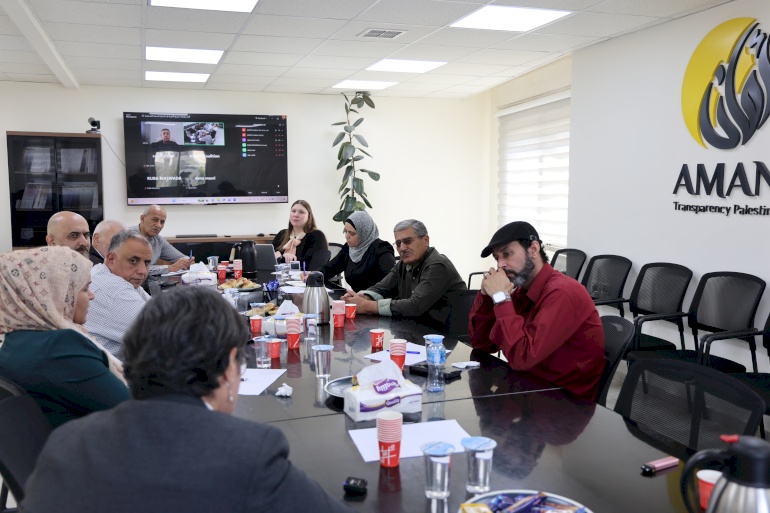
At an AMAN Workshop on Equitable Medicine Distribution to Health Centers
Calls for a National System Allowing Citizens to Check Which Medicines Are Available and Where to Obtain Them, and for a National Disease Registry
Ramallah - The Coalition for Accountability and Integrity (AMAN) held a session to discuss a research paper on the mechanisms and procedures for distributing medicines to Palestinian health centers, with the participation of representatives from the Ministry of Health, civil society organizations, and stakeholders concerned with health and oversight.
Opening the session, AMAN Executive Director Issam Haj Hussein stressed that government efforts to rationalize spending must not adversely affect essential services, particularly in the health and social development sectors, given their direct impact on groups most in need. He explained that the paper forms part of AMAN’s and civil society’s contribution to reform efforts by examining the state of public services and proposing measures to improve their efficiency, transparency, and equitable access.
Clear and Fair Criteria for Medicine Distribution
Researcher and paper author Zakaria al-Sarhad presented the paper’s key findings. He explained that it sought to determine whether clear and objective criteria are in place for distributing medicines to health centers and facilities affiliated with the Ministry of Health in a manner that ensures fairness, transparency, and integrity in access to services. It also examined oversight and accountability mechanisms governing the distribution process.
The paper found that the financial crisis and the continued withholding of clearance revenues have directly affected the Ministry of Health’s ability to provide medicines and medical supplies, amid mounting debts owed by the Ministry to healthcare providers. Severe shortages of certain medicines, particularly medications for chronic diseases and cancer, have also resulted in the rationing of available quantities, affecting patients’ ability to obtain the medicines they need on a regular basis.
The paper also addressed the impact of checkpoints, closures, military operations, and settler attacks on the transportation of medicines and medical supplies, particularly to villages, towns, and outlying areas. It further noted that staff shortages and reduced working days and hours have affected the regular dispensing of medicines.
Challenges in Transparency and Electronic Integration
The paper indicated that a procedural framework is in place for assessing needs and distributing medicines based on several criteria, including population size, disease patterns, previous consumption, population density, and disease incidence rates.
However, it identified challenges related to the uneven distribution of pharmacy staff among governorates and the limited application of disclosure and conflict-of-interest policies at the level of health directorates and centers.
It also found that there is no integrated electronic system connecting health centers with directorates and warehouses, limiting the accuracy of planning and the efficiency of distribution. In addition, procedural manuals, distribution protocols, and information on the services provided by health centers are not sufficiently made available to citizens.
With regard to oversight and accountability, the paper noted that procedures are in place for documentation, inventory, receipt and handover, and stock monitoring, while most complaints concern medicine shortages and delays in supply.
A National System Allowing Citizens to Check Medicine Availability
The paper recommended adopting a standardized scientific methodology for distributing medicines based on population size, disease burden, and actual consumption, with periodic reviews. It also called for a more equitable distribution of pharmacy staff among governorates and increased allocations for procuring essential medicines, particularly medicines for chronic diseases and life-saving medications.
It further called for emergency plans and alternative supply chains to ensure the continued delivery of medicines during crises and closures, as well as broader involvement of doctors, pharmacists, and health center staff in determining annual needs.
The paper recommended expanding the application of conflict-of-interest disclosure policies and the Code of Conduct to cover all personnel involved in pharmaceutical services, conducting periodic corruption risk assessments, and publishing medicine distribution criteria, procedural manuals, and dispensing protocols.
It also emphasized the importance of developing a national system that allows citizens to check which medicines are available and where they can obtain them, completing the digital transformation process, and connecting health centers through a unified health information system. It further called for stronger internal and external oversight, activation of the complaints system, and measures to ensure that complaints are documented, verified, and responded to.
Calls for a Unified National Disease Registry
During the discussion, Ismail Abu Ziada, Health Sector Coordinator at the Palestinian NGO Network (PNGO), stressed the importance of establishing emergency warehouses in the governorates to ensure continuity of medicine supplies during crises. He also highlighted the need for a unified disease-mapping system that provides accurate data on diseases and healthcare needs, thereby improving planning, resource allocation, and oversight.
He noted that the lack of accurate data on the number of patients with chronic diseases poses a challenge to assessing needs and called for civil society organizations and physicians to be involved in developing and updating the disease map.
For his part, Alaa Badarneh, Legal Adviser at the Center for Defense of Liberties and Civil Rights “Hurryyat,” stressed that distribution mechanisms must take actual needs and disparities between governorates and health centers into account and ensure that medicines reach remote areas, particularly given the presence of checkpoints and restrictions on movement. He also called for priority to be given to medicines for chronic diseases and older persons.
Ministry of Health: Medicine Availability Varies with Supply and Need
Shatha Shraim, Director of the Pharmacy Department for Primary Health Care at the Ministry of Health, explained that medicine availability levels change continuously depending on supply deliveries and the quantities available, and that relying on a fixed percentage does not accurately reflect this changing reality. She said available quantities are distributed among governorates according to need and are subsequently distributed within health directorates based on actual needs.
Safaa Blaibleh, Director of the Pharmacy Department at the Ministry of Health’s General Directorate of Hospitals, explained that hospitals assess their needs annually with the participation of pharmacy directors and specialist physicians, taking into account hospital size, the number of beds, medical specialties, patient numbers, and previous consumption.
She noted that the financial crisis and supply difficulties have at times resulted in quantities being received that fall far short of actual needs, requiring priorities to be set, beginning with life-saving medicines and those needed for surgical procedures. She also stressed that differences in the quantities available do not necessarily indicate the absence of a fair distribution mechanism, but may instead result from the limited quantities supplied in the first place.
A National Disease Registry
Jad Al-Tawil, Chairman of the Board of Directors of the Palestinian Society for Bleeding Disorders, stressed the need to establish a unified national disease registry that would provide accurate information on patient numbers and their needs. He also expressed the Society’s willingness to contribute the data available to it.
Ohoud Mraqtan warned of the serious consequences of shortages of certain medicines, particularly cancer medications. She called for stronger accountability over the management of pharmaceutical resources, verification of cases involving the disposal of expired medicines, and optimal use of budgets allocated to the health sector.
Concluding the discussion, Issam Haj Hussein stressed that reforming the health sector cannot be separated from the broader debate on public spending priorities. He invited participants to attend the 2026 Public Budget Conference, organized by the Civil Society Team for Enhancing Public Budget Transparency on October 14, with the aim of developing practical recommendations to help control expenditures and direct resources toward national priorities and essential services.
Participants emphasized that fairness in medicine distribution depends not only on whether medicines are available, but also on clear and publicly disclosed criteria, accurate health data, an integrated information system, equitable distribution of staff, and effective oversight, accountability, and complaints mechanisms. These elements are essential to ensuring that citizens have access to pharmaceutical services on objective, fair, and transparent grounds.