AMAN Calls for Developing and Adopting a Dedicated Regulation and Unified Procedures Manual for Issuing Certificates of Origin
Discussion Session Examines Agricultural Sector Reforms and Corruption Risks in the Issuance of Palestinian Certificates of Origin
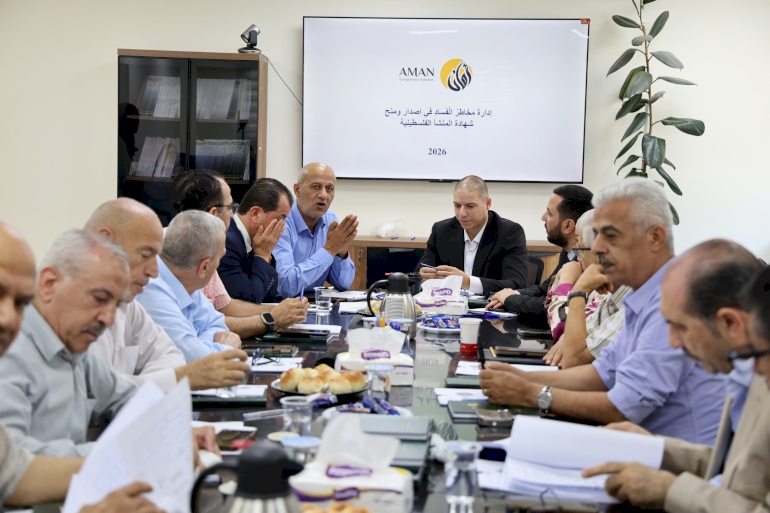
Ramallah - The Coalition for Integrity and Accountability (AMAN) held a discussion session on the current state of reforms in the agricultural sector and corruption risks in the procedures for issuing Palestinian certificates of origin. The session brought together representatives of the Ministries of Agriculture, Industry, and Interior, the Federation of Palestinian Chambers, the Farmers Union, civil society organizations, and other relevant stakeholders to discuss existing challenges, ways to strengthen integrity, transparency, and accountability, and support the agricultural sector reform process.
AMAN Executive Director Issam Haj Hussein opened the session, emphasizing that civil society contributes to the reform process by monitoring progress, identifying gaps and challenges, and providing decision-makers with practical recommendations to address them.
Haj Hussein explained that AMAN, in coordination with the Government Reform Unit, is preparing supplementary reports on several issues related to the government’s reform agenda. He noted that the Coalition has prepared a report assessing progress on agricultural sector reforms, along with a specialized study on corruption risks in the procedures for issuing and granting Palestinian certificates of origin.
He stressed that certificates of origin are important not only from an economic and commercial perspective, but also have a national dimension in the Palestinian context. They help protect the identity of Palestinian products and guard against the risk of settlement products or other non-Palestinian goods entering markets under a Palestinian identity.
Regarding reforms in the agricultural sector, Haj Hussein stressed the need to move away from emergency interventions and responses toward sustainable, integrated development policies that link land protection with support for farmers, increased production, and stronger food security, particularly amid the continued Israeli occupation policies of land confiscation and seizure.

Risks in Certificate of Origin Issuance Procedures
During the session, Dr. Fadi Rabaya, the researcher who prepared the study “Managing Corruption Risks in the Issuance and Granting of Palestinian Certificates of Origin,” presented its key findings. He explained that the study focuses on Palestinian certificates of origin for agricultural products of national origin exported from Palestine to foreign markets.
He noted that certificates of origin play a key role in establishing the Palestinian identity of products and determining their eligibility for customs facilities and exemptions. They also help protect national products and enhance their credibility and competitiveness in foreign markets.
The study identified several weaknesses that could increase the risk of corruption or irregularities in the procedures for issuing certificates of origin for agricultural products. These include an incomplete legislative framework governing the issuance of such certificates, with no dedicated regulation currently in place; the absence of a unified procedures manual despite the involvement of several official bodies in the issuance process; weak electronic integration among these bodies; and inconsistent archiving and document retention practices across chambers of commerce and industry.
The study also identified challenges facing agricultural directorates in conducting field inspections due to limited human resources and transportation, potentially weakening oversight at one of the key stages in the certificate issuance process.
The risk assessment found that both the likelihood and potential impact of irregularities vary across the different stages of certificate issuance, with several stages presenting medium to high levels of risk. The potential impact may be particularly significant at the final certification stage, as this stage gives the certificate legal validity. Approving inaccurate information at this stage could have commercial and financial consequences and undermine the credibility of Palestinian products.

Adopting a Dedicated Regulation and Unified Procedures Manual for Issuing Certificates of Origin
The study recommended adopting a dedicated regulation on certificates of origin that clearly defines the procedures, competent authorities, required documentation, and respective responsibilities. It also called for the establishment of a unified national electronic platform connecting all entities involved in issuing certificates of origin, allowing applications, documents, and approvals to be submitted and exchanged electronically while providing a clear process that can be tracked and audited.
The recommendations also included standardizing electronic archiving practices, adopting a unified procedures manual, strengthening the segregation of duties and authorities, enhancing post-issuance oversight and periodic audits, publishing the procedures and requirements for obtaining certificates of origin, and raising staff awareness of corruption risks and ways to prevent them.

Ministry of Agriculture: Increasing the Burden on Farmers Stronger Oversight Without
Tareq Abu Laban, Assistant Undersecretary for the Economic Sector at the Ministry of Agriculture, stressed that exports are a vital sector and that improvements to procedures should facilitate the export process and reduce financial costs and bureaucratic burdens on exporters and farmers, rather than introduce additional requirements that increase those burdens.
He explained that the Ministry issues certificates related to regulatory and phytosanitary requirements in accordance with international standards, while certificates of origin serve to establish the national identity of Palestinian products. He emphasized that any improvements to the procedures must take into account the particular circumstances of the Palestinian context.
Khader Daraghmeh, Director General of Industrial Development at the Ministry of Industry, noted that procedures for issuing certificates of origin vary depending on the nature of the product and sector. He stressed the importance of verifying quantities intended for export against actual production levels to reduce the risk of manipulation.
He called for the development of an integrated electronic system connecting the relevant entities and enabling the tracking of products, documents, and related procedures. He also called for institutionalizing certificate of origin issuance procedures and establishing a unified overall framework, while taking into account the technical particularities of different sectors and regions.

Consensus on the Importance of Electronic Integration and Standardized Procedures
Nazih Mardawi, representative of the Federation of Palestinian Chambers, emphasized the importance of standardizing procedures and strengthening electronic integration between chambers of commerce and government entities. He noted that the Federation is moving toward developing a unified, centralized system that would enable certificates of origin and related documents to be tracked, strengthen oversight, and reduce the risk of manipulation and forgery.
Abbas Milhem, Secretary-General of the Palestinian Farmers Union, stressed that the value of corruption risk assessments lies in identifying and addressing weaknesses at an early stage, rather than obstructing procedures or assigning blame to those responsible for implementing them.
Milhem warned of the risk of non-Palestinian products entering the export supply chain and being passed off as Palestinian products, which could damage the reputation of Palestinian goods and undermine market confidence in them. He called for expanding the electronic monitoring system currently applied to the date sector to cover other agricultural crops, particularly olives, and for strengthening the Ministry of Agriculture’s role in verifying the origin and quantities of products.

AMAN: Corruption Risk Management Is a Preventive Tool, Not a Response After Problems Arise
Concluding the discussion, Azmi Shuaibi, Anti-Corruption Advisor to AMAN’s Board of Directors, stressed that the value of corruption risk studies lies in their ability to anticipate problems and identify weaknesses before they develop into actual crises.
He emphasized that the priority is to standardize procedures for issuing certificates of origin, develop a unified and integrated electronic system for implementing and tracking those procedures, adopt a clear procedures manual, and build staff capacity to apply it. These measures would help reduce corruption risks and protect the identity and credibility of Palestinian products without imposing unnecessary burdens on farmers and exporters.