AMAN Calls for Unified Shelter Management in Gaza and Greater Transparency and Fairness in Aid Distribution
During a Discussion Session on the Governance of Temporary Shelter, AMAN Stresses the Need to Unify Data and Targeting Criteria, Involve Displaced People in Setting Priorities, and Activate Complaints and Accountability Mechanisms
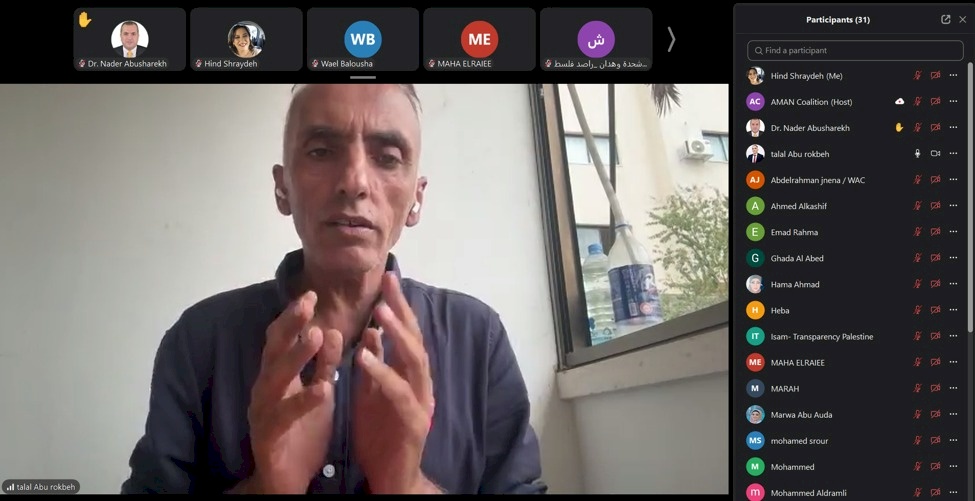
Gaza - The Coalition for Accountability and Integrity (AMAN) held a discussion session via Zoom on a research paper titled "Governance of Temporary Shelter Management in the Gaza Strip and Challenges to Integrity, Transparency, and Accountability." Representatives of civil society organizations and relevant stakeholders participated in the session to discuss the main challenges facing shelter management in the Gaza Strip and ways to strengthen institutional coordination, transparency in resource allocation, fairness in aid distribution, and the participation of displaced people in decisions concerning their needs and living conditions.
Participants emphasized the importance of developing a unified national framework for the governance of shelter management, consolidating databases and targeting and distribution criteria, and activating complaints and feedback mechanisms. These measures would help ensure the fair and effective use of available resources and strengthen accountability to affected communities.
Weak Institutional Coordination and Limited Information Integration Are Key Challenges in Shelter Management
Opening the session, Wael Baalousha, AMAN's Regional Office Director in the Gaza Strip, stressed the importance of strengthening governance of shelter management amid the continuing displacement crisis, the approaching winter season, and growing concerns about the living conditions of displaced people. He noted that the large number of actors involved, scarce resources, difficulties in humanitarian access, and constantly changing needs require stronger coordination and clearer responsibilities in order to support a fair humanitarian response and the transition toward recovery.
Presenting the research paper, researcher Dr. Talal Abu Rukbeh explained that the main challenge is not the absence of institutions, criteria, or coordination mechanisms, but rather the limited integration among them, weak links between available information and decision-making processes, and uneven application of integrity, transparency, and accountability standards at shelter sites.
The paper found that the humanitarian system has data and maps of needs and shelter sites, as well as mechanisms for monitoring and coordinating aid. However, these tools do not always form an integrated system that enables displaced people to access information, participate in setting priorities, and hold the entities responsible for providing services accountable.
It also noted that the large number of actors and overlapping mandates, together with the limited representation of community committees and displaced people in coordination and decision-making structures, reduce the effectiveness of the response and its ability to ensure fair distribution of resources and services.
Recommendations to Unify Shelter Management and Strengthen Oversight of Aid
The paper called for activating a specialized Palestinian national body to oversee shelter management, coordinate the efforts of national and international actors, and link the humanitarian response to national priorities, while building on existing coordination mechanisms. It also recommended adopting a unified operational framework that clearly defines responsibilities, service standards, targeting criteria, and oversight and accountability mechanisms.
The paper further recommended developing a unified platform for managing shelter data and establishing an up-to-date national registry of shelter sites, needs, and assistance. This would improve coordination and prevent duplication while ensuring the protection of displaced families' personal data.
With regard to fairness in distribution, the paper stressed the need to publish targeting and aid eligibility criteria in advance and to adopt clear criteria based on levels of need and vulnerability. It also called for separating responsibilities for assessing needs, selecting beneficiaries, distributing assistance, verification, and handling complaints.
The paper also called for developing a system to track assistance from its source to the beneficiary, regularly publishing information on needs, resources, and interventions carried out, and issuing an information card explaining the rights of displaced people, eligibility criteria for services, the responsible entities, and procedures for submitting complaints.
It emphasized the importance of involving displaced people's committees and local communities, including women and the most vulnerable groups, in identifying needs and priorities and reviewing intervention plans. It also called for establishing a unified and secure complaints and feedback system that is easy to access, ensures timely responses, and uses complaints to improve services and correct procedures.
Participants: Practical Measures Are Needed to Ensure Fairness and Protect the Rights of Displaced People
Participants' contributions focused on the need to address fragmented efforts among institutions operating at shelter sites and to unify databases and information-sharing on needs and assistance. This would help reduce duplication of interventions and inequities in the distribution of resources among camps and displacement sites.
Participants also stressed the importance of involving displaced people in managing shelter sites and setting their priorities, establishing representative committees according to clear criteria, and increasing transparency regarding aid, its sources, and distribution mechanisms. They also called for complaint channels accessible to everyone, including non-digital options.
Participants emphasized the need to take into account the needs of women and the most vulnerable groups, adopt clear measures to prevent exploitation and favoritism in aid distribution, and ensure the provision of water, sanitation, maintenance, and protection services. They also called for temporary shelter management to be linked to early recovery plans and a gradual transition toward sustainable housing solutions.
At the conclusion of the session, participants stressed the importance of translating the paper's recommendations into practical, implementable measures and strengthening advocacy efforts with international organizations and donors to improve governance of shelter management. They emphasized that the needs, rights, and participation of displaced people must form the basis for managing the humanitarian response.
The discussions concluded that improving shelter governance does not necessarily require creating new structures. Rather, it requires activating existing institutions and mechanisms, clarifying responsibilities, integrating information, and strengthening community oversight and accountability.