AMAN Calls for Exceptions to Be Properly Governed and Subject to Clear, Binding Standards
AMAN Holds Discussion on Exceptions in the Exercise of Functions and Powers by Ministry of Transport and Communications Officials in Service Delivery and Licensing
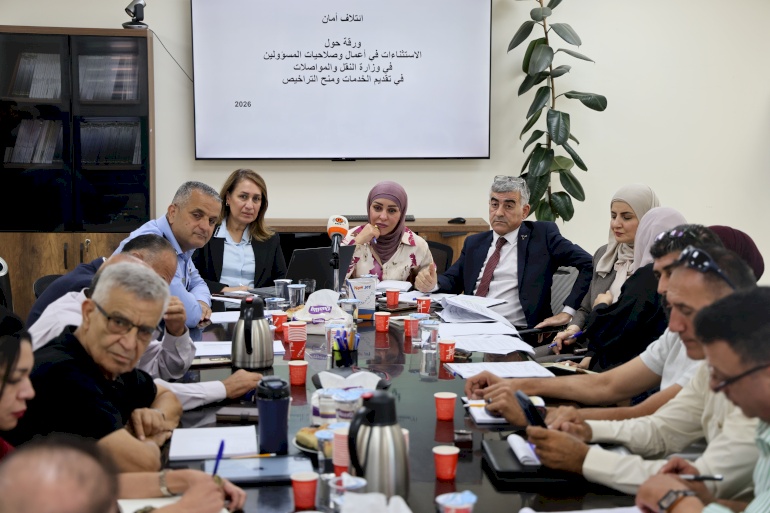
Ramallah - The Coalition for Accountability and Integrity (AMAN) held a discussion session on a research paper titled “Exceptions in the Exercise of Functions and Powers by Officials at the Ministry of Transport and Communications in Service Delivery and Licensing.” The session examined the use of discretionary powers and exceptions within the Ministry and the extent to which they are governed by clear rules and standards that safeguard integrity and transparency and reduce the risk of abuse of authority.
Opening the session, AMAN Operations Director Hama Zeidan explained that administrative reform, concessions, and licensing were selected as a focus in line with the Coalition’s new 2027-2028 strategy, which seeks to engage more closely with resilience-related issues and strengthen the ability of citizens and institutions to address current challenges.
Zeidan noted that AMAN is placing greater emphasis on several vital sectors, including health, education, the environment, and renewable energy, as well as concessions, licensing, and services related to border crossings and mobility. These areas may create opportunities for corruption. She added that the study was prepared in cooperation with the Ministry of Transport and Communications.
Zeidan stressed that AMAN generally cautions against expanding the use of exceptions. As a rule, clear, general rules and procedures should apply to everyone without exception. At the same time, the Palestinian context and exceptional circumstances may, in some cases, require specific exceptions. This underscores the importance of properly governing such exceptions, limiting them to the narrowest possible scope, subjecting them to clear and binding standards, and ensuring that decisions are justified, documented, and reviewable. These safeguards help promote equality and transparency and protect the public interest.
Some Discretionary Powers Are Not Always Governed by Written, Uniform Standards
Researcher Raeda Qandil, who prepared the research paper, presented its main findings on the exceptions and discretionary powers exercised by officials at the Ministry of Transport and Communications in providing services and granting licenses and approvals.
The paper found that the broadest powers in this area are vested in the Licensing Authority, followed by the Traffic Controller and then the Minister. Other powers are assigned to the “competent authority,” making the scope of delegated authority an important factor in determining who ultimately has decision-making power.
It also found that certain regulations and procedures, including the regulation on the ownership of public transport operating licenses and the 2019 decision regulating private transport, introduced important procedural safeguards for granting certain licenses. These include needs assessments, public announcements, lotteries, publication of the names of eligible applicants, and institutional and oversight involvement. However, these safeguards still need further development, particularly because there are no published methodologies or indicators for assessing needs or determining the allocation of licenses, routes, taxi offices, and private transport companies.
The paper noted that some discretionary powers are not consistently governed by written and uniform standards. Not all decisions are properly reasoned and documented, nor do they follow a clear review process. There is also no unified inventory of exceptions, standardized application form, or central registry of decisions on exceptions. In addition, some procedural manuals and instructions are outdated, have not been formally approved, or are not publicly available.
The scope for discretion is not limited to the initial licensing stage. It also extends to decisions made after a license has been issued, including amendments, renewals, cancellations, the imposition of new conditions, approval of transfers, suspensions or sales, and the selection of administrative penalties. Such decisions may have economic and legal consequences comparable to those arising from the initial decision to grant a license.
Government Efforts to Address Key Issues
At the same time, the paper identified government efforts to regulate exceptions provided for under the legislation governing the Ministry’s work. Measures have included ending the practice of granting exceptions on an individual basis, referring special requests to the Council of Ministers, reviewing legislation and cataloging the relevant powers, automating services, and referring suspected corruption cases to the competent authorities.
Recommendations for Governing Exceptions and Regulating Discretionary Powers
The paper recommended reviewing priority legislation and clearly specifying the circumstances, scope, duration, and authority responsible for granting an exception. It also called for clarifying open-ended terms used in some legislation, such as “public interest,” “convincing excuse,” and “reasonable cause,” and establishing verifiable criteria to ensure consistent treatment of comparable cases.
It further recommended adopting a written and publicly available methodology for conducting needs assessments and allocating licenses, routes, taxi offices, and private transport companies, as well as establishing uniform standards in areas requiring technical judgment. The paper also called for a standardized application form for exceptions that sets out the legal basis, relevant facts, public interest considerations, alternatives, technical and legal opinions, duration, and potential implications.
In the areas of transparency, digitalization, and oversight, the paper recommended establishing a unified electronic registry of applications for exceptions and the decisions issued on them. It also called for compiling all applicable procedural manuals and instructions, updating and formally approving them, and publishing the versions currently in force. Periodic data should also be published on applications for exceptions, related decisions, needs assessments, and the distribution of licenses, while ensuring the protection of personal data.
The recommendations also stressed the importance of enforcing conflict-of-interest and confidentiality rules, providing clearly publicized and secure channels for complaints and grievances, and conducting regular training for officials and employees involved in licensing and service delivery on the limits of discretionary authority, the Anti-Corruption Law, and conflict-of-interest disclosure requirements.
The paper called for an implementation plan for the proposed reforms that identifies the responsible entity, timeframe, and completion indicator for each measure. This would help turn the current reform efforts into sustainable institutional rules that do not depend on the Ministry’s current administration.
It emphasized that reform is not intended to eliminate discretionary authority altogether, but to govern its exercise in a way that preserves the necessary degree of technical and administrative flexibility while requiring equality, transparency, justification, documentation, and review for decisions that confer a benefit or affect the legal status of a license holder.
Ministry of Transport and Communications: We Have Ended Individual Exceptions
Commenting on the paper, Ministry of Transport and Communications Undersecretary Mohammad Hamdan said the paper supports ongoing reform efforts and is the product of a participatory approach that highlights key challenges and proposes practical solutions to address them. He noted that the Ministry has recently issued several regulations governing the transport sector while also reviewing the powers granted under existing laws and regulations.
Hamdan explained that the changing nature of the transport sector, its close connection to citizens’ needs, demographic changes, and emergency circumstances require some degree of discretion in decision-making. However, he stressed that such powers must be clearly defined and measurable and based on clear, published principles and criteria.
He confirmed that the Ministry has ended the practice of granting individual exceptions and formed a committee to examine cases in which an exception may be warranted. Any exception, he said, must apply generally and be based on defined criteria rather than being directed at specific individuals.
As an example, Hamdan cited the decision to exempt all segments of the transport sector from the requirement to submit a clearance certificate for 3 months in light of the economic circumstances affecting the sector.
He added that the Ministry is working to expand the digital delivery of services, allowing citizens to complete their transactions quickly and efficiently, while also unifying databases and linking the Ministry’s transport directorates. These measures are intended to reduce the number of people who need to visit Ministry offices in person and improve service efficiency.
He also noted that a legislative committee is reviewing laws and regulations related to exceptions and discretionary powers with the aim of regulating them and establishing clear lines of authority for decision-making.
Hamdan stressed that the powers granted to officials must be subject to clear safeguards and standards. At the same time, he noted that the Ministry is not the sole decision-making authority in certain matters, particularly those involving border crossings, because they are governed by existing agreements and obligations.
On vehicle imports, he explained that the Ministry does not have a presence at the crossings and that its procedures focus on reviewing vehicle documentation rather than physically inspecting the vehicles themselves. He said this issue therefore needs to be addressed through an integrated system of oversight at the crossings.
Transport Sector Representatives: The Need for Regulated Flexibility That Responds to Conditions on the Ground
Abdul Hakim Ghannam, a representative of the Driving Schools Union, raised concerns about the growing number of vehicles operated by driving schools, noting that there are approximately 270 driver-training vehicles. He called for a clear and binding decision regulating the number of vehicles operated by driving schools and limiting their impact on citizens and road traffic.
Jawad Omran, Secretary of the Taxi Offices Union in Ramallah and Al-Bireh, called for extending the permitted service life of vehicles in light of current economic conditions and the difficulties office owners face in securing liquidity and obtaining loans. He argued that certain exceptions may be necessary given the realities of the Palestinian context.
Alaa Miasi, head of the General Transport Workers’ Union, warned that an absolute ban on exceptions could compound the difficulties facing the transport sector amid closures and ongoing changes in movement along roads and through crossings. At the same time, he stressed that exceptions must be properly regulated and governed by clear standards to prevent decisions from being based on personal judgment and to protect the public interest and citizens’ rights.
Institutionalizing Reform and Ensuring Its Continuity
Dr. Azmi Al-Shuaibi, Anti-Corruption Adviser to AMAN’s Board of Directors, expressed concern about the challenges that could confront the reform process. He stressed that moving away from an approach that has been followed for years and adopting a new one will require commitment, follow-up, and continuity.
Al-Shuaibi emphasized the need to distinguish between general and case-specific exceptions. A general exception that benefits everyone and can be justified on public-interest grounds, he explained, is fundamentally different from a privilege granted to a particular individual, company, or institution. He stressed that past practices should not be treated as vested rights that justify their continuation.
He called on the government to adopt the reform underway at the Ministry of Transport and Communications as a sustainable, institutionalized government policy that does not depend on any particular individual or administration, so that the Ministry’s experience can be built upon and the lessons learned can be applied across other ministries and government institutions.