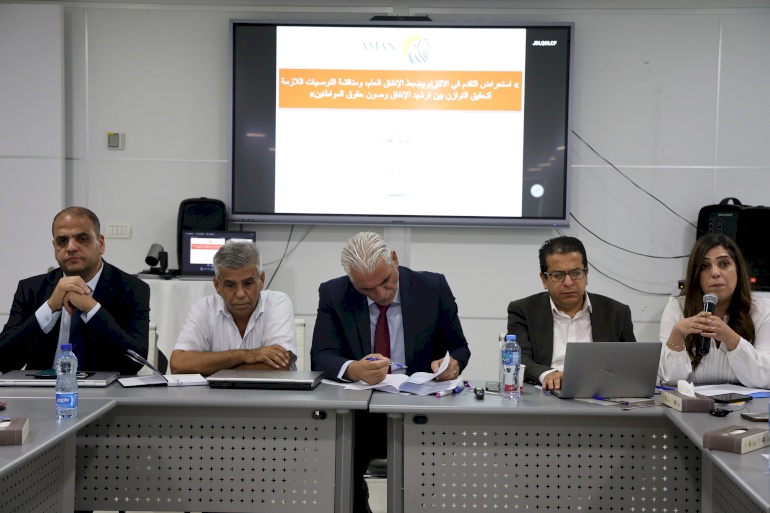
During a Specialized Working Session to Review Progress in Implementing Fiscal Policy and Public Financial Management Reforms
Civil Society Team: Public Finance Reform Requires a Comprehensive Review of the Structure of Palestinian Authority Institutions
Ramallah - The Civil Society Team for Enhancing Public Budget Transparency called for a comprehensive review of the structure of Palestinian Authority institutions. This should include functional reviews of ministries and government institutions, clarification of their roles, mandates, legal affiliation, and financial burdens, as well as continued reform of the salary and pension systems and the management of arrears. The aim is to improve the efficiency of public financial management while safeguarding citizens’ rights and the quality of essential services.
The call came during a specialized working session held by the Team to review progress in implementing the first pillar of the National Development and Reform Program, which focuses on fiscal policy and public financial management, and to discuss measures to rationalize spending. The session was held more than a year and a half after the launch of the program’s first phase (2025-2026), amid the continuing financial crisis and the complete suspension of clearance revenue transfers for more than a year.
The session addressed three key issues identified as priorities under the fiscal policy and public financial management track of the National Development and Reform Program and the reform agenda: controlling and rationalizing public spending; public-sector salaries, wages, and employment; and public debt and arrears.
There was broad agreement during the discussion that addressing the financial crisis cannot be limited to austerity measures or spending cuts. Rather, it requires structural and administrative reforms that address weaknesses in the public-sector structure and improve the efficiency of resource management, while ensuring that citizens - particularly poor and marginalized groups - do not bear the cost of the financial crisis.
Among the main recommendations was a comprehensive functional review of Palestinian Authority ministries and institutions, including an assessment of whether institutions and bodies with similar or overlapping mandates could be merged and whether some institutions genuinely require financial and administrative autonomy. Other recommendations included reviewing the salary, wage, and employment system, addressing government arrears and obligations, and reforming the pension system.
Ministry of Finance: Work Underway to Address Structural Imbalances and Develop the Salary Scale
Responding to the issues raised during the session, Ministry of Finance and Planning Undersecretary Majdi Al-Hassan said the government recognizes the weaknesses in the existing financial and administrative structure. He noted that work is underway to address structural problems within the Palestinian Authority and develop a more efficient institutional structure capable of meeting the needs of the State of Palestine, in cooperation with civil society experts.
Al-Hassan explained that this work also includes developing the salary scale and career progression system, as well as moving toward engaging experts to carry out specific assignments rather than relying on permanent employment.
He stressed that reforming vital sectors, particularly health, education, social protection, and security, requires restructuring and better management of spending rather than simply reducing it. He also pointed to government efforts to expand domestic provision of healthcare services and reduce referrals for treatment outside government institutions, while making greater use of digitalization and artificial intelligence to improve government services.
Rationalizing Spending Without Undermining Services or Citizens’ Rights
In the first paper, researcher Moayad Affaneh reviewed progress in adhering to public expenditure control measures amid the continued withholding of clearance revenues, limited external support, and rising public debt and arrears, as well as the resulting impact on the government’s ability to finance expenditures and provide essential services.
The paper stressed the need to reassess expenditure commitment control policies and procedures at the end of 2026 and strengthen the Ministry of Finance’s oversight of responsibility centers based on clear and consistent standards, ensuring that expenditure controls are applied fairly and without exceptions.
It also emphasized that expenditure rationalization policies should prioritize protecting the quality and adequacy of essential services, particularly health, education, and social protection, and should ensure that poor and marginalized groups do not bear the cost of the financial crisis.
The paper called for more effective measures to rationalize operating and non-priority expenditures. These include reviewing appointments and promotions to senior positions, tightening controls on contracts and petty cash expenditures, reviewing the wage bill and other salary-equivalent payments, setting a maximum salary for officials at public institutions, and reviewing allowances and benefits to which recipients are not entitled.
It also proposed studying the merger of certain ministries and responsibility centers, reviewing embassies and representative offices in geographically close areas, accelerating digital transformation, and expanding private-sector participation in selected infrastructure and public-service projects to reduce costs and improve spending efficiency.
Reforming the Wage Bill Starts With Reviewing the Structure of the Public Administration
Researcher Yousef Al-Zummar presented a paper assessing and monitoring measures to control salaries and wages and related reforms in Palestine for 2025-2027, recognizing the wage and salary bill as one of the key areas for achieving fiscal sustainability.
The paper called for a long-term plan to reduce the share of salaries and wages to between 30% and 40% of total government expenditure. It also recommended drafting a new Civil Service Law and establishing a unified salary scale that incorporates the various allowances, while taking specialization, the nature of the risks, and levels of responsibility into account when determining grades.
It further recommended regulating the various forms of contract-based employment, activating mechanisms to redeploy surplus staff to institutions facing personnel shortages, and reassessing staffing levels and the distribution of employees across institutions and governorates based on the volume of services provided and citizens’ needs.
The paper also proposed establishing a government complex in each governorate to house government departments rather than maintaining numerous separate directorates and offices. It called for studying the possibility of reducing the number of ministries and government bodies and merging institutions with similar mandates, as well as reviewing decisions granting financial and administrative autonomy to government institutions and the additional costs those decisions impose.
It emphasized that reforming the wage bill should not weaken the government’s ability to provide essential services. Instead, reform should be based on reallocating resources and personnel according to actual needs and improving the efficiency of the public administration.
Auditing and Scheduling Arrears and Reforming the Pension System
In the third paper, Shaker Ziada reviewed the current state of arrears and possible approaches to addressing them, noting that arrears have evolved from a tool for managing short-term liquidity into an accumulated financial obligation that places pressure on economic and social stability.
The paper called for an independent and comprehensive audit of all arrears to determine the government’s actual obligations and verify the validity of claims. It also recommended activating a reverse tax-offset mechanism that would allow companies and suppliers with overdue government receivables to offset those amounts against their tax liabilities according to a clear mechanism and timetable.
It further recommended prioritizing the repayment of arrears owed to small and medium-sized enterprises and vital sectors in order to reduce the risk of financial distress and preserve their ability to provide services and maintain employment.
Over the medium and long term, the paper called for reforming the pension system and scheduling the Pension Authority’s debts in a manner that strengthens its financial sustainability. It also recommended establishing a specialized unit within the Ministry of Finance to manage and inventory arrears, monitor their scheduling, and publish regular and transparent reports on their size and development. In addition, the paper called for incorporating the issue of arrears into the annual Public Budget Law and strengthening oversight and accountability over their management.
Experts: Fiscal Reform Requires Institutional Reform and More Effective Oversight
The working session included an extensive discussion among representatives of government bodies, civil society organizations, and economic and financial experts on the priorities and various dimensions of fiscal and administrative reform.
Mohammad Salameh stressed the importance of distinguishing between borrowing to finance the budget deficit and managing public debt. He called for more efficient management of the debt structure in terms of currencies, cost, composition, and the resulting economic implications.
Economic journalist Ayham Abu Ghoush emphasized the close relationship between fiscal and administrative reform and stronger oversight. He called for restructuring the Palestinian Authority’s administrative apparatus, strengthening oversight mechanisms, and addressing imbalances associated with the wage bill.
Economic expert and analyst Thabet Abu Al-Rous said the reform strategy should not focus solely on financial measures. It should also be accompanied by policies that stimulate productive sectors, particularly industry and agriculture, helping to broaden the revenue base and strengthen the national economy’s ability to withstand financial pressures.
Researcher on corruption and public affairs Dr. Ahmad Abu Diya emphasized the importance of conducting functional reviews of ministries and government institutions, merging institutions and bodies wherever possible, and regulating contract-based employment. He also called for reviewing the scope of financial and administrative autonomy granted to government institutions in light of the actual need for their services and the resulting burden on the budget.
Dr. Tahreer Al Araj, Director of MIFTAH, focused on the need to assess the impact of expenditure-control policies on public services and citizens’ rights, particularly in the health, education, and social protection sectors. She also proposed a number of options for strengthening the financing of essential services, including strengthening corporate social responsibility in the private sector and developing a solidarity-based health insurance system.
At the conclusion of the session, participants stressed that successful reform of fiscal policy and public financial management requires balancing efficient spending, structural reform, and stronger oversight and transparency on the one hand with the protection of citizens’ rights and continuity of essential services on the other. This would ensure that reform measures address imbalances sustainably rather than merely managing the immediate consequences of the financial crisis.