AMAN Coalition holds a discussion session on the draft report titled: The Reality of Governance (Integrity, Transparency, and Accountability) in the Appointment of Senior Positions in the Palestinian Ministry of Health
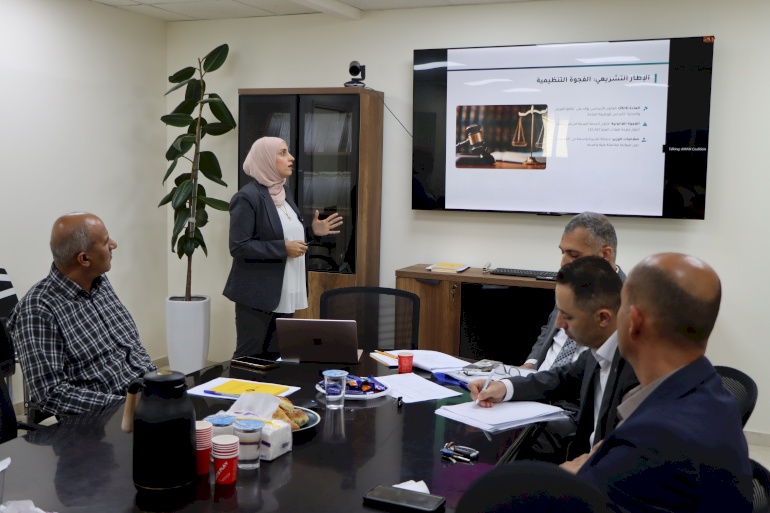
AMAN Coalition held a discussion session on the draft report titled, “The Reality of Governance (Integrity, Transparency, and Accountability) in the Appointment of Senior Positions in the Palestinian Ministry of Health,” with the participation of representatives from the Palestinian Ministry of Health, public and civil society institutions and experts in public administration and the health sector.
The session was opened by Isam Haj Hussein, Executive Director of AMAN Coalition, who emphasized that this report forms part of AMAN’s contribution to reforming the civil service system and supporting the government’s reform agenda through the provision of practical recommendations within the functional review process for six public institutions identified in the agenda, including the Palestinian Ministry of Health. He noted that, over the years, AMAN has consistently addressed the issue of appointments and promotions to senior positions, based on the imperative to uphold the principles of equal opportunity and equality in access to public office. However, he stressed that practical implementation still requires stronger adherence to these principles.
Isam Haj Hussein further noted that AMAN Coalition has repeatedly recommended the establishment of a ‘Good Governance Committee’ to oversee appointments and promotions to senior positions and to strengthen integrity and transparency in these processes. He also expressed his appreciation to the Palestinian Ministry of Health and all relevant stakeholders for their cooperation in the preparation of the report.
The researcher, Dr. Areen Badran, presented the findings of the report, which indicated that the Palestinian Ministry of Health, as one of the largest government institutions, requires continuous development and updating of its organizational frameworks to respond to the growing demand for healthcare services.
Dr. Areen noted that the report, which reviewed the appointment process for senior positions in the Palestinian Ministry of Health between 2021 and 2025, with a particular focus on 2024 as a representative year, found that 57% of appointments were made through nomination or temporary assignment, while only 43% were filled through competitive recruitment processes which undermines adherence to the principle of equal opportunity.
The report also highlighted the problematic use of temporary assignments for extended periods, which grants an unfair advantage to certain candidates, in addition to the limited role of preventive oversight and the reliance on subsequent oversight.
The report also demonstrated that the Civil Service Law No. (4) of 1998 and its 2005 amendments granted the Council of Ministers broad authority to nominate and appoint candidates without requiring clear and publicly advertised competitive procedures. This has reinforced the use of non-competitive mechanisms for filling senior positions, particularly in cases where vacancies arise as a result of retirement.
The report further highlighted the limited disclosure of screening and interview procedures, the continued confidentiality surrounding certain stages of appointments, and the frequent filling of senior positions without public advertisement. It also pointed to weaknesses in objection mechanisms, including the absence of mandatory timeframes for resolving complaints, the limited involvement of internal control units, and the lack of a performance contract system for leadership positions.
For his part, Ayed Atif Al-Waheed, Director General of Administrative Affairs at the Palestinian Ministry of Health, stated that the appointment to the position of Undersecretary was made prior to the most recent amendments as the job description for the position had been prepared and was subsequently further developed. He added that the Ministry had reviewed and updated the job descriptions for standard positions and is currently awaiting their approval by the General Personnel Council. In parallel, the Ministry is working on developing job descriptions for supervisory positions, noting that 32 separate job descriptions for specialist physicians were consolidated into just 2.
In turn, Nizam Ramadan, Legal Advisor to the Palestinian Ministry of Health, explained that the Ministry reviewed its job descriptions in response to directives of the Council of Ministers and revised a substantial number of them to ensure alignment with the Civil Service Law. He affirmed that appointments to the position of Undersecretary are based on standardized job descriptions approved by the Council of Ministers, noting that eight undersecretaries were selected through a formal competitive recruitment process.
Ramadan added that job descriptions are currently being used and relied upon in practice, even though they have not yet been formally approved. He noted that senior positions are governed by standardized and officially approved job descriptions, similar to those used for undersecretary positions, and that these are relied upon in the appointment process, while work is ongoing to prepare and further develop job descriptions for supervisory positions.
Hani Al-Kilani, a representative of the Ministry of Industry and a member of the National Job Description Committee, stated that the committee was established between 2015 and 2017 with the participation of 45 entities, before being streamlined to 17 ministries and institutions to support the development of job descriptions. He explained that, since 2017, standardized job descriptions covering all administrative levels up to the position of Undersecretary have been adopted, with clearly defined duties and competencies. He added that the initiative also included the development of organizational structures, resulting in the completion of 54 out of 78 structures. He further noted that, in coordination with the Palestinian Ministry of Health, the committee has prepared 35 job descriptions to date, with work continuing to finalize the remaining ones. However, the primary challenge lies in implementation and compliance, underscoring the importance of training the relevant appointment committees to ensure the accurate preparation and effective application of these job descriptions.
Dr. Azmi Al-Shuaibi, Advisor to the Board of Directors of AMAN Coalition for Anti-Corruption Affairs, emphasized that the development of these controls represents a positive step forward. He noted that AMAN has spent more than 15 years advocating for the development of job descriptions. He stressed the importance of the General Personnel Council submitting these job descriptions to the Council of Ministers for formal approval, in order to ensure their standardization rather than tailoring them according to the specificities of each ministry. At the same time, he underscored the need to maintain sufficient flexibility within the system to accommodate changes and the establishment of new institutions.
Dr. Azmi Al-Shuaibi explained that the core challenge lies in the weak enforcement of job descriptions despite their formal adoption, an issue that AMAN Coalition has repeatedly highlighted in its reports. He renewed the call for the establishment of an oversight committee to monitor compliance both before and after appointments in order to address any deviations. He also emphasized the importance of leveraging the expertise of retired technical professionals through the creation of a specialized body dedicated to this purpose. He stressed that the most significant challenge continues to lie in effective implementation.
At the conclusion of the session, participants recommended that all appointments to senior positions be subject to open and competitive recruitment processes, that precise job descriptions be developed for leadership positions, and that a defined time limit be established for temporary assignments. Additional recommendations focused on strengthening transparency by disclosing evaluation results and the rationale for selection decisions, expanding the use of open announcements, and enhancing electronic platforms to publish appointment criteria. Participants further recommended linking senior positions to annual performance contracts and involving the State Audit and Administrative Control Bureau and the Ministry of Finance in reviewing integrity and financial suitability prior to appointments. They also expressed support for the establishment of a national high-level body to be known as the ‘Good Governance Committee’, with the mandate of strengthening integrity in the management of public office. In addition, they emphasized the importance of ensuring women’s representation and integrating a gender perspective into appointment announcements.