The AMAN Coalition Holds a Specialized Session to Discuss a Draft Study on Managing Corruption Risks in the Municipal Development and Lending Fund
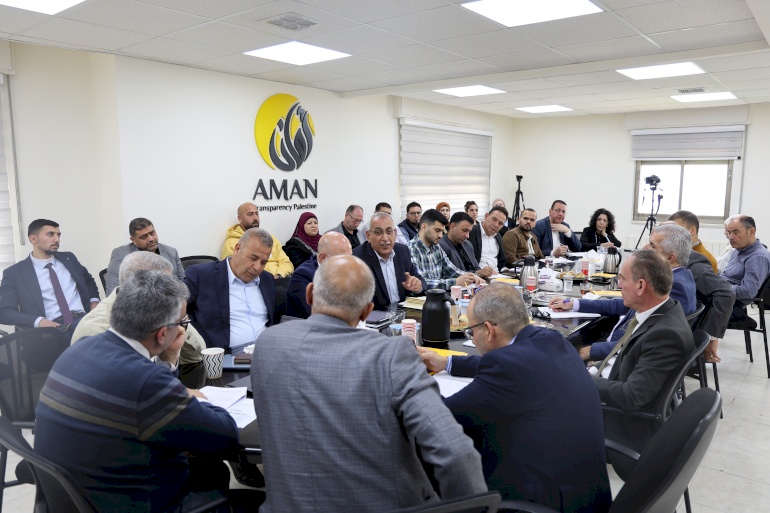
Ramallah – The Coalition for Integrity and Accountability (AMAN) held a specialized session to discuss a study titled: “Managing Corruption Risks in the Work of the Municipal Development and Lending Fund,” with the participation of experts and representatives of relevant stakeholders, including the Municipal Development and Lending Fund, the Council of Ministers, and representatives of local government units.
The session was opened by AMAN’s Executive Director, Issam Hajj Hussein, who noted that the study is part of a series developed by AMAN within a preventive framework aimed at safeguarding public institutions against corruption risks. He explained that these studies provide recommendations grounded in corruption risk analysis, designed to guide institutions, strengthen internal governance, and better structure their relationships and operational mechanisms in ways that minimize opportunities for corruption and mitigate its impact.
For his part, the study’s author, Dr. Kayed Tanbour, presented its key findings and recommendations, noting that the Municipal Development and Lending Fund serves as a principal instrument in financing infrastructure projects and enhancing the quality of public services, despite the complex political and economic challenges shaping its operating environment.
Tanbour further stressed that the current context necessitates the adoption of a proactive and comprehensive approach to corruption risk management, grounded in strengthening effective partnerships with donors, local government units, and a wide range of stakeholders. He also underscored the importance of institutionalizing sound governance systems and activating robust oversight and accountability mechanisms, in order to curb corruption risks and enhance transparency and institutional trust as an urgent and indispensable priority.
The study found that the Fund operates within a robust institutional oversight framework grounded in multiple layers of control, clear segregation of duties, and strictly regulated procedures. This is further supported by a comprehensive set of professional guidelines, a code of conduct, and a high degree of procedural transparency, all of which contribute to reducing the likelihood of administrative and financial irregularities. However, the findings indicate that, should such risks materialize, their impact would be considerable, given their direct implications for the equitable distribution of resources and the institution’s credibility.
The study also highlighted that its analysis focused on corruption risks concentrated at key decision-making points involving professional discretion or interaction with external actors, particularly in areas such as grant allocation and management, the contracting of external auditors, and the appointment of internal auditors.
The study puts forward a set of targeted recommendations to strengthen corruption risk management, foremost, the development of detailed risk maps for decision-making processes and their integration into institutional policies. This should be complemented by the adoption of proactive oversight tools to identify potential irregularities, together with strengthened transparency through improved documentation and disclosure systems.
The recommendations also emphasized the importance of investing in building institutional capacity, fostering a culture of integrity and professional conduct, and strengthening accountability mechanisms. These measures are essential to ensuring the continued effectiveness of the oversight system and its alignment with international best practices in governance and combating corruption.
Various remarks
For his part, the Director General of the Municipal Development and Lending Fund, Mohammad Al-Ramahi, affirmed that the Fund’s participation in the preparation of the study reflected a spirit of openness and full cooperation, driven by a commitment to leverage all available opportunities to further enhance its performance. He stressed that welcoming external assessments demonstrates a firm conviction in the value of independent oversight in strengthening institutional performance and improving the management of corruption risks. He stated, “We are open to any effort that contributes to improving our performance, based on our belief that the Fund is a national institution and that its financial resources belong to the Palestinian people.”
Al-Ramahi reviewed the Fund’s establishment and evolution, noting that it was created by a decision of the Council of Ministers in 2005. He explained that its work later shifted toward an integrated programmatic approach, particularly with the launch of the Municipal Development Program in 2008–2009. He emphasized that a key factor in the Fund’s success has been its ability to limit political influence by establishing clear and transparent mechanisms for allocating resources to local government units, thereby ensuring fairness and reducing the scope for external interference.
Al-Ramahi added that the Fund has worked to institutionalize a comprehensive oversight framework based on clearly defined decision-making pathways and a separation of authorities across all stages, thereby minimizing the potential for individual influence and reinforcing institutional integrity. He also noted that the Fund has developed a set of unified operational manuals, with donors aligning their procedures accordingly, which has contributed to improving implementation efficiency and strengthening coherence in program management.
He further explained that these manuals are subject to periodic review every four years to ensure alignment with international best practices, with positive implications for the performance of local government units. He affirmed that the Fund will give serious consideration to the study’s recommendations, examining them in depth and addressing any identified gaps in order to further strengthen and develop its institutional framework.
Highlighting a notable achievement, Al-Ramahi stated that the Fund has become the first Palestinian national institution to obtain accreditation from the Green Climate Fund within a record period of no more than one year of assessment, after meeting governance requirements and international standards. He noted that this accreditation opens the door to direct access to new sources of financing, supporting efforts to advance sustainable development in Palestine.
In a related context, the Advisor to the Minister of Public Works for Governance and Director General of Complaints at the Ministry, Ahmad Al-Kababji, explained that the core challenge lies in reducing the scope of discretionary authority exercised by decision- makers through the strict application of existing procedures and regulatory frameworks. He noted that while committees and responsible officials base their decisions on these procedures, there remains room for further strengthening and improvement.
He noted that when broad authority in making decisions is exercised without clear documentation, it becomes difficult to trace the decision-making process or identify potential irregularities, even when citizens submit complaints, particularly in the absence of adequate documentation of complainants and of the complaint handling process.
He also emphasized the need for the Fund to strengthen its mechanisms for preventing conflicts of interest and to ensure that these mechanisms are directly linked to an effective complaints system, thereby reinforcing the role of independent oversight in monitoring and follow up. He stressed that when a complaint is submitted, clear and documented procedures must be in place to allow for proper tracking and thorough review.
The Director General of the State Audit and Administrative Control Bureau, Jaffal Jaffal, noted that the most significant risks are concentrated in the project implementation phase, given its complexity and the level of detail it entails, which require close and sustained oversight. He added that risks become more pronounced at the level of project outputs, particularly where these are not subject to direct supervision by the Fund. He stressed that mitigating these risks requires strengthening the Fund’s capacity to ensure effective field representation and oversight of project implementation within local government units.
The discussions also highlighted several areas of priority requiring continued attention and follow-up, including raising awareness among staff of local government units on integrity and anti-corruption, strengthening systems for receiving and handling complaints, and enhancing capacities in development oriented financial management, among other priorities.