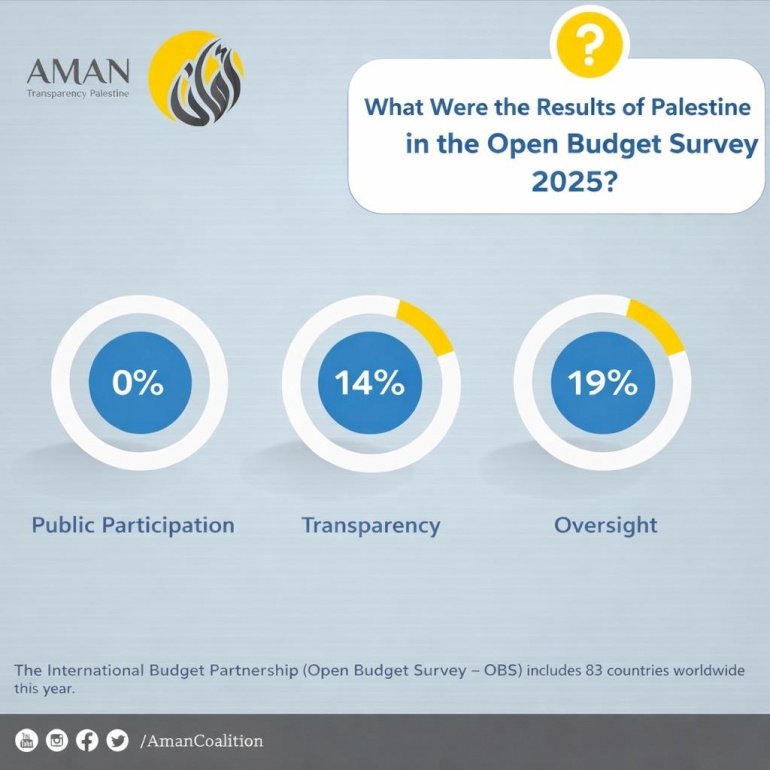
For the tenth consecutive time, the International Budget Partnership has issued the Open Budget Survey (OBS), which this year covered 83 countries worldwide. For the second time, Palestine has participated in this survey through the Coalition for Integrity and Accountability (AMAN).
The Open Budget Survey is the only independent and globally comparable research tool of its kind. It is based on documented data and international standards to measure three main dimensions: the extent of public availability of budget information, the level of public participation in the budget formulation process, and the role of oversight institutions in supervising public financial management.
The results of the 2025 survey show a slight improvement in transparency compared to 2023, with Palestine scoring 14 out of 100, up from 8 out of 100. The oversight score also increased modestly from 17 to 19 out of 100. In contrast, levels of public participation remained at zero out of 100, with no noticeable improvement.
These low results, compared to other countries, are primarily attributed to the absence of the Legislative Council as the official oversight body mandated to monitor the budget process at all its stages. In the absence of the Council, the budget is issued and its implementation is followed through decisions issued by the President, within a context of concentrated authority in the Office of the President. This office does not exercise an institutional oversight role, given the nature of its executive responsibilities, as well as limited human resources and the multiplicity of its functions.
Reports issued by the Coalition for Integrity and Accountability (AMAN) also indicate that the concentration of financial decision-making and the absence of separation of powers constitute key factors underlying the weakness of the oversight system, which is negatively reflected in Palestine’s results in this survey.
In addition, Palestine continues to face significant challenges as a result of Israeli occupation practices, which hinder the work of the government and limit its ability to carry out effective financial planning. The withholding of clearance revenues directly affects the regularity of budget preparation and adherence to publication timelines, as well as the government’s capacity to deliver services and allocate resources to vital sectors.
In light of these complex political and economic conditions, government priorities are constantly shifting, which limits its ability to comply with transparency and participation standards within international timeframes and benchmarks.
Nevertheless, there is a growing need to strengthen citizen participation, particularly through civil society institutions, in ways that help reinforce trust between the government and citizens and improve the management of public resources. Palestine’s low results in this survey serve as an early warning indicator that can be used as an opportunity for reform and improvement.
In this context, the AMAN Coalition emphasizes that effective participation is not limited to informal or ad hoc meetings, but requires clear institutionalization that ensures the involvement of civil society organizations in all stages of the budget process, from preparation through to evaluation.
Strengthening transparency also requires the comprehensive publication of budget information across all stages in simplified and multi-format formats, ensuring accessibility for all citizens. This includes the publication of the “Citizens Budget” not only after budget approval, but also at the draft budget stage, enabling citizens to express their views prior to its adoption.
With regard to oversight, despite the role of the State Audit and Administrative Control Bureau, there is an urgent need to ensure the follow-up and implementation of recommendations contained in audit reports, particularly those related to the final accounts, in order to enhance accountability and reduce shortcomings.