Achieving an Average Rating With Slight Progress Compared to 2023 Results,
the Coalition for Integrity and Accountability (AMAN) Holds a Discussion Session to Present the 2025 Integrity in the Palestinian Judiciary Index Results
Ramallah – With the participation of representatives from the Supreme Judicial Council, the Ministry of Justice, the Palestinian Bar Association, and a number of human rights organizations and stakeholders in judicial affairs, the Coalition for Integrity and Accountability (AMAN) launched the 2025 Integrity in the Palestinian Judiciary Index. The Index aims to track developments and changes related to the integrity and governance of the Palestinian judiciary, as well as the challenges facing its integrity system, ultimately formulating recommendations for decision-makers to strengthen and safeguard the independence of the judiciary.
The session was opened by Soumoud Al-Barghouthi, Director of the Studies and Monitoring Unit, who noted that this is the third edition of the AMAN Index, now issued regularly every two years. She explained that it is an evaluative tool for assessing judicial integrity and independence. It does not seek to evaluate individual judges’ performance or issue judgments on specific judicial decisions, instead, it focuses exclusively on analyzing and evaluating the governance of its administration, including the institutional, regulatory, and procedural frameworks that shape the judicial environment and affect its level of integrity.
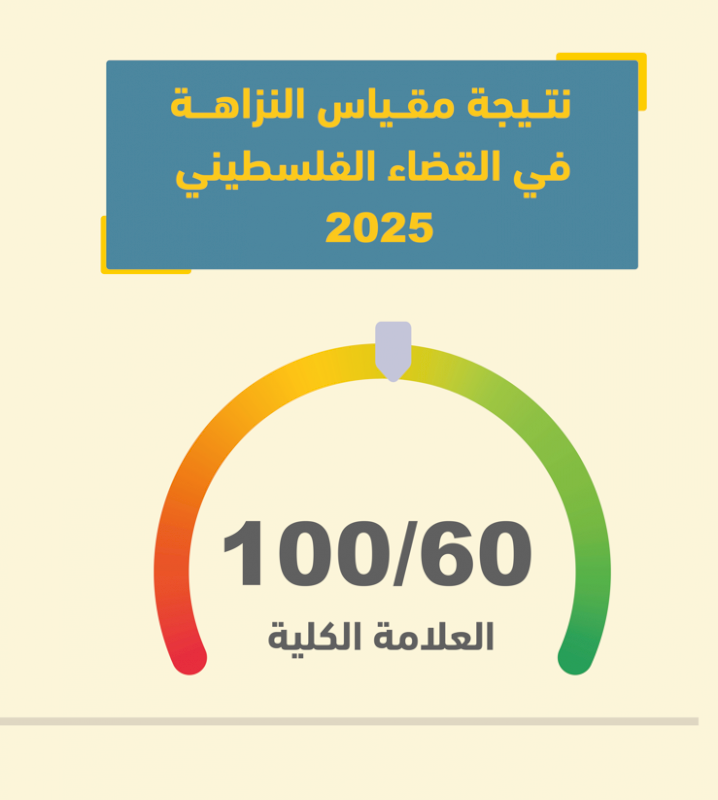
The final score of the Integrity in the Palestinian Judiciary Index reached 60 out of 100, corresponding to an average rating, with an improvement of two points compared to the previous 2023 report. However, the results showed the continued presence of indicators requiring interventions at multiple levels.
Researcher Rafe’ Youssef presented the results, explaining the methodology used in preparing the Index. He noted that it relied on 80 indicators distributed across four main areas: independence, effectiveness, capacity, and appointments and personnel affairs. These were also organized around four pillars of integrity, including integrity values, transparency, accountability, and anti-corruption, and across two sectors, legislation and practices. He highlighted the clear gap between the two sectors, confirming that the main issue lies in implementation and practice rather than in legislation.
“Average” Rating
The final score of the Integrity in the Palestinian Judiciary Index reached 60 out of 100, placing it at an average rating, with a two-point improvement compared to the 2023 report. However, the results revealed the continued presence of indicators that require interventions at multiple levels.
Researcher Rafe’ Youssef presented the findings, outlining the methodology used in preparing the Index. He explained that it relied on 80 indicators distributed across four main areas: independence, effectiveness, capacity, and appointments and personnel affairs. These indicators were also organized around four pillars of integrity: integrity values, transparency, accountability, and anti-corruption, and across two sectors, legislation and practices. He emphasized the clear gap between the two sectors, confirming that the main challenge lies in implementation and practice rather than in legislation.
Results of Sub-Indices for Judicial Integrity
Among the four integrity areas, independence and effectiveness showed balanced improvements of 4 points each. Independence increased from 52 to 56, corresponding to an average rating, while effectiveness rose from 57 to 61, also an average rating. This indicates a persistent gap between constitutional guarantees and practical application, the influence of interventions on judicial independence, and ongoing challenges in the timely resolution of cases and enforcement of court rulings.
By contrast, the capacity field declined sharply from 52 to 45 points, a drop of 7 points, corresponding to a low rating. This represents a red alert that could undermine progress in the other areas, reflecting weaknesses in human and financial resources, infrastructure, and technical equipment. Meanwhile, the appointments and personnel affairs field remained stable at 66 points, an advanced rating, in both reports, due to improvements in judicial competition systems, codes of conduct, and evaluation procedures.
The report also highlighted several critical issues, including interference in appointments through the requirement of security approval, weak enforcement of court rulings, particularly against government bodies, the absence of legislation regulating the right to access information, limited job security guarantees for judges, and weak institutional capacity and court infrastructure.
Recommendations to Overcome Challenges and Ensure Integrity in the Palestinian Judiciary
The report presented a set of reform recommendations focused on three main areas. The first, constitutional and legislative reform, emphasized consolidating judicial independence and unity, strengthening constitutional guarantees to prevent interference in judicial affairs, and developing a legislative framework for transparency and accountability. The second, internal institutional reform, called for restructuring appointment and promotion standards based on competence and integrity, enhancing job security for judges, and building a comprehensive strategy to improve governance and combat corruption. The third, operational and service development, focused on improving engagement with the public, completing the internal organizational structure, and developing the human and technical capacities of courts to enhance judicial performance and strengthen citizens’ trust in the justice system.
Multiple Remarks
H.E. Judge Hala Mansour, Chief Judge of the Planning Department at the Supreme Judicial Council, noted that Palestinian courts have continued their work without closure even under the most difficult circumstances, despite significant pressures. She highlighted that the Council’s General Secretariat operates in a state of emergency with high organizational standards, pointing to the destruction of parts of the Tulkarm courts while judges continue to perform their duties there. She emphasized that the slow pace of development is due to the exceptional political and economic conditions facing our people. She also noted that judges’ freedom of expression is guaranteed within professional standards, explaining that publicly expressing opinions on cases still under consideration is considered a professional violation, while judges may express opinions in ways that do not affect professional matters.
Regarding the Judicial Probation Period, Judge Mansour clarified that the probation period for judges lasts three years, serving as a safeguard for the judge rather than a tool of pressure. She noted that no judge’s service has ever been terminated during this period, as the law requires evaluation based on competence and the reports approved by the Council.
Concerning the publication of Supreme Judicial Council decisions, Judge Mansour explained that the Council’s decisions, deliberations, and minutes are confidential under recent legal amendments due to the potential discussion of sensitive professional matters. She added that a public inquiries team was established, providing tangible benefits for citizens, alongside the launch of a specialized unit to enhance human rights capacities, including anti-torture measures and prison oversight.
She confirmed that each Council department has its own regulations and instructions, and that the appointment and promotion of judges are conducted according to the Judicial Authority Law, while lists of translators and experts are submitted by the Ministry of Justice without Council involvement in their selection.
Mr. Ahmed Thabaleh, Deputy Minister of Justice, stated that the judiciary enjoys independence in performing its duties within the framework of the separation of powers among the legislative, executive, and judicial authorities, with mutual oversight among them. He emphasized that complete separation of powers is not practically possible, but the essence of the principle lies in ensuring that judges can issue decisions without any influence or interference.
Mr. Thabaleh stressed the need to regulate judges’ use of social media, clarifying that judges are not permitted to express opinions on cases currently before the court. As for security clearance, he noted that the Judicial Authority Law is the sole parliamentary legislation on the matter and explicitly requires good conduct and behavior as one of the criteria for appointment to the judiciary.
Attorney Karim Mohammed, representing the Bar Association, stated that the Palestinian judiciary faces a significant backlog of cases due to the severe shortage of judges and staff, requiring the recruitment of additional personnel capable of handling accumulated and postponed cases. He called for granting the Bar Association an active role in this context, alongside ensuring administrative and financial independence for judges and fair treatment. Atty. Mohammed also noted that since 2011, no civilian has been tried before the Palestinian military judiciary (Security Forces Courts).
Meanwhile, Attorney Ashraf Abu Hayyeh, Legal Advisor at Al-Haq, added that the prevailing field conditions directly affect the functioning of the judiciary, leading to delays and case accumulation. He explained that judges’ freedom of opinion and expression is subject to regulatory limitations, with the option for a judge to step aside if expressing an opinion on a case under consideration, emphasizing that this freedom supports community development. He also stressed that the requirement of good conduct and behavior for judicial appointments should be based on clear and defined references, not on security reports, noting that no legislative amendments have explicitly defined these references.
Mr. Jafal Jafal, Director General of the Financial and Administrative Control Bureau, highlighted the weakness of the accountability system in the administrative judiciary, noting that its members consist solely of judges, which calls for the inclusion of other parties, such as academics or associations. He also criticized the amendment of the Administrative Judiciary Law without discussion or review outside the judicial authority, stressing that judicial independence does not justify the absence of debate, and that such amendments should be discussed within government institutions and presented to the public.
Meanwhile, Majid Arouri, Executive Director of the Independence Foundation, emphasized that any integrity index or evaluation must be based on a set of written, clear, and publicly declared standards, enabling relevant entities to comply and operate according to them as an established reference.
The session concluded with remarks from Dr. Azmi Al-Shuaibi, Advisor to the Board of the Coalition for Integrity and Accountability (AMAN) on Anti-Corruption Affairs. He confirmed that the Integrity Index was prepared according to clear guidelines and in partnership and dialogue with the Supreme Judicial Council, aligning its criteria with the Palestinian context without compromising its essence. He stressed that the index focuses on integrity rather than performance evaluation, and that the main challenge lies in weak respect for the rule of law rather than a lack of legislation, as violations are concentrated in practice. He added that the indicators are comprehensive and consistent with international standards, taking external factors into account in their interpretation, and concluded by emphasizing that freedom of expression is a fundamental legal principle that cannot be restricted under the pretext of internal procedures but must be regulated within legal frameworks.