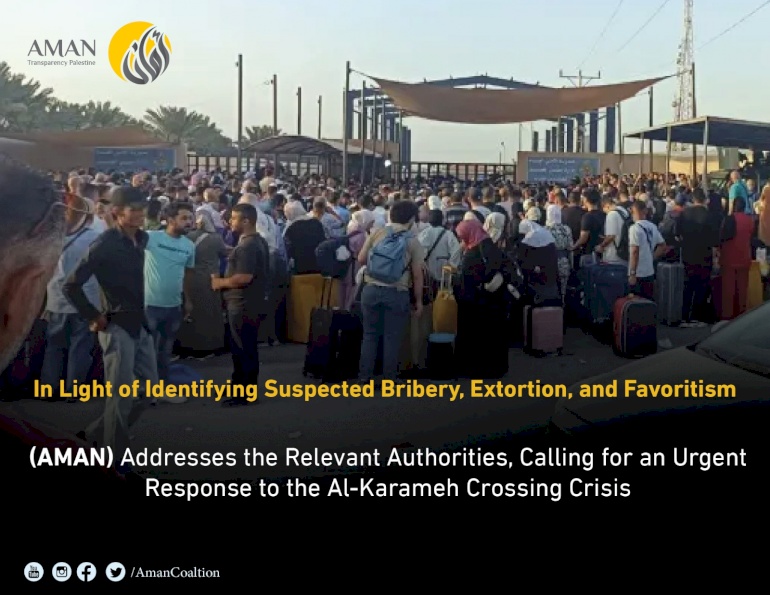
In Light of Identifying Suspected Bribery, Extortion, and Favoritism,
(AMAN) Addresses the Relevant Authorities, Calling for an Urgent Response to the Al-Karameh Crossing Crisis
Ramallah - The Coalition for Integrity and Accountability (AMAN) sent urgent letters to the Council of Ministers, the Ministry of Transport and Communications, the Anti-Corruption Commission, and the General Authority of Crossings and Borders, against the backdrop of the serious escalation of the travel crisis at the Al-Karameh Crossing (King Hussein Bridge). This crisis is accompanied by systematic daily humanitarian suffering that has gone beyond seasonal or temporary conditions to become a structural crisis affecting human dignity and the fundamental right to freedom of movement, and leaving cumulative social, economic, and psychological impacts on citizens. This situation necessitates urgent and decisive intervention at the highest official levels.
In its letters, the Coalition affirmed that, as part of its follow-up on citizens’ suffering and the increasing volume of complaints and grievances it has received, it has identified alarming indicators. These include the increase in exploitation and extortion, the growing suspicion of favoritism and bribery, and the flourishing of a black market linked to bookings and services, in addition to the unjustified rise in travel costs and the resulting additional economic burdens on families. This is compounded by escalating humanitarian risks facing the most vulnerable groups due to overcrowding and prolonged waiting hours under inappropriate conditions.
The Coalition noted that the VIP service, in the context of limited operating capacity and entrenched structural congestion, has in many cases become an additional burden on citizens and a source of profit that is not matched by any tangible improvement in service quality. This situation increases the risk of exploitative practices and renders the service a domain that requires strict oversight and accountability in accordance with established legal procedures.
The Coalition stressed that, while it fully recognizes the constraints imposed by the Israeli occupation’s control over operating hours, the number of travelers, and the pace of movement, these constraints cannot serve as a justification for leaving citizens to confront chaos and violations. Rather, they underscore the need to adopt effective and responsible crisis management that curbs exploitation and prevents humanitarian suffering from being turned into a fertile ground for brokerage and corruption. It further affirmed that addressing these practices cannot be a solely Palestinian responsibility, as part of the system of services and procedures intersects with arrangements on the Jordanian side. This reality necessitates urgent bilateral coordination and joint measures that ensure integrity, transparency, and equal opportunity for travelers.
The Coalition for Integrity and Accountability (AMAN) presented a set of recommendations, emphasizing the necessity for the relevant official bodies to keep the public informed, in a transparent and responsible manner, about the steps being taken and the actions adopted to resolve this crisis.
In this regard, AMAN recommended that the Prime Minister’s Office implement two parallel and complementary tracks to address the crisis. The first is an immediate response at the highest levels, entailing a publicly announced national crisis management framework, including urgent and systematic coordination with the Jordanian side as a key stakeholder in the relevant services and procedures. This should be complemented by the activation of oversight and anti-corruption mechanisms to confront exploitation and extortion, dismantle brokerage networks and the black market, and rectify systemic loopholes that allow favoritism and bribery, while encouraging citizens to report corrupt practices. This approach ensures integrity, equal opportunity, and the protection of travelers’ rights, while establishing a foundation for ongoing bilateral coordination with the Jordanian side.
The second track involves a national strategic approach for sustainable resolution, including launching an international pressure campaign on the occupation linked to the right to freedom of movement and travel without discrimination or obstacles, including demanding that the crossing operate 24 hours a day, alongside activating appropriate political, diplomatic, and legal pressure channels to lift restrictions on freedom of movement.
Regarding its message to the Anti-Corruption Commission, the Coalition for Integrity and Accountability (AMAN) recommended a set of measures, most notably: directing focused monitoring and oversight toward patterns of exploitation, extortion, and suspected bribery and favoritism throughout the entire travel process, including private routes, paid services, bookings, and intermediaries; documenting and analyzing complaints to identify recurring points of failure; and activating an official and continuous coordination channel with the relevant Jordanian authorities to share documented complaints (within legal frameworks) and ensure referral and follow-up, guaranteeing investigation of any suspicions related to bribery, extortion, brokerage, or abuse of influence.
In its message to the Crossings and Borders Authority, the Coalition for Integrity and Accountability (AMAN) called for giving this issue the highest priority by developing and adopting a comprehensive set of operational and oversight measures. These include clear, publicly announced procedures to regulate movement within the crossing and its surrounding areas, and control paid service channels, including the VIP service, under transparent standards that prevent discrimination or purchasing priority. AMAN also recommended publishing official fees, approved services, and rules of use to reduce exploitation caused by lack of information.
The Coalition further urged daily field monitoring linked to a fast and secure complaints mechanism, along with an official referral and coordination channel with the relevant Jordanian authorities to handle cross-border complaints. All procedures should be publicly disclosed, closely monitored, and documented to strengthen deterrence, build trust, and limit opportunities for exploitation.
Regarding its correspondence with the Ministry of Transport and Communications, AMAN recommended focusing on two interconnected areas. The first is developing a clear and binding regulatory framework for transport services associated with the crossing, ensuring equal opportunity and transparency, preventing monopolistic, discriminatory, or easily manipulated arrangements, unifying points of reference, clarifying responsibilities, and publishing official information publicly.
This should be complemented by strengthening oversight and anti-corruption mechanisms in the transport sector linked to the crossings, monitoring indicators of exploitation, extortion, and bribery, taking deterrent measures, enhancing complaint channels and whistleblower protection, and supporting bilateral coordination with the Jordanian side within available frameworks.
AMAN concluded by emphasizing the importance of publicly disclosing the adopted regulatory and oversight procedures, monitoring their implementation, and documenting results responsibly. This approach enhances transparency and public trust while underscoring the seriousness of addressing the escalating travel crisis that affects Palestinian citizens daily.