Under the slogan “A people who reject corruption will inevitably prevail,” and following a two-year hiatus due to the genocidal war on the Gaza Strip,
AMAN Marks the International Anti-Corruption Day by Holding the National Integrity Ceremony for 2025
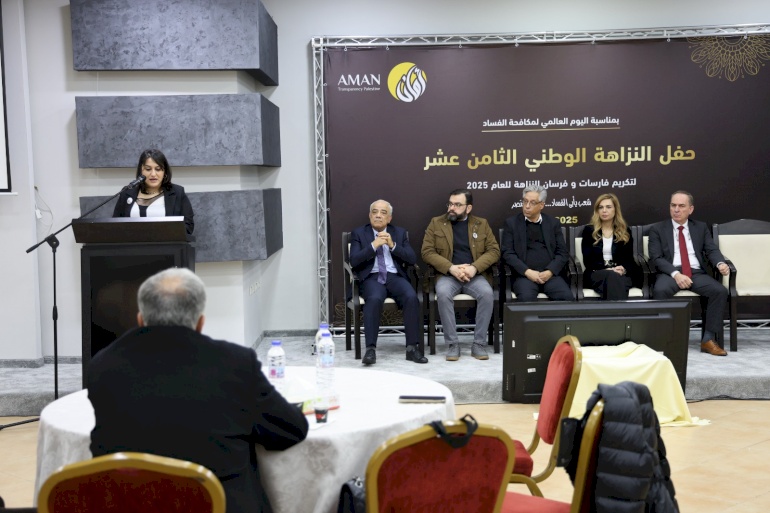
Ramallah/ Gaza – Under the slogan “A people who reject corruption will inevitably prevail,” and on the occasion of the International Anti-Corruption Day, the Coalition for Integrity and Accountability (AMAN) held the eighteenth National Integrity Ceremony across the West Bank and the Gaza Strip, with virtual participation via the Zoom platform to include our people in the Gaza Strip. During the ceremony, the Knights of Integrity for 2025 were honored, recognizing those who contributed to promoting integrity values and combating corruption in Palestinian society.
The awards ceremony comprised three main categories. The first was the Integrity and Anti-Corruption Award for employees in the Palestinian public sector and local authorities. This award is granted to those who initiated the reporting of corruption cases, refused to engage in corrupt practices, provided official testimonies or reliable information, or launched initiatives that contributed to strengthening integrity systems within their institutions. The second category was the Martyr Shireen Abu Akleh Award for Best Investigative Report Addressing a Corruption Case, designated for media professionals who produced and published investigative reports that exposed corruption cases and contributed to enhancing public accountability. The third category was the award for Best Research on Anti-Corruption Topics, granted to researchers who presented specialized academic studies addressing integrity systems and the fight against corruption.

The ceremony opened with a speech by Mr. Abdul Qader Al-Husseini, who noted that the event comes after a two-year suspension due to the crime of genocide being committed against the Gaza Strip. He emphasized that the repercussions of this crime were not limited to Gaza alone, but extended to affect Palestinian existence and identity across the entire Palestinian geography. Al-Husseini also mourned the journalist Hassan Douhan, a member of the technical committee for the Martyr Shireen Abu Akleh Award for Best Investigative Journalism, who was killed as a result of bombardment during the genocidal war on the Gaza Strip.
In his remarks, Al-Husseini stressed the necessity of entrenching integrity, justice, and transparency systems in the management of public affairs and public funds, in a manner that ensures accountability for corrupt actors and prevents impunity. He underscored the importance of anti-corruption efforts at this critical stage, considering them a fundamental pillar for strengthening the resilience of Palestinian citizens on their land and for building their trust in effective and honest national institutions.
He further noted that corruption is a transboundary crime that transcends geographic borders, with impacts extending across global, regional, and local levels, affecting various aspects of economic, political, and social life. He pointed out that marking the International Anti-Corruption Day this year under the slogan “With youth against corruption, for a future governed by integrity” carries particular significance in the Palestinian context, as youth constitute a genuine instrument of change when empowered to effectively participate in decision-making.

Elections and Strengthening Trust in Governance
Mr. Al-Husseini then clarified that the Coalition for Integrity and Accountability (AMAN) is closely monitoring developments related to the decision by law concerning local elections. He stressed the importance of holding elections in all their forms and emphasized that the governance system must commit to considering the remarks and recommendations of civil society, particularly those submitted on draft laws.
He warned that disregarding these remarks after they have been presented for public discussion undermines the credibility of dialogue and weakens trust in consultation and decision-making processes. He explained that the decision by law on local elections ignored substantive comments that had previously been submitted and introduced a new condition that was not subjected to public debate. This condition fundamentally affects the right to political participation and contradicts international human rights standards, the Declaration of Independence, and the provisions of the Palestinian Basic Law. He called on the Palestinian government to refrain from imposing any political conditions on those wishing to run for elections.

Occupation Practices Undermine the Work of Oversight and Accountability Institutions in the Gaza Strip
Al-Husseini also addressed the challenges associated with the recovery phase in the Gaza Strip, in light of the ongoing genocidal warfare and the occupation’s circumvention of agreements. He pointed to the uncertainty surrounding the future governance of the Gaza Strip, alongside attempts to shift decision-making outside the national framework, in ways that constrain oversight and accountability. He warned of the growing risks of organized and transboundary corruption amid the absence of a unified system of transparency and accountability, and emphasized the importance of empowering official oversight institutions and strengthening the role of citizens in reporting corruption cases, including in the Gaza Strip.
Applications and Nominations for the 2025 Awards
Dr. Ihab Bsieso delivered a speech on behalf of the panel of judges in the West Bank and the Gaza Strip, explaining that the technical and specialized award committees worked incessantly over several months to review applications and nominations, in accordance with criteria and weighting systems that are developed annually. Bsieso affirmed that the committees submitted their recommendations to the executive management and to the panel of judges, composed of national and professional figures, for final consideration, noting that the awarding process is based on a rigorous evaluation carried out by specialized technical committees for each award category.
He added that the suspension of award adjudication procedures in 2023 was due to the outbreak of the genocidal was on the Gaza Strip, while no awards were announced and no applications were received in 2024. Following consultations with relevant stakeholder groups in Gaza, the evaluation process was resumed in 2025, with works completed during the interruption period included to allow them to compete. This year, the Coalition for Integrity and Accountability (AMAN) received 11 applications for the Public Sector and Local Authorities Award, nine research submissions under the Best Research in Anti-Corruption Award, and 13 investigative reports submitted for the Martyr Shireen Abu Akleh Award.

Public Sector Awardees: Awad Al-Sharouf and Ihab Abulrubb
The Integrity and Anti-Corruption Award in the category of employees in the public sector and local authorities was awarded to Mr. Awad Al-Sharouf, a forensic technician and Head of Outpatient Clinics at the Forensic Medicine Department of the Palestinian Ministry of Justice Directorate in Hebron, and to Ihab AbulRubb, a government employee in the Traffic Department at the Tubas Magistrate’s Court.
Al-Sharouf received the award in recognition of his professional and ethical stance in exposing a corruption case that infringed upon citizens’ right to access a public service that is legally supposed to be provided free of charge. He documented unlawful practices involving a physician who collected money in exchange for issuing officially stamped forensic medical reports, with amounts ranging between 200 shekels and 500 dinars. After verifying the facts through one of the service recipients who had been compelled to pay, Al-Sharouf submitted a formal report to the Anti-Corruption Commission and provided testimony before the relevant authorities. This led to the case being referred to the Anti-Corruption Crimes Prosecution and subsequently to the court, which issued a conviction and imposed a prison sentence on the accused.

Watch the video of our awardee Awad Al-Sharouf
The award management decided to grant Ihab Abulrubb the 2025 Integrity and Anti-Corruption Award in recognition of his courage in exposing the exploitation of a loophole in the fines collection system. Some violations had been recorded as “paid” without official receipts, which enabled manipulation, embezzlement, and the wasting of public funds. In response, Abu Abulrubb reported the matter to the court president and then submitted an official letter to the Supreme Judicial Council in the absence of any documents verifying the payments. Following the investigation, evidence of manipulation and embezzlement emerged. He was summoned to provide testimony before the Anti-Corruption Prosecution and later appeared as a key witness before the Anti-Corruption Crimes Court.

Watch the video of our awardee Ihab Abulrubb
Martyr Shireen Abu Akleh Award Winner: Journalist Mushira Tawfiq from the Gaza Strip
Journalist Mushira Tawfiq won the Martyr Shireen Abu Akleh Award for Best Investigative Report for her investigation titled: “How Some Civil Society Institutions Became Involved in Drug Trade in Gaza.”
The investigation documented the disappearance of medicines from hospitals while they were being sold at high prices on the black market. It exposed how some employees of health institutions were exploiting medicines that had been sent as aid, who sold them illegally, constituting a clear abuse of public trust. Medicines that were supposed to be free were turned into a profitable trade at the expense of patients and the wounded, amid an ongoing humanitarian tragedy and genocide.
The investigation also showed that the absence of clear mechanisms for managing medical aid, and the lack of written oversight regulations, created a gap exploited to generate illicit profits at the expense of human lives. The report helped draw attention to these practices and prompted responsible authorities to initiate corrective measures to ensure that medicines reach those entitled to them, highlighting the power of investigative journalism to uphold citizens’ rights and reinforce integrity even under the most challenging circumstances.

Watch the video of our awardee, journalist Mushira Tawfiq
Researcher Alaa Jaradeh Wins Best Specialized Research in Anti-Corruption for the Undergraduate Category
Researcher Alaa Jaradeh won the 2025 Best Specialized Research in Anti-Corruption Award for the undergraduate category for her study titled: “Combating Corruption in Aid Distribution During the Genocide in the Gaza Strip.” The research focused on how corruption in exacerbating civilian suffering during the famine officially declared by the United Nations in 2025. Jaradeh employed a legal text analysis methodology, conducted interviews with legal and academic experts, and distributed a questionnaire to assess the state of integrity in the distribution of humanitarian aid.
The study concluded that weak relief institutions and emergency plans, the absence of centralized coordination, and improper practices in managing warehouses and distribution points created gaps in fairness and integrity in aid delivery. It also highlighted the importance of developing transparent mechanisms to ensure that food and aid reach those entitled to them without discrimination or exploitation. The research presented a clear roadmap to enhance integrity and combat corruption in humanitarian relief distribution in the Gaza Strip, including the use of an application to track all forms of aid, designated distribution points, complaint mechanisms, and a coordinated plan among all civil society institutions.

Watch the video of our awardee, researcher Alaa Jaradeh
Researcher Ra’fat Abulrubb Wins Best Specialized Research in Anti-Corruption for the Graduate Category
Researcher Ra’fat Abulrubb won the 2025 Best Specialized Research in Anti-Corruption Award for the graduate category for his study on “The Impact of Internal Control on Deterring Fraud within the Palestinian Government Sector,” focusing on the role of forensic accounting as a moderating factor to strengthen this system. The study employed the COSO framework for internal control and applied a questionnaire to employees of various Palestinian oversight and judicial institutions: the Audit Bureau, the Anti-Corruption Commission, the Economic Prosecution, the Financial Follow-up Unit, and external auditing bodies.
The results showed that internal control is the first line of defense against fraud. The study emphasized that integrating forensic accounting with internal control is more effective than operating separately, and that inadequate coordination or insufficient staffing undermines the effectiveness of deterrence. The researcher called for building an advanced oversight system based on technology and clear legislation, and for the establishment of a Palestinian body of forensic accountants to safeguard public funds and strengthen integrity in the government sector.

Watch the video of our awardee, researcher Ra’fat Abulrubb
The ceremony concluded by praising the courage of whistleblowers and exposers of corruption and honoring the technical committees, while expressing hope for renewed gatherings next year under better circumstances. With the start of the recovery and reconstruction phase in the Gaza Strip, the ceremony emphasized the Palestinians’ right to self-determination, the need to monitor reconstruction efforts, ensure accountability, and uphold belief in a future enriched by a promising generation of Knights and Dames of Integrity and Anti-Corruption in Palestine.