Israeli Restrictions Undermine the Role of Palestinian Civil Society Institutions in Oversight and Accountability
The Coalition for Integrity and Accountability (AMAN) Examines Israeli Restrictions on International Institutions and Their Impact on Civic Space in Gaza
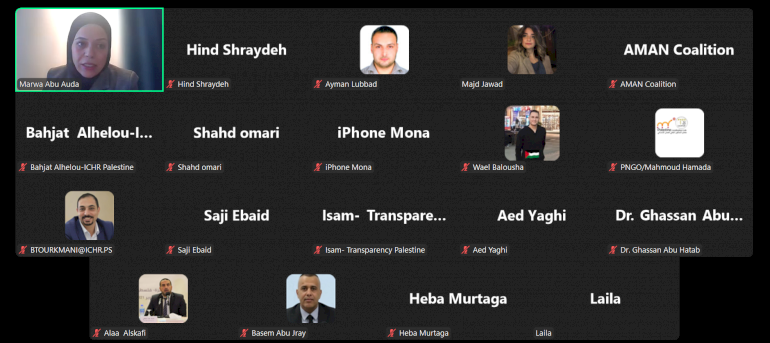
Ramallah – The Coalition for Integrity and Accountability (AMAN) held a Zoom session to discuss a draft report titled “The Conditions and Restrictions Imposed by the Israeli Occupation on International Entities Operating in the Gaza Strip and Their Impact on Palestinian Civic Space.” The purpose of the report is to analyze Israeli restrictions on humanitarian work across political, economic, and logistical dimensions, assess their direct impact on the ability of international institutions to deliver aid, and examine the independence and effectiveness of Palestinian civil society institutions in oversight and accountability. This is intended to provide an in-depth understanding of the mechanisms used by the occupation to control humanitarian assistance and identify their repercussions for civil society.
The discussion session was opened by Marwa Abu Odeh, Advocacy and Community Accountability Coordinator at the Coalition for Integrity and Accountability (AMAN). She explained that Israeli restrictions on international and local institutions involved in humanitarian aid delivery have narrowed civic space and created an unstable operating environment. As a result, negative practices have emerged, including increased reliance on local intermediaries and higher costs for delivering assistance to beneficiaries.
The Siege as a Political Tool
Researcher Ayman Lubbad reviewed the report, explaining that field data and international reports confirm that Israeli restrictions on the entry of materials, the movement of humanitarian personnel, and the management of crossings in the Gaza Strip are deliberately employed as a political tool, rather than being merely the outcome of war or technical considerations. He clarified that these restrictions include the expansion of the list of items classified as dual-use, the obstruction of medical equipment and materials related to infrastructure, communications, and energy, and the rejection of dozens of requests to allow life-saving assistance to enter, even amid an unprecedented humanitarian emergency.
Politicization of Aid and Declining Equity of Access
Drawing on testimonies from international institutions operating on the ground, the report showed that the politicization of aid has been one of the most serious direct consequences of Israeli restrictions, with humanitarian assistance being used as a means of political leverage, directly affecting the fairness of its distribution.
The absence of a unified national registry of eligible groups, combined with weak coordination between international and local actors, has contributed to patterns of discrimination and inequality. This has been reflected in the repeated provision of aid to certain groups while other, more severely affected groups are deprived, weakening transparency and widening the gap of trust between local communities and distributing bodies.
The report further noted that the operating environment deteriorated into a state of near-complete operational suffocation during the war, followed by the emergence of a “new permanent reality” after the ceasefire. In this context, restrictions have continued to function as a control mechanism that prevents a transition from emergency relief to recovery and reconstruction pathways.
Sharp Geographic Gaps in Aid Distribution
The report addressed how Israeli restrictions on movement and the designation of so-called “accessible areas” have resulted in large parts of the Gaza Strip, particularly the northern and eastern areas, being deprived of humanitarian assistance and health services for extended periods. In fact, aid distribution has come to be governed by geographic accessibility rather than the level of humanitarian need, creating a stark condition of geographic inequity and deepening disparities between different areas of the Strip. This has also led to an erosion of transparency and accountability in humanitarian work, because international institutions have relied on local partners and intermediaries, weakening monitoring and evaluation systems.
Diminishing the Role of Palestinian Civil Society
Israeli control over border crossings and the rejection of a large number of requests submitted by international institutions, along with indirect pressures in the selection of local partners, have undermined the independence of Palestinian civil society organizations. Many of these organizations have shifted from being independent actors to secondary implementers of externally designed projects, constraining their ability to carry out their roles in community oversight, accountability, and advocacy, as they become increasingly preoccupied with survival and emergency response under the weight of the siege.
Calling for an Independent National Humanitarian Coordination Platform and Restoring the Oversight Role of Local Organizations
The report included recommendations for the establishment of an independent national humanitarian coordination platform, operating with the highest possible degree of political independence, and comprising international organizations, key Palestinian institutions, professional unions, and relevant official bodies. The platform would unify targeting criteria and clarify the distribution of roles among various actors, in order to enhance fairness and transparency in the distribution of humanitarian assistance.
In the recommendations also stressed the importance of activating the role of Palestinian civil society in oversight and evaluation by forming community committees tasked with reviewing beneficiary lists, monitoring complaints, and reporting any manifestations of discrimination or corruption in aid distribution. It was further emphasized in the report the need to invest in building the capacities of local organizations in governance and financial management, in ways that ensure their independence and strengthen their ability to perform an effective oversight role.
Unifying Data to Ensure Equity, Prevent Duplication, and Strengthen Accountability Mechanisms
The report included a call for establishing a unified database of humanitarian aid beneficiaries, based on clear standards for transparency and the protection of personal data. It also included an emphasis on the fact that data unification is a key step in reducing unjustified duplication of assistance, addressing cases of deprivation, and improving the efficiency of humanitarian planning and response in view of the very limited resources. It also highlighted the need to activate genuine and effective complaints mechanisms that ensure accountability, curb violations, and enhance local community trust in implementing bodies.
Emphasizing the Neutrality of Humanitarian Work and Its Separation from Political Agendas
The recommendations highlighted the importance of preserving the neutrality of humanitarian work and fully separating the objectives of aid from the political considerations associated with the siege. They called for activating UN accountability mechanisms to ensure that assistance is not used as a tool of political pressure and to safeguard the core principles of humanitarian action.
The concluding recommendation of the report advised advocating for a comprehensive, multi-level approach that integrates legal, diplomatic, and international advocacy efforts to address the impact of Israeli restrictions on humanitarian work. It also stressed the importance of strengthening communication channels between local communities and the international community, contributing to a more coherent and sustainable humanitarian response capable of meeting the growing needs of affected populations.
Various Comments
Salah Abdul Aati, Chair of the International Commission for Supporting the Rights of the Palestinian People (HASHD), emphasized that Israeli restrictions on humanitarian and civil work are a core part of a broader strategy of collective punishment in the Gaza Strip. These measures aim to weaken Palestinian society’s resilience, dismantle its institutions, and turn aid into a tool of political pressure. He noted that the occupation seeks to impose a misleading narrative of the humanitarian crisis as a natural disaster, manipulating both the quantity and quality of aid, undermining the independence of humanitarian decision-making through threats and prohibitions, while fostering a legal and political environment dominated by fear, all of which limit the effectiveness of the humanitarian response.
Meanwhile, Alaa Skaffy, Director of Al-Dameer Association for Human Rights in Gaza, commented that one of the most serious restrictions and challenges facing Palestinian civil and humanitarian work is the escalation of occupation-driven campaigns of incitement and defamation targeting humanitarian institutions, particularly the United Nations Relief and Works Agency (UNRWA). These actions form part of a systematic strategy to restructure civic space, illustrated by the establishment of alternative entities, such as the so-called “Gaza Humanitarian Foundation,” intended to sideline effective organizations.
Bassem Abu Jari, from Al Mezan Center for Human Rights, emphasized the need to dedicate a broader section of the report to highlighting the United Nations Relief and Works Agency for Palestine Refugees (UNRWA), as one of the most influential international institutions in the Gaza Strip. He noted that UNRWA has been systematically battered with Israeli logistical and legislative restrictions, with serious impacts on health and relief services. He also highlighted the importance of strengthening the report with statistical data to illustrate the scale and role of international institutions before and during the war, and to examine the factors driving the expansion or withdrawal of some of these institutions. He stressed that what is happening goes beyond restrictions on institutions, reflecting a deliberate and comprehensive siege policy targeting all components of the Gaza Strip, including the private sector, through the prevention of essential supplies and goods.
Bakr Al-Turkmani, Coordinator of Investigations and Complaints at the Independent Commission for Human Rights, explained that during the ongoing war of extermination in Gaza, the Israeli occupation implemented systematic policies and measures targeting UN and international institutions, as well as Palestinian civil society organizations, which significantly undermined oversight and accountability. He emphasized the need to restore the role of Palestinian civil society organizations in leading relief and humanitarian work, organizing their relations with international and UN institutions, and ensuring they are not marginalized in any stage of humanitarian operations, from active participation to actual, not formal, planning. He also stressed the importance of international and UN institutions fulfilling their role in holding the Israeli occupation accountable for its crimes, rather than becoming entities that merely respond to the distortions it imposes on humanitarian and relief work. These institutions are accountable to the local community, not above accountability, and any neglect in this role practically weakens the humanitarian response and entrenches the restrictions imposed on the Gaza Strip.