The Coalition for Integrity and Accountability (AMAN) Holds its 2025 Annual Conference on “Integrity and Justice Safeguards in Managing the Early Recovery Phase in the Gaza Strip”
The Need to Adopt a Unified National Strategy and Plan for Managing the Early Recovery Phase Based on Transparency Values, Accountability Systems, and Anti-Corruption Principles
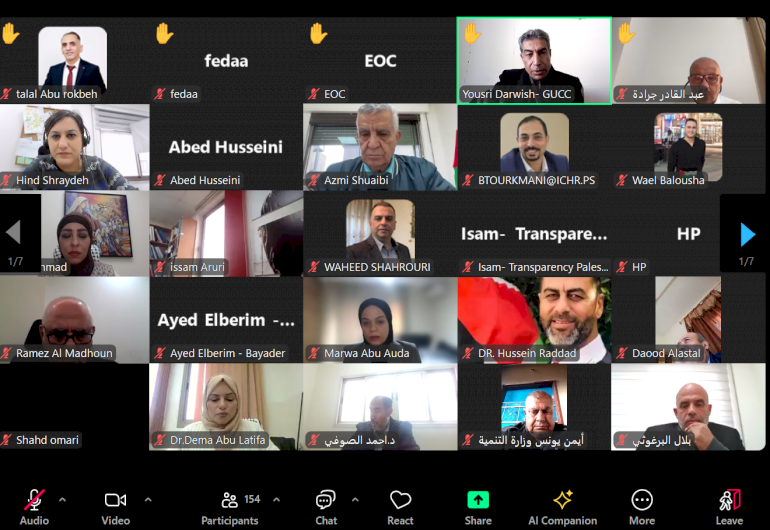
Ramallah / Gaza – The Coalition for Integrity and Accountability (AMAN) held its 2025 annual conference titled “Integrity and Justice Safeguards in Managing the Early Recovery Phase in the Gaza Strip” through the Zoom platform, with the participation of representatives from various Palestinian sectors, as well as local, regional, and international institutions.
The conference focused on strengthening transparency, integrity, and justice in post-war recovery processes, particularly in the most sensitive sectors such as relief, shelter, infrastructure, health, education, and the justice sector. It included specialized discussion groups for each of the six issues presented, where the main challenges and obstacles to ensuring integrity and transparency were reviewed.
Participants analyzed corruption risks in a context of instability and set clear standards to guide future plans and procedures, aiming to develop practical safeguards that include protecting civil society and enabling it to conduct oversight, establishing independent monitoring mechanisms for funding, relief, and rehabilitation, and providing open data for institutions and the public, in order to build a transparent and fair system for managing national and international resources during the early recovery phase.
Multiple Local and International Actors without Clear Roles Increases the Complexity of Recovery
The conference was launched by the Deputy Chair of the Board of Directors of the Coalition for Integrity and Accountability (AMAN), Dr. Nader Abu Sharkh, who stated in his opening remarks that the early recovery phase in the Gaza Strip after the war is a sensitive stage that requires focusing on integrity, transparency, and justice in all phases of planning, implementation, and oversight. Dr. Abu Sharkh explained that the extensive destruction caused by the war did not only result in human losses, but also damaged institutional and social structures, making strict oversight controls essential to ensure that assistance and services reach those who are entitled to them.
Dr. Abu Sharkh noted that recovery under the presence of multiple local and international actors increases the complexity of the process and creates unprecedented challenges for ensuring integrity and preventing corruption. He stressed that effective coordination, strengthening independent accountability mechanisms, and setting clear rules for information-sharing are essential pillars for safeguarding citizens’ rights. He also emphasized that AMAN’s role is to support Palestinian reference bodies, strengthen transparency in funding and contracts, monitor operations in vital sectors, and work on enabling civil society to conduct oversight and access open data in order to build a transparent and fair system during the early recovery phase.
The Importance of Unifying National Efforts to Address the Challenges of the Agreement’s Second Phase
Dr. Azmi Al-Shuaibi, Advisor to the Board of Directors of the Coalition for Integrity and Accountability (AMAN) on Anti-Corruption, emphasized in a conceptual introduction the need to unify national efforts to confront the challenges of the second phase of the agreement and to ensure integrity and anti-corruption within a coherent national framework. He noted that the second phase of the agreement has not yet officially begun, and that international and regional parties, along with the indirect participation of some Palestinian actors, have not set a clear timeline for implementing the provisions of this phase. As a result, because the Palestinian side relies most on the agreement’s implementation, it faces constant pressure, which is frequently used to justify repeated delays.
The Absence of a Unified Legal and Institutional Framework Increases the Likelihood of Corruption
Dr. Al-Shuaibi warned that the agreement left significant gaps in the details of governance, recovery, and reconstruction. He explained that the International Peace Council, established under the leadership of U.S. President Trump, has not had its role clearly defined, including its authority over managing projects, financial funds, and investments. In addition, there is no clear framework for setting funding priorities or defining financial and administrative systems, with some of these responsibilities assigned to the World Bank. He also noted that the distribution of initial assistance is not clearly defined, particularly given the obstructive role of the Israeli occupation as the controlling power over the borders, which underscores the need for a clear Palestinian vision that prioritizes the interests of the people over partisan and factional considerations.
Dr. Al-Shuaibi pointed to a second challenge in the second phase, namely, the absence of a legal reference framework for the new bodies that will be established by the International Peace Council, for either Palestinian executive entities or bodies run by international experts. He warned that the absence of such a framework would create opportunities for international and Israeli interventions, undermining the implementation of the second phase of the agreement. He stressed that the solution lies in forming a national Palestinian framework based on existing legislation, with the Basic Law as its foundation, in a manner that strengthens the role of civil society institutions in oversight and accountability and protects the national process from attempts to internationalize legislation or exploit the legal vacuum to obstruct recovery.
Establishing a Comprehensive Data Monitoring Observatory to Enhance Transparency in Gaza’s Recovery
Dr. Al-Shuaibi warned that the current environment, which involves multiple local and international actors along with a projected influx of funds, presents significant opportunities for corruption if strong central mechanisms are absent. He explained that experiences in countries such as Iraq and Lebanon have shown that having multiple actors operate without a unified framework, the likelihood of escape from accountability increases, highlighting the need for systematic measures to strengthen integrity and combat corruption. He emphasized the importance of developing national anti-corruption plans, creating a unified network to coordinate the oversight roles of various groups and institutions, building monitoring capacities, and establishing a monitoring center in the Gaza Strip that consolidates all data and ensures its publication by all entities responsible for recovery.
Dr. Al-Shuaibi also stressed that the success of any anti-corruption plan depends on the effective use of international support, including oversight of funds and projects implemented by international institutions and the private sector. He noted that this international support must adhere to transparency and integrity standards to prevent exploitation or monopolistic practices. He further explained that AMAN has begun coordinating its efforts with Transparency International to leverage its global influence and contribute to international advocacy campaigns aimed at ensuring that donors comply with international standards.
Challenges of Reconstruction in Gaza: Fragile Governance and Risks of Politicization
In his paper, researcher Talal Abu-Rukbeh’s emphasized the fact that the reconstruction process in Gaza faces complex challenges, including poor coordination among local and international actors as well as multiple governing authorities, which weakens oversight and threatens transparency in resource distribution. The paper noted that reliance on conditional external funding, coupled with weak financial systems and databases, creates an environment prone to corruption and politicization, limiting the ability to allocate resources according to the population’s actual needs.
Mr. Abu Rukbeh noted that the absence of a unified legislative framework and strong oversight mechanisms, along with limited participation from the local community and technical personnel, further complicates implementation and exposes vital projects to delays or deviation from recovery priorities. He also stressed that difficult social and economic conditions directly affect the efficiency of resource distribution, thus making a sound governance environment and independent institutions to monitor implementation essential for fair and effective reconstruction.
Developing a National Plan to Assess Damages and Consolidate Data in a Unified Database
In that same paper, Mr. Talal Abu-Rukbeh presented a set of practical recommendations to enhance transparency and accountability in the reconstruction process. These included developing a national plan to assess damages and consolidate them in a unified database, and establishing a coordinating body that brings together municipalities, ministries, civil society, and donors under a clear charter defining authorities and decision-making mechanisms. He also called for adopting integrity standards in contracting companies, ensuring full disclosure of funding and projects, and engaging international institutions such as Transparency International to monitor compliance with these standards.
His recommendations further included building local capacities, establishing specialized implementation units, creating a system to monitor performance indicators, and activating independent technical and financial auditing mechanisms, with a focus on protecting vulnerable groups and integrating protection standards throughout all stages of implementation. He emphasized that the success of the reconstruction process will depend not only on funding but also on the ability of Palestinian and international institutions to adopt a governance model based on integrity, transparency, and accountability, ensuring sustainable recovery and the restoration of a dignified life for the people of Gaza.
Humanitarian Aid Management: The Necessity of a National Beneficiary Registry
With regard to humanitarian aid, in his paper, Researcher Abdel-Mun’em Tahrawi highlighted that the management of humanitarian aid in Gaza faces unprecedented challenges, including multiple governing authorities, Israeli restrictions on crossings, politicization of aid, weak coordination between local and UN actors, and unclear databases, all of which increase the risk of discrimination or unfair exclusion. He noted that if these challenges are not addressed, they could undermine public trust and hinder equitable access to aid during the recovery phase.
He presented recommendations to strengthen integrity and transparency, including establishing a unified decision-making authority, adopting a national beneficiary registry capable of data operation, activating data protection mechanisms, enhancing the role of UN coordination, standardizing registration and distribution procedures, and linking funding to compliance with transparency standards. He also recommended expanding community oversight and involving vulnerable groups in setting targeting criteria to ensure fair distribution and protect the relief system from politicization and diversion.
Challenges in Gaza’s Education Sector: A Comprehensive Plan and Adopting a Hybrid Face-to-Face Digital Learning Model
While, in his paper, Researcher Badr Hamdan highlighted the scale of the challenges facing the education sector in Gaza after the war, pointing to the extensive damage sustained by educational institutions, infrastructure, and academic staff. He noted that the absence of a unified national vision, weak governance, and limited coordination between local and international actors, along with restrictions on educational materials and psychological and educational gaps, all increase the difficulty of resuming education in a fair and safe manner. The researcher also drew attention to the risks of corruption and politicization in the distribution of educational resources, which threaten the sustainability of recovery efforts and equitable access to education.
Mr. Hamdan presented recommendations for a comprehensive plan to rehabilitate the education sector, including precise damage assessments, mobilizing organized and transparent international funding, adopting a hybrid face-to-face digital educational model, providing alternative facilities in a fair and equitable way and embracing a participatory national vision following recovery. He also proposed student financial support programs, equitable geographic planning for reconstruction, establishing a digital emergency platform, and enhancing sustainable support for universities, while emphasizing mechanisms for transparency, governance, and accountability to ensure sustainable and fair recovery.
An Independent National Authority to Oversee the Shelter Sector
Regarding shelters, in his paper, Researcher Hisham Al-Kahlout focused on the main challenges related to integrity, transparency, and fairness in the procedures and criteria for determining eligibility for temporary shelter, as well as identifying the guarantees that should be in place under the current circumstances to strengthen integrity, transparency, and accountability and reduce the risks of corruption in shelter management.
He warned of major risks that threaten integrity, neutrality, and accountability in the shelter sector during the recovery phase in Gaza. The first risk is the International Peace Council’s use of non-transparent mechanisms to appoint supervisory bodies, potentially making the them subject to external political agendas, weakening civil society’s ability to monitor them, and raising the risk of corrupt practices. He then stated that the privatization of shelter services and operations, with their privileges granted to transnational companies, could create international corruption risks due to overlapping interests between donor countries and multinational corporations. He also highlighted the risks posed by the Peace Council and its operational entities managing state-owned land without following national and legal frameworks. Such practices could enable corruption in land use, exchanges, granting of concessions, and valuation, while compromising fairness in the distribution of critical resources during the recovery phase.
Establishing an Independent National Authority to Ensure Neutral and Effective Oversight
In his turn, researcher Hisham Al-Kahlout recommended in his paper a set of measures to address the risks threatening the shelter sector in Gaza, with focus on strengthening national oversight and community participation. The recommendations include ensuring genuine Palestinian representation on the Shelter Council, most importantly through the establishment of an independent national authority that includes representatives from international actors, civil society, and operational entities to guarantee neutral and effective oversight. He also called for developing a unified national framework for procurement and supply operations to ensure standardized technical criteria and strict monitoring, as well as adopting a comprehensive legal framework for managing state-owned land based on objective valuation and regular disclosure.
Establishing an Independent Supervisory Body for Medical Evacuations and a Mechanism for Complaints
Researcher Sami Abu Shammaleh presented a paper on “Integrity and Justice Guarantees in Managing Medical Evacuation from Gaza During the Early Recovery Phase,” particularly in light of the near-collapse of the health sector, the multiplicity of intervening actors, and the absence of a unified legal and institutional framework.
In that paper, he notes that the medical evacuation process consists of several complex procedural stages requiring precise coordination between local and international actors. However, this process operates in a turbulent environment lacking a unified Palestinian reference framework, with weak accountability mechanisms for the Medical Committee and the World Health Organization, and with the Israeli occupation controlling border crossings and security passage approvals. The researcher emphasized that these conditions result in unjustified disparities between cases, serious delays that threaten patients’ lives, and increasing opportunities for intermediaries, bribery, politicization, or manipulation, all of which jeopardize fairness and transparency in the provision of medical evacuation services.
He also called for the establishment of an independent observatory for medical evacuations, a formal complaints and grievance pathway, and the development of tools to enhance transparency in managing this file, including a national registry and a civil guide for prioritization and justice standards. Mr. Abu-Shammaleh also advised pressuring international actors, including the World Health Organization and the UN Office of Internal Oversight, to publish periodic data, appoint an integrity and independence advisor in the Gaza office, and remove the file from politicization through alliances with international medical and human rights organizations. He then emphasized the importance of protecting the most vulnerable groups, increasing treatment opportunities, and improving hospitals’ operational efficiency in the sector, to ensure that treatment reaches those entitled to it without discrimination or neglect.
Institutional Risks Facing the Justice Sector
As for researcher Aya Al-Mughrabi, she presented a study titled “Integrity and Effectiveness Guarantees in the Justice Sector During the Recovery Phase in Gaza,” emphasizing that the justice sector is a key component in ensuring the rule of law. She noted that all components of the justice systems, including the civil police, public prosecution, courts of all types, and lawyers, were systematically targeted during the genocide, in addition to the absence of a unified legal framework regulating their work.
She noted that the current conditions increase the likelihood of unequal treatment for some cases. She added that the absence of an independent oversight body to monitor the work of judges and the public prosecution further heightens these risks and creates opportunities for unfair practices, including intermediaries or circumvention of formal procedures, which ultimately undermine the credibility of the justice sector.
The Importance of National Consensus on a Unified Strategy to Rebuild the Justice Sector
For her turn, Researcher Aya Al-Mughrabi called for unifying the judicial structures between the West Bank and Gaza and for establishing a judicial body that represents all Palestinians, grounded in standards of integrity, competence, and impartiality. She also emphasized the importance of achieving national consensus on a unified strategy for rebuilding the justice sector, including defining organizational structures, supervisory scopes, limits of responsibility, and vertical and horizontal accountability mechanisms. In addition, she stressed the need to adopt transparent financial and administrative systems and to facilitate the flow of data between judicial institutions and civil society organizations, with the overarching aim of strengthening the independence of the judiciary from political or partisan interference.
The Need to Adopt a Unified National Strategy and Plan for Managing the Early Recovery Phase
In his reading of the conference’s final statement, Yusri Darwish, a board member of the Coalition for Integrity and Accountability (AMAN) in Gaza, reviewed the key conclusions for managing recovery along with a set of essential recommendations. The statement noted that the many legislative and institutional bodies, and the overlapping roles of local, regional, and international actors, in the absence of a unified Palestinian national framework for managing recovery, increase the risks of deviation in the administration of public services and the misuse of authority for improper purposes.
The statement also contained a statement regarding the fact that the large number of intervening parties, including the Peace Council, the Stabilization Force, the International Funding Fund, and official and civil Palestinian entities, heightens the likelihood of marginalizing Palestinian national decision-making, due to the Israeli occupation’s harsh policies as well as the weak institutional preparedness resulting from the internal division and the absence of a unified leadership. It further explained that the upcoming phase is the most vulnerable to risks of corruption and abuse of power, especially as the Israeli occupation continues to control crossings and vital resources, uses humanitarian aid as a tool for tormenting and oppressing the people of Gaza, and imposes external management models that are not subject to public accountability.
Adopting Unified Palestinian Legislation and Institutional Structures in the Administration of the Gaza Strip
The conference’s final statement called for strengthening the unity of the Palestinian institutional framework between the West Bank and Gaza, and for utilizing the Arab and regional role, while adhering to integrity and fairness across all areas of recovery. The conference emphasized the need to adopt a unified national strategy for managing the early recovery phase and what follows, based on transparency and accountability systems. This includes adopting unified Palestinian legislation and institutional structures, conducting unified local, legislative and presidential elections, safeguarding inclusive community institutions, and strengthening the role of unions, associations, and chambers of commerce.
The stated strategy underscored enabling official oversight bodies to fulfill their responsibilities, enhancing community oversight, and establishing unified national data platforms covering damaged infrastructure, education, displaced persons, patients and medical evacuation, and a unified registry for humanitarian aid. The final statement also emphasized requiring all local and international parties to follow a transparent disclosure system, adopt standards of competence and integrity in selecting committee members, publish all recovery plans, financial and administrative reports, and beneficiary lists, establish a temporary national coordination body for infrastructure rehabilitation, restore UNRWA’s capacity to coordinate humanitarian relief, develop a national plan for the gradual reactivation of the justice system, and implement awareness programs on integrity and anti-corruption.
Building Trust and Restoring Palestinian Rights
The final statement concluded by calling on the international community to respect the unity of Palestinian institutions and their legal framework, and to reject using aid as a tool to manipulate political or social dynamics, while ensuring full disclosure of funding and implementation mechanisms. The final statement of the conference also emphasized that successful recovery depends on a transparent and accountable governance system capable of protecting Palestinian national decision-making, strengthening the resilience of the people, and guaranteeing their rights to freedom, dignity, and equality. It concluded that rebuilding Gaza does not begin with cement alone, but with restoring integrity, building trust, and safeguarding the Palestinian people’s human and national rights to manage their own future.
Conference Recommendations in the Final Statement
Regarding public administration in Gaza, the conference statement offered a recommendation for adopting Palestinian legislation and unified Palestinian institutional frameworks as the legal and institutional reference for officials and staff. It further called for viewing the reform requirements outlined in the international plan as an opportunity to hold unified local, legislative, and presidential elections across the West Bank, Gaza, and Jerusalem. It also emphasized preserving structural institutions that unify Palestinian society and enhancing their role, including unions, syndicates, and chambers of commerce.
On addressing corruption risks and strengthening integrity, transparency, and accountability in the recovery and reconstruction process, the conference’s final statement included a recommendation for activating official oversight institutions, such as the Financial and Administrative Audit Bureau, the Anti-Corruption Commission, and complaints units, and enabling them to perform their roles in Gaza according to relevant Palestinian legislation. It also called for strengthening community accountability efforts, including the role of civil society organizations, media, and unions, to monitor the management of recovery and reconstruction.
In the same context, the statement included a recommendation to establish and adopt unified national data platforms incorporating education data, the infrastructure damage registry, patient and medical evacuation records, displaced persons database, and a registry of humanitarian aid and relief beneficiaries. It also called for establishing a national governance framework for the recovery phase, including the formation of a single national authority to coordinate and oversee all sectors, and requiring all local and international parties to follow a transparent system for disclosing funding and data.
Furthermore, the conference’s final statement called for adopting the Palestinian public procurement legislation to ensure transparency and integrity in bidding, awarding contracts, and disclosing the actual beneficiaries and owners of companies, along with applying standards of integrity, professionalism and competency for members of committees overseeing the preparation of recovery plans, preventing their politicization or influence by favoritism and nepotism.
It also emphasized the need to publicly publish all sectoral recovery plans, including funding data, financial and administrative reports, beneficiary information, and the criteria for their selection. It also included a call for the creation of a temporary coordinating authority to unify the efforts of local actors in infrastructure rehabilitation, including municipalities, ministries, the private sector, civil society, professional associations, and international donors, operating under a transparent charter that defines powers and decision-making mechanisms, as well as for establishing a national registry of contracting companies.
Moreover, the statement included a call for establishing a temporary coordinating authority to unify the efforts of local actors in infrastructure rehabilitation, comprising of municipalities, ministries, the private sector, civil society, professional associations, and international donors, under a transparent charter defining powers and decision-making mechanisms, as well as creating a national registry of contracting companies.
It was also emphasized in the statement that UNRWA’s central role in coordinating relief must be restored, and underscored the need for raising awareness among recovery and aid management personnel about integrity and anti-corruption standards. It also advised developing a national plan to gradually reactivate the judicial system, documenting all violations committed during the war and linking them to international accountability mechanisms, while initiating immediate efforts at all levels to unify the justice sector and judicial institutions between the West Bank and Gaza, and harmonize the applicable legislation, laws, and reference procedures.