In Light of the outrageous rise in meat prices and demands to evaluate quota management,
AMAN holds a hearing session on the quota system and commodity lists, urging the government to develop action plans for a public food security strategy, expedite imposing price caps on meat and toughen penalties for smugglers
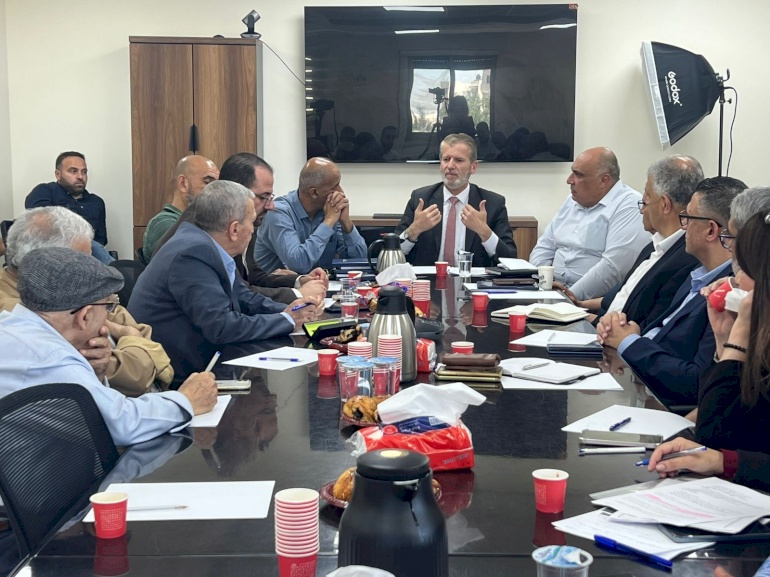
Ramallah – The Coalition for Accountability and Integrity (AMAN) held a hearing session addressing the current state of integrity, transparency, and anti-corruption efforts in the quota system and commodity lists. Participants included representatives of the Prime Minister’s Office (Institutional Reform Executive Office), the ministries of National Economy (MoNE), Agriculture and Health, security agencies, the State Audit and Administrative Control Bureau (SAACB), the General Administration of Crossings and Borders, the Society for Consumer Protection, the Federation of Palestinian Chambers of Commerce, Industry and Agriculture, the Farmers’ Union, the Union of Butchery Owners, the Olive Oil Council and the Palestine Trade Center (PalTrade), as well as a number of concerned parties, traders, municipalities, civil society organizations and the media.
Issam Haj Hussein, AMAN’s Executive Director, opened the session, stressing the importance of strengthening citizens’ steadfastness amid the genocide currently committed against the Palestinian people, by improving service delivery and controlling prices. He pointed to the significant challenges related to governance and oversight on the quota system management, noting that the quota has failed to achieve its stated goal, to reduce prices. In this context, previous AMAN reports and investigative media reports conducted in collaboration with Wattan Media Network revealed market monopolies and resistance to implementing a meat-stamping system that distinguishes between imported and local meat—creating opportunities for fraud by selling imported meat as local at higher prices. Although the Council of Ministers (COM) approved a slaughterhouse regulation in 2019, it has not yet been implemented due to the absence of a designated oversight authority and potential conflicts of interest.
The Anti-Corruption Commission (ACC) also pointed out the paralysis of the joint economic committee, which led to a freeze in the allowable import quantities despite a growing population, in addition to the absence of customs coding for imported goods, and non-compliance of some traders with their allocated import quotas. The system also suffers from weak internal accountability and a lack of regular control over quota distribution. Experts warn that the continuation of this dysfunction poses a serious threat to national food security, especially as citizens face increasing costs of living. This calls for a comprehensive reform of the quota system and the activation of oversight and accountability mechanisms to ensure fair distribution and price stability.
Haj Hussein emphasized the need for disclosing the beneficial owners of companies, not just the names of the authorized signatories. He explained that AMAN has been following up on this issue, due to growing suspicions that several companies, operating under different names may actually be owned by the same individual, thereby reinforcing monopoly and price manipulation. He also pointed to the widespread phenomenon of smuggling goods into the Occupied Territories, warning of the serious and unethical nature of this behavior, especially in light of the ongoing genocide in the Gaza Strip. He stressed that such a national crisis calls for enhanced oversight, rather than engagement in actions that undermine the economy and public interest. Haj Hussein called on the security agencies and relevant oversight bodies to strengthen monitoring and accountability mechanisms to curb smuggling operations. He urged harsher penalties for anyone proven to be involved in smuggling goods into the Occupied Territories, noting that such acts pose a direct threat to the Palestinian market and constitute an indirect collusion with the occupation system.
For his part, Engineer Bashar Saifi, the Deputy Minister of National Economy, confirmed that the current Palestinian government has undertaken a series of measures to improve governance in managing the quota and commodity list system, which fall under the classifications A1 and A2 according to the Paris Economic Protocol signed under the Oslo Accords in 1993. He noted that the purpose of the quota system is to save time and effort while providing goods to citizens at lower prices, since they are either fully or partially exempt from customs duties.
Saifi explained that the current quota system allows for importing 12,500 tons of frozen meat to the West Bank and Gaza (7,500 tons for the West Bank and 5,000 tons for Gaza), in addition to 800 tons of frozen lamb meat and 50,000 live sheep. However, he criticized the fact that these quotas have remained unchanged since 1994, despite the population having doubled since then. He clarified that the government retains Gaza’s share in anticipation of a political breakthrough that would allow for its distribution.
He also pointed out that the current quota committee, whose membership is renewed every two years, includes representatives from the ministries of Economy, Agriculture and Industry, SAACB, Customs and security agencies. This committee has established standards and procedures approved by the government to ensure fairness and transparency in the distribution of quotas. He added, "Given the limited availability of quotas, we are committed to distributing them fairly and according to clear criteria."
Saifi announced that, in line with its commitment to transparency, disclosure, and enhancing partnerships with the private sector and society, two days ago MoNE published a list of companies that received quotas for frozen lamb and veal meat, as well as live sheep, along with details on quota distribution for the first quarter of 2025. MoNE also opened the door for submitting objections. The disclosure reflected compliance with Council of Ministers Decision No. 24/19, which outlines the unified mechanism for A1 and A2 quota and commodity list committee, chaired by MoNE, and with the membership of the ministries of Agriculture, Industry, Finance (Customs), SAACB, and COM Secretariat acting as the committee’s secretariat.
As for the quota distribution details, 88 companies applied for frozen veal meat quotas, of which 68 were approved; 64 companies applied for frozen lamb quotas, of which 27 were approved. As for the quota for live sheep, set at 50,000 heads, nine companies applied and were all approved according to the established standards.
Saifi pointed out that MoNE requests an increase in quotas from the Israeli side, and seeks to establish a long-term quota system that contributes to price regulation and the setting of price caps. The Ministry has also contacted municipal slaughterhouses to require them to place a distinct stamp on quota meat, allowing consumers to distinguish it from other types of meat (local or non-quota imported) in terms of price and quality.
Saifi asserted that the Ministry has taken measures to prevent monopolies by opening applications to all companies, provided they meet certain criteria, including: having been operating for at least one year, possessing tax invoices, cold storage facilities, among other requirements. Files were reviewed to ensure there were no duplicate applications, and security agencies were involved when manipulation was suspected.
In a related matter, Saifi noted that President Mahmoud Abbas ratified the Competition Law, reflecting the government’s direction toward enhancing economic justice, although it has not yet been published in the Gazette.
Regarding the issue of smuggling to Israel, Saifi stressed that the Ministry is working in coordination with the Customs Police to monitor and combat this issue due to its harmful impact on the Palestinian market and economy.
On his part, Salah Hanieh, head of the Society for Consumer Protection, questioned why the quota system has not had any noticeable impact on consumers, explaining that this issue is not limited to meat alone, but extends to all commodity lists. He pointed out that since the arrival of the first shipment under the quota system, there has been no recorded drop in prices, which raises questions about the effectiveness and actual benefit of this system for the end consumer. Regarding the meat sector, Hanieh explained that local livestock production covers approximately 85% of demand, while imported meat is supposed to cover only 15% to create balance in the market. However, this balance does not exist in practice. He called for exerting pressure on all relevant authorities, primarily the Ministries of Agriculture and Economy, to intervene in price regulation—especially with the approach of Eid al-Adha—so that everyone is placed under real price monitoring to ensure consumer protection.
Nazih Mardawi, representative of the Federation of Chambers of Commerce, Industry and Agriculture, affirmed that the quota quantities have not increased in line with population growth. He pointed to the lack of transparency and clarity in pricing mechanisms and quota distribution. He said, “We do not know where the problem specifically lies,” referring to the absence of a clear database and the lack of any official body that provides details about pricing, the number of local sheep, or even the real cost of imported sheep upon arrival at the port. He added that the State of Palestine, due to its ongoing financial crisis and the theft of clearance revenues, does not provide any support to livestock breeders—unlike other countries in the region.
Assem Shawahneh, SAACB representative, stated that their 2018 report included several recommendations related to the quota and commodity list system. He pointed out the lack of any official confirmation from MoNE or any other Palestinian party regarding whether the Israeli authorities actually grant the 20% quota as stipulated in the Paris Economic Protocol. Shawahneh called on MoNE to coordinate efforts to increase import quantities in line with population growth, and to review the content and scope of agreements signed by Israel with exporting countries to ensure full Palestinian benefit. He also stressed the importance of adopting clear and transparent standards and criteria that ensure a fair and efficient quota distribution mechanism.
On their part, representatives of the Union for Butchery owners confirmed that they had decided to stop slaughtering sheep as a step aimed at protecting the product and ensuring its availability to citizens ahead of Eid al-Adha. They emphasized that, “the boycott was launched only to protect Al-Adha, as a feast without justice is not a true feast”. They explained that their decision came in support of consumers amid the outrageous price hikes and accused some traders of “criminal monopolization” of sheep. They called for taking serious steps to resolve the current crisis and regulate the market.
The union called for a comprehensive solution starting with support and reinforcement of local livestock production through effective government intervention and direct support for breeders. The union also stressed the need to combat smuggling, noting that it had contacted the Customs Police regarding this issue. They expressed their shock at the high pricing of imported live sheep, despite them entering under the quota system and receiving customs exemptions. They considered that the crisis actually began last February, when large numbers of mother sheep were slaughtered, contributing to the decline in supply.
Union representatives pointed out that nine companies applied to import sheep under the quota, several of which are owned by a single individual, raising suspicions of monopoly. The union, in turn, demanded a clear distinction between local and imported meat through an official stamp, including information on the origin and age of the animal. They stressed the importance of the role of the Ministry of Local Government in overseeing the implementation in all regions. They also called for a fair reference price to regulate the market and limit the abuses of certain traders benefiting from weak oversight.
Meanwhile, Ahmad Hajjaj, Director General of Agricultural Marketing at the Ministry of Agriculture, stated that a recent statistic revealed the presence of approximately 120,000 heads of sheep ready for slaughter in the local market ahead of Eid al-Adha.
Nazih Rweished, Head of the Import and Export Department at the Ministry of Health (MOH), recommended involving the Ministry in the quota system. He pointed out that MOH is excluded from the mechanisms of managing this vital system, despite its importance and direct impact on public health and food safety.
Raed Bayed, Director of Al-Faloja Industry Foods Stuff Co, noted that the crucial defect lies in the mechanisms of importation, pointing out that the increase in the number of importers has not led to a drop in prices. On the contrary, it has contributed to price increases—contrary to basic market logic—as some importers seek to export the sheep to the Israeli market due to higher prices and profits. He considered monopoly the root of the crisis and said that the available quota quantities do not meet the needs of the Palestinian market. He demanded fair distribution and reorganization of the relationship with importers, noting that some quota license holders are reselling them despite signing commitments that prohibit this. He also emphasized that protecting genuine traders is a key entry point to protecting consumers and ensuring price stability.
Ibrahim Qadi, the Director General of the Consumer Protection Department at the MoNE, attributed the ongoing price crisis to the lack of immediate intervention in setting clear price ceilings. He emphasized the need to set a fixed price for live sheep with a maximum limit, and for meat prices to have a maximum limit as well. He asserted his readiness to implement those ceilings as part of an effective oversight system.
Qadi also called for cooperation with oversight bodies by providing the names of those involved in smuggling operations, considering them a direct threat to Palestinian food security and public security, especially given the critical economic and living conditions.
During his intervention, Majdi Abu Zaid said that the quota system is not limited to the import of sheep only but includes the entire commodity lists, which requires raising public awareness and about it and making it available to the public. He criticized the continuous rise in commodity prices, despite global price drops, such as animal feed, which are not reflected in the local market. He described this as, "a reality Palestinians are accustomed to".
Abu Zeid stressed the need to verify Israel’s commitment to providing the 20% quota stipulated in the Paris Agreement and to monitor the mechanisms for its entry and organization. He pointed to allegations of monopoly in the market and called for serious investigation of these claims, considering them a matter of national security that require the intervention of the Intelligence Services, Preventive Security and Customs Police, with zero tolerance for smugglers.
He criticized the absence of an executive plan for the food security strategy and emphasized the need for an in-depth study that includes a documented and accurate record of imported meat quantities, clear price ceilings, and mandatory slaughtering in official slaughterhouses, especially in villages and in “Area C.” He also called for daily data updates to create a national database linked to the quota system, connecting the slaughterhouses with MoNE, and making this information publicly available.
Dr. Azmi Shu’aibi, advisor to AMAN Board of Directors on anti-corruption affairs, affirmed that developing public policies is a government responsibility, to which the civil society contributes. He noted that managing the quota file should not be subject to the free market principle, since the government provides and regulates this service. Therefore, the government must bear responsibility before the people regarding food security. Shu’aibi stressed the need to subject the quota system to strict controls and apply deterrent penalties against violators. Such controls possibly include setting price ranges between a reference price and a specific price, which requires a clear government decision to regulate the market and protect consumers. He also emphasized the need to amend the Companies Law to require disclosure of the beneficial owners of companies and to expedite the publication of the Competition Law.
Bashar Saifi, Deputy Minister of Economy, concluded the meeting, affirming that the Ministry continues to strengthen the participatory and transparent approach and welcomes recommendations and solutions that help overcome challenges facing the management of the quota and commodity lists. He noted that AMAN hearing session constitutes a significant contribution to discussion, leading to a set of recommendations that will be followed up.