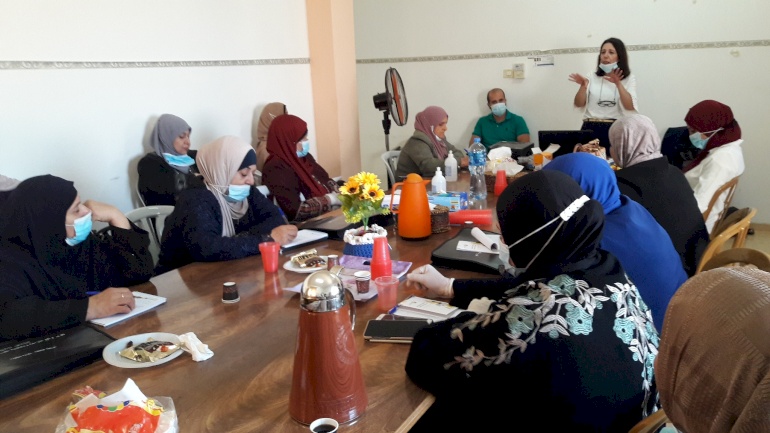
Ramallah – In collaboration with the Palestinian Initiative for the Promotion of Global Dialogue and Democracy (MIFTAH), the Coalition for Accountability and Integrity (AMAN) concluded an awareness raising event targeted at building the capacity of participants in accountability. In addition to introducing the concepts of integrity and fight against corruption, the event cast light on the impact of corruption on society at large, and on women in particular. The session brought together a group of feminist members of local government units (LGUs), representatives of civil society organisations and community institutions, and young activists from across the governorate of Tulkarem.
The awareness raising event is part of the efforts made by AMAN to strengthen the system of integrity and fight against corruption. As women are the most affected by corruption, highlighted the protection of women’s rights against the consequences of corruption. A special focus was placed on raising women’s awareness of the concept and various forms of corruption, including favouritism, nepotism, bribery, extortion, money laundering, conflict of interests, embezzlement and waste of public funds. A review included the systems, indicators and mechanisms of accountability, outlining those applicable at LGUS.
At the end of the session, participants stressed the need that AMAN continue to organise awareness raising events on the concepts and means of combating corruption. Participants also called on the Palestinian leadership and government to uncover corruption crimes and bring the full force of the law to bear on the perpetrators of crimes against women. Significant as it is, law enforcement builds up public conviction of recourse to the law in all their day-to-day activities.
Participants further highlighted the need to expose corruption cases on media outlets. Rather than keeping them secret, public option will be mobilised for these cases. According to participants, persistence of different forms of corruption threatens development in Palestine as well as women’s needs and priorities of educational, health, economic, and social services. The emphasised that zero tolerance should be adopted towards perpetrators of corruption crimes, including powerful public figures.