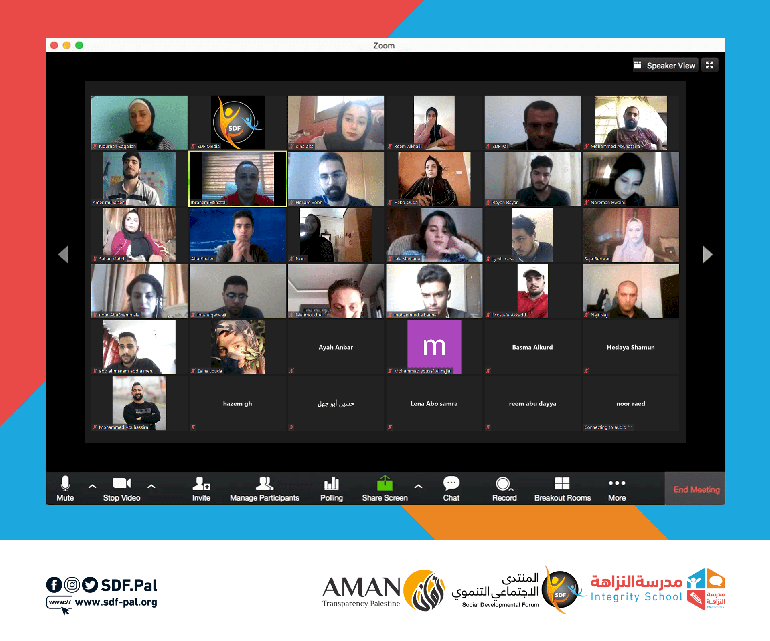
Gaza- Despite the closure of the Gaza Strip in order to prevent the spread of the Coronavirus (Coved-19) in addition to other difficulties encountered by Palestinians living in the Gaza Strip, one of which is the continuous daily power outage, 60 young men and women aged 18-29 have concluded the Virtual Integrity School for 2020. Activities and events were conducted via social media over four consecutive days, from the 21st to 24th of September, which constituted a new and different approach from the familiar.
Activities of the Integrity School focused on introducing the young generation to the concept of corruption, its causes and consequences. This stemmed from our belief that all citizens, first and foremost the youth, must be involved in the fight against corruption. For this to happen, young people must be armed with knowledge and information that would prevent them from becoming involved in acts of corruption with all its forms. The goal is to build a broad anti-corruption populace base that is active in promoting integrity through all means including oversight and community accountability activities concerning performance and management of public affairs. We also aim to build a strong anti-corruption culture that is rich in values of integrity, principles of transparency and social accountability systems.
Activities of the program included training in the various forms of corruption, through a review of some examples, including favoritism, nepotism, wasta, embezzlement, waste of public money, etc. Activities also introduced participants to the concept, pillars and tools of community accountability as well as methods of planning for the management of similar accountability sessions. With this in mind, participants were expected to develop a number of initiatives and accountability sessions slot titles to be implemented later, with focus on information-seeking methodologies to ensure documntation credibility by using information taken from official and reliable sources. The exercises also included a presentation of Palestine's results of the Corruption Perceptions Index (CPI), by highlighting ways and mechanisms to combat corruption. The training also focused on the role of young people in detecting suspicious acts of corruption through the various reporting tools, as well as on improving their applied skills in analysing the impact of corruption on the types and quality of services, plans and programs provided by state institutions to young people.
At the end of the training course, participants were able to define titles and broad outlines of issues affecting the youth sector,which were adopted and developed in the form of community accountability sessions. These sessions are planned to be carried out by holding a national accountability day in the various areas of the Gaza Strip, where knowledge, skills, media tools and use of community outreach platforms will be utilized to achieve the desired impact.
In conclusion, in order to create a community movement that rejects corruption and is able to promote integrity and build a system at the national level that is based on knowledge and awareness, it is vital to recognize the importance of investing in the youth sector by involving them in the anti-corruption and community accountability efforts. This is especially important since they are the largest and most affected sector in society, and hence are able to make the most difference in this regard. To also unify community efforts by investing in the expertise and tools of partner institutions with the purpose of pressuring for change. At the same time it is equaly important to work on enhancing these institutions’ oversight role through having integrate values of integrity, anti-corruption systems and tools in their work strategies, programmes, procedures and regulations, which will contribute to the creation of the anti-corruption movement desired.