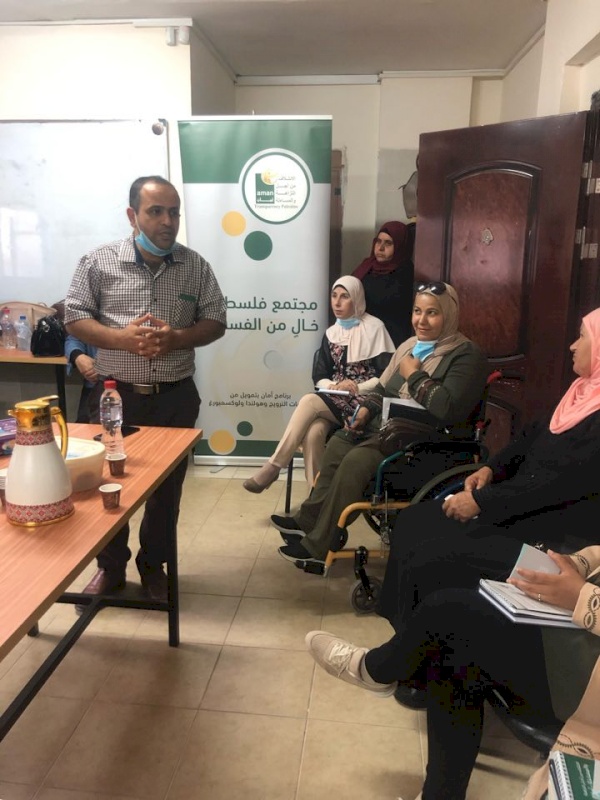
Engaging 64 trainees from Jenin, Tubas, Tulkarem and Nablus,
Ramallah – The Coalition for Accountability and Integrity (AMAN) concluded four awareness raising sessions, which targeted persons with disabilities (PWDs) and their families. These events were designed to raise community awareness about the concept, impact, and ways to combat corruption. Bringing together 64 trainees, the training sessions were held in the governorates of Jenin, Tulkarem, Tubas, and Nablus.
These meetings are part and parcel of AMAN’s vision and role in strengthening the integrity system, anticorruption effort, and protection of the rights of PWDs against the consequences of corruption. Of all groups of society, PWDs are the most seriously affected by corruption. AMAN cooperated with the Palestinian Medical Relief Society (PMRS), which runs a community rehabilitation programme with a particular focus on defending the rights of PWDs. Besides awareness raising, the PMRS programme rehabilitates PWDs to re-integrate into and have an influence on society.
Trainees recommended that more time be allotted to similar training sessions. A series of training events should be developed to promote empowerment and provide awareness raising to PWDs on their rights. In addition to corruption cases, this activity will enhance PWDs’ knowledge of integrity, transparency, and community accountability. PWDs also recommended that a handbook on the rights of PWDs be compiled in Braille. This publication will provide an overview of conventions and rights relating to the forms of corruption and complaint mechanisms.
To combat corruption, trainees stressed the need to raise awareness of complaint mechanisms and to improve integrity and community accountability, particularly among PWDs and their families. To this avail, specialised trainings will address corruption cases and day-to-day domestic challenges that face PWDs, particularly in remote areas such as villages and refugee camps. PWDs called on decision makers to pay attention to and provide capacity building to PWDs so that they are more capable and aware of ways to express their opinions, present their stories on social media platforms and the internet, and be more open to and have a bearing on community issues.
Trainees demanded that decision makers, including heads of local government units and disability organisations, bear their responsibilities. These should exercise pressure on the government to fulfil PWDs’ just demands in line with human rights conventions and treaties.
In a similar vein, trainees called on public institutions to align workplaces to the needs of PWDs with a view to increasing the employment of competent and experienced PWDs. In particular, they called the Police to integrate PWDs in policing operations, particularly in clerical work such as technology, law, administration, etc.
In each session, trainees were introduced to the difference between rights and services delivered to PWDs. Reference was made to the rights of PWDs under relevant conventions. In addition to crucial knowledge about rights, significant information was presented to empower PWDs to exercise the right to hold accountable duty bearers for their legally enshrined rights and issues in tandem with relevant conventions.
The training provided a thorough overview the importance and role of PWDs’ representative boards and PWD laws. It made clear the concepts of corruption in issues of PWDs, employment fraud, compulsory costs. The training also included a presentation on complaint mechanisms at AMAN and the Independent Commission for Human Rights. The presentation involved an analysis of several cases and issues on which complaints were filed.