Challenges facing the security sector, requires policy solutions
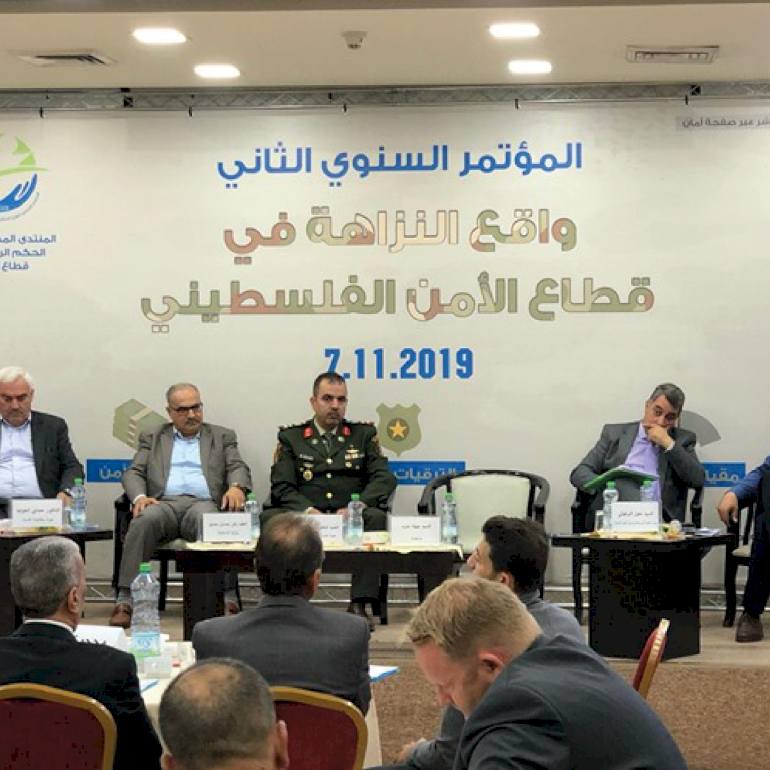
Ramallah- For the second consecutive time, the Civil Forum to Promote Good Governance in the Security Sector organized its second annual conference, themed “the state of integrity in the Palestinian security sector”, to present for the first time the findings of the Integrity Index of the Palestinian Security Sector 2019. The Index was developed by the Forum with contribution from local experts to provide periodic description of the state of the integrity in the security sector in Palestine. The Integrity Index had an overall score of 55%, with classification as intermediate. The absence of the legislative sector and its oversight role over security bodies undermined the Index score. This is a sign of increased risk and gaps and high probability of corruption. The situation requires immunizing the security sector.
The meeting discussed important issues including the allocations to the security sector on the Palestinian public budget and disbursement of salaries to security staff. It concluded actionable recommendations for the Palestinian government to apply professional standard to promote the system of integrity, transparency and effective accountability of the security sector.
Active participation of security sector
The security sector participated openly from different administrative levels and engaged in dialogue with the civil society. Majdi Abu Zeid, the Executive Director of the Coalition for Integrity and Accountability – AMAN and the Executive Secretariat of the Civil Forum, commended the cooperation of the security sector, especially with the advent of the new government. He recalled the instructions issued recently by the head of government/ Minister of Interior, His Excellency, Mohammad Ishtayyah, who values civil society organizations and considers them a fundamental partner to promote resilience and rebuild trust between citizens and their public institutions.
In his intervention, Abu Zeid reiterated AMAN’s claim to the Prime Minister to enact the Law on Access to Information, since it presents the cornerstone and starting point to enhance integrity and combat corruption. It is the genuine expression of a serious political will, committed to building partnerships and acting in professionalism and transparency while being subject to accountability. He called upon the Palestinian security sector to explain its position vis-á-vis the Law on Access to Information to be acquitted of the charges that they delayed its enactment.
Yousef Harb: A civil sector e-platform … to be launched next March
In his speech, Mr. Yousef Harb, the Deputy Interior Minister, welcomed the recommendations of the conference and stressed that they will be submitted to Palestinian decision-makers. He commended the positive environment created by the sitting government. Harb also announced that the Ministry of Interior will launched three months ago an interactive 24/7 e-platform. He explained that the technical teams receive around one thousand calls a month and follow up on inquiries from the civil and security sector. He also announced the Ministry’s intention to launch a cyber-window for the civil sector next March. The window will enable citizens to review the services provided by the civil society organizations, classified as per their specializations. Furthermore, the Ministry will open district offices to serve Palestinian citizens in the Jordan Valley, Rafidia-Nablus and Birzeit.
Researcher Jehad Harb presented the findings of the Integrity Index of the Palestinian security sector. He explained that the index uses eighty indicators to calculate the scores. The indicators are divided into two sectors: regulatory and policy sector and practice sector. They are also categorized into three pillars: principles of transparency, systems of accountability and values of integrity. The three pillars cover five areas relevant to the activity of the security sector: political administration, which received a very low score, security sector budget, which received a low score, procurement and bidding, and appointments and conduct of staff, which received advanced scores. Meanwhile, intelligence services received a very low score.
Two key challenges facing the integrity system: Paralysis of the Legislative Council and weak practices
The major challenge according to the Index lies in two areas: weak oversight over the intelligence services and weak political will. The situation stems mainly form the absence of the legislative council, which affected largely the scores on the Integrity Index of the security sector. On another level, the regulatory framework received an advanced score compared to the low score attained by the practice level, with a difference of 30 points. Although there is clear lack of legislation, including regulations to oversee intelligence services, and clear lack of mechanisms to assess if the candidates nominated to senior positions in the security sector are fit for the positions. Furthermore, the Law on Access to Information was not promulgated, as well as the governmental system of classification of documents to specify how to deal with security and governmental information and documents, as well as the delay before dissemination. However, the key challenge in the integrity system lies in the practice.
Weak transparency indicators reveal poor communication with citizens, including conducting regular consultations with the public about the policy of the security sector and its security strategy. Moreover, officials in charge do not publish periodic report to monitor compliance within the annual reports of security organizations. There isn’t sufficient information to fulfill requests from citizens, media, or civil society about the budget of the security sector in a timely manner.
Recommendation to organize general elections and establish a national security council
The Index formulated a number of recommendations, mainly promulgation of a decree to set the date of general elections and enable citizens to elect their representatives to the political institutions. Additionally, it is necessary to re-establish the national security council to oversee and control the policies, administration and budgets of the intelligence services.
The Council of Ministers needs to establish a “committee of quality of governance in the public sector, with members who have expertise and integrity to review the nominations to senior (civil and security) posts. It further needs to create a risk-management unit for the security sector and revisit the challenging environment that triggers corruption in the security sector. It also needs to expand its regular consultations with the public on the policy of the security sector and its security strategy. Additionally, it should publish annual reports and expand the relationship between the security sector and civil society. The compliance and internal control units in the security sector need capacity building and qualified human resources as well las sufficient funding in addition to clear declared standards on appointment of security staff. Transparency in procurement needs to be enhanced as well.
Colonel Ihasan Hamayel form the Ministry of Interior commended the Integrity Index report and underlined its value to help the security sector adopt quality standards and overcome its weaknesses. Hamayel also welcomed partnership and opening to the civil society.
Dr. Hamdi Al-Khawaja, from the Anti-Corruption Commission listed the studies required to address the system of integrity in state institutions and apply the integrity index thereto. He reiterated involvement of stakeholders and underlined the importance of transparency to promote citizens’ trust in state institutions, mainly the security sector.
In his presentation, Mr. Shawan Jabareen, Director of Al-Haq Institute, commented on the omission by the Index of abuse of power by the security entities and it negative repercussions on human rights. He addressed abstention by a security organ to enforce a court decision to release a citizen, which may be classified as corruption.
Increasing spending on the security sector means less for education, health and social care
The second session shed light on the report on financial management and budget of the security sector, with its allocations on the public budget. It also addressed financial control on spending of the security sector since it represents the key tools of financial planning and the main instrument to identify government goals, policies, programs and use and distribution of its resources.
The report showed that the security sector received the largest allocations, which affects spending on other service and developmental sectors like education, health and social care.
83.5% of current budget of the security sector spent on salaries
The report showed the decrease in budget allocations to the security sector in 2018, compared to previous years, stating it was the least thus far. It also revealed an improvement in the distribution of allocations to different sectors on the public budget. However, the main reason behind this drop in spending is attributed to the voluntary and forced early retirement policy, which affected 11,055 military staff according to budget figures of 2018. There is no indication of rationalization of expenditure in other expenses in the security sector.
Budget of the security sector (current and developmental expenses) represent about 21% of the total budget of the PNA. The current budget of the security sector reached 3.475 billion NIS in 2018, including 83.5% on salaries. The remaining budget covered operational cost (7.9%) and transformational cost (8.6%) and capital expenses (less than 1%).
A financial system needs to be issued by the Council of Ministers for the security sector
The report recommended that the Council of Ministers issued a financial system for the security sector to define the spending mechanisms and centers of responsibility. Or it can amend the existing 2005 financial system to take into consideration the specificity of the security entities. The Ministry of Finance must submit accurate figures in the public budget regarding the number of staff members and their distribution across the security organs. It should not be limited to the overall number. Furthermore, it is necessary to restructure the budget of the security sector to address structural flaws and enhance the efficiency of the security sector. It is necessary to review the number of staff members and develop recruitment policies while increasing operational and capital cost to cover needs and build safe capacities. The financial allocations and expenses of security and military organs must be clarified as the Ministry of Finance needs to identify the approved financial ceilings to promote planning of the security sector. It should segregate the central financial expenses from the expenses of the Ministry of Interior in the MoF monthly reports, as stipulated in the Budget Law. It should further pursue the financial reform of the security sector and devise clear and specific policies for every spending item, like internal missions (miscellaneous).
The session also discussed the distribution of military ranks in security sector and its impact. It further proposed solutions to address the problem and lower costs while restructuring the organizational structure on proper professional basis to promote their role in law enforcement and imposition of public order.
The report showed that 65.829 military staff members were employed by the Palestinian security forces in 2018, showing a reduction from previous years due to voluntary and forced retirement policy applied by the government affecting 18,000 military staff, mostly in the Gaza Strip.
A general salary is six times the salary of a soldier
On another level, the total monthly salaries of security staff reached 242 million NIS, 63% of them to ranks of officers from sergeant to colonel. There are many high-rank officers since the pay of a first lieutenant is twice the pay of a soldier, and the salary of a major is six times the salary of a soldier. A Brigadier general receives the salary of five soldiers and a brigadier receives four times the pay of a soldier. The numerous high-ranking officers is a direct reason behind the high salary bill.
Lack of regulations for the security service law till now
The paper recommended accurate application of the security service law regarding recruitment and qualifications for promotion. The same applies to the mandate of majors and the articles related to the termination of high-ranking officials according to the general pension law. A new organizational structure is needed for the security sector to fulfill the needs in every rank from top to the bottom of the hierarchy. The salaries of presidents of security entities with a major rank must be specified as well as for the other directorate general led by brigadiers. Regulations need to be issued to enforce the security service law and govern seconding to specialized training abroad to tailor it to the needs of all administrations of the security sector. The same applies to Al-Istaqlal Academy, which needs to respond to real security training needs and ranks in its courses.
Miscellaneous
In his intervention, Brigadier Ahmad Al-Othmani from the Organization and Administration Commission, denied the figures in the report and announced that a new promotion system has been in place since beginning 2019. It shall also apply criteria to promotions to levy the burden on high ranks.
Captain Mohammad Al-Madani from the Central Financial Administration, stated that the reduction in current expenditure is a positive indicator that the security budget is transferred to other developmental sectors.
The presentation by the State Administrative Audit and Control Bureau referred to poor closure of expenses in the security sector and lack of supporting evidence. There are now laws applicable to the security sectors and they do not have clear organizational structures linked to job descriptions.
Economic researcher, Dr. Nasser AbdelKareem, proposed a different vision about the size of the budget allocated to the security sector and called for expanding government spending to make it need-based with focus on quality of spending rather than rationalized numbers. Figures alone are meaningless. The solution starts by revisiting policies and regulations to change the budget, starting by restructure military ranks and link them to the benefits offered. He also called for focus on financial management rather than budget to scrutinize operational cost and enhance transparency, efficiency, professionalism, and accountability.
The Civil Forum for Promotion of Good Governance in the Security Sector< submits recommendations to official organizations to inform their polcies.