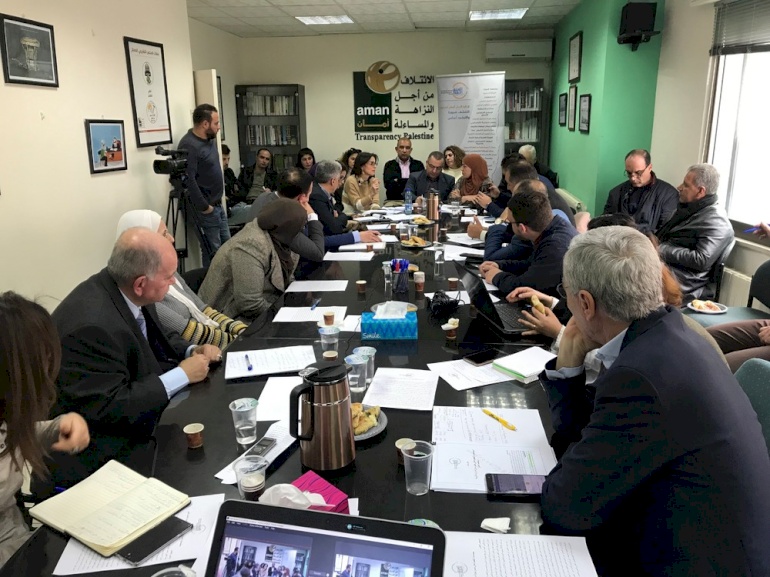
Ramallah – Amid a growing financial crisis and problematic transfers of budgetary allocations to Palestinian universities, the Civil Society Team for Enhancing Public Budget Transparency discussed its draft report, titled Higher Education Allocations in the Ministry of Education and Higher Education’s Budget. In the discussion session, participants raised a core question: What is the actual percentage of expenditure on Palestinian universities from budgetary allocation of the Higher Education Programme. Of 22 percent (US$ 86,310,000) designated for the education sector, almost 8 percent is earmarked for the Higher Education Programme.
In addition to clear fluctuations in budgetary allocations to governmental universities, transfer criteria, which were approved more than 20 years ago, are not transparent. Mostly representatives of universities, participants in the discussion demanded that the Ministry of Education and Higher Education (MoEHE) adopt clear, timely upgraded and informed criteria to distribute budgetary allocations to Palestinian universities. In partnership with relevant bodies, the process will ensure fair distribution to all universities, while at the same time catering for quality higher education and qualifications. This will be based on identifying tuition fees according to standard credit hours in various university programmes, taking account of the national priority of each programme and labour market needs.
University representatives coincided that higher education appropriations, if any, were inadequate. These fall short of university needs and development plans. In particular, participants highlighted the problem caused by irregular transfers of budgetary allocations. In the session, some representatives stated that relevant universities did not receive any budgeted amounts in 2018. Others asserted that their universities did not have any amounts over the past few years.
Discussants agreed that education should be the focus of attention insomuch as it is a right for all and a national priority. They demanded that the MoEHE review the goals of higher education and set achievable priorities for years to come. This will be in compliance with Goal 4 of the Sustainable Development Goals (SDGs) 2030: “Ensure inclusive and equitable quality education and promote lifelong learning opportunities for all.” It will also be consistent with National Priority 8 of the National Policy Agenda 2017-2022, namely, Quality Education for All. Participants called on the government, MoEHE and Ministry of Finance and Planning to abide by transferring university appropriations on a regular basis.
Ms. Amal Hammad, Chair of the MoEHE Planning Department, explained that the Higher Education Programme’s share of the 2019 public budget was US$ 89 million. This is evidence that the MoEHE has established the Higher Education Programme as a public budget line item. However, this figure has not been approved yet. So far and for the 51st day in a row, the government has not published the 2019 public budget. Hammad also indicated that the MoEHE ensured a balanced distribution of expenditure priorities in line with available financial resources. According to Hammad, this is because the Ministry runs seven programmes, including higher education.
Despite positive developments in the Higher Education Programme’s budgeted allocations, both governmental and nongovernmental Palestinian universities need much more. Budgetary appropriations are insufficient for universities. These do not cover strategic planning needs and requirements of universities and relevant programmes, including scientific research. For the latter, the MoEHE has allocated NIS 1.7 million to each university. However, this initiative needs to be supported and maintained in order to develop scientific research in Palestine. Also, mechanisms should be developed to promote private sector participation in funding, and using outputs of, scientific research.
Mr. Hashem Thweib, representative of Al-Quds University, highlighted support of education process in Jerusalem. As at the time of reporting, the remaining amount of the 10 percent appropriations earmarked for supporting higher education in Jerusalem has not been disbursed. Meantime, budgeted amounts of primary and secondary education were already transferred. According to Thweib, Al-Quds University did not receive any amounts at all in 2018. The university cannot resolve its crisis by raising the price of credit hours in light of widespread high cost of living in Palestinian society.
Mr. Amjad Barham, representative of the Palestine Polytechnic University, said that no development budgets have been disbursed to the university in 2018. Barham highlighted that the Lending Fund was declared bankrupt, imposing an additional burden to both the university and the students. This situation runs count to the principle of Education for All. In this context, participants called for separating school education from higher education. The latter should not be managed or planned on a centralised basis. Management and planning need to be an outcome of a collective effort made by relevant agencies.
Dr. Issam Khalil, representative of Al-Quds Open University, stressed that the causes of university financial crisis need to be laid out and examined with a view to finding a common solution. Khalil indicated that some causes are beyond universities’ control. For example, the difference in exchange rates amounted to JD 7 million over the past five years. The Ministerial Committee obliged universities to fix JD exchange rate at NIS 5.5. Universities were promised to make up the difference and cover the deficit, which did not in fact happen. Khalil also cited falling currency, decreasing actual value of the price of credit hours.
Mervat Bulbul, representative of Birzeit University, highlighted the unclear vision of the Higher Education Council. Inexistent private universities are currently represented by the council. In addition to lacking a real dialogue between universities, higher education is being privatised.
Dr. Hisham Kuheil stressed that planning at the MoEHE, universities and relevant bodies should be informed by a participatory approach, built on scientific grounds, and representative of society from across the spectrum. The planning process should be guided to maintain public interest, first and foremost the student community.
Dr. Issam Khalil, Vice President of Al-Quds Open University for Financial and Administrative Affairs, spoke of university shares of government support. According to Khalil, although it accommodates almost 40 percent of Palestinian university students, Al-Quds Open University’s share of government support is just 4 percent of the amount earmarked to all Palestinian universities. Demanding that it be reconsidered, Khalil asserted that this distribution was unfair and prejudicial to Al-Quds Open University.
Dr. Mu’tassem Abu Daqqah, Director of the Institutional Research Unit at Birzeit University, indicated that Birzeit University’s share of the budgeted appropriations of higher education was 8 percent. Dr. Youil Anastas, Vice President of Bethlehem University for Financial Affairs, said that Bethlehem University accounted for 3.2 percent of the amounts budgeted for Palestinian universities.