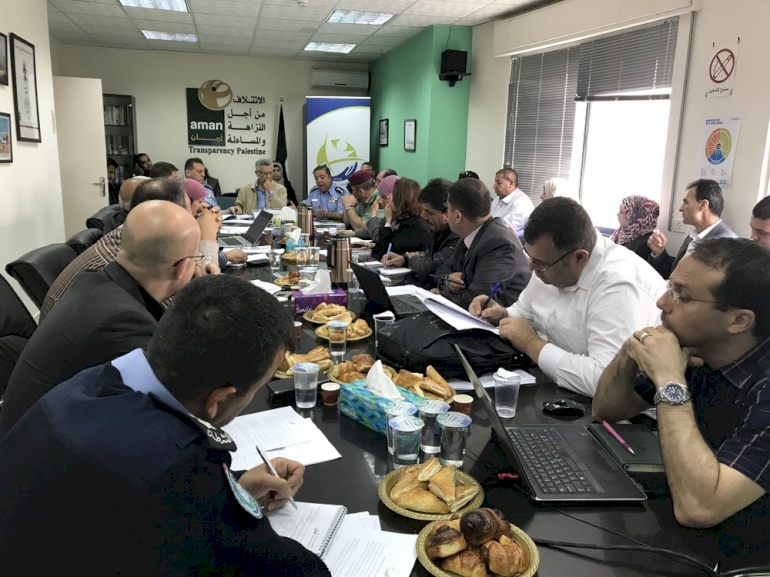
During a Meeting on Police Strategy 2017-2022 Organized by the "Civil Society Forum for Enhancing Good Governance in Security Sector"
The Civil Society Forum for Enhancing Good Governance in the Security Sector and the Palestinian Police Force have announced the launching of partnership between the Forum and the police force. The announcement was concluded at a hearing held by the Forum at AMAN Coalition headquarters (Forum’s Secretariat) on the "Palestinian Police Strategy 2017-2022". The meeting was attended by Brigadier General Ibrahim Abu Laban, the Assistant of Chief of Police for Planning and Development, Brigadier General Iyad Shtayyeh, Director of Research, Planning and Development Department and a number of civil society organizations, public institutions and security forces.
At the beginning of the meeting, Dr. Azmi Shuaibi from the Forum’s Secretariat said that the forum seeks to enhance cooperative and integral work with the security sector, especially the Palestinian police force, which is considered in accordance with law as a “regular civil force" and it is the closest and most interactive with the Palestinian citizens. The Forum, through this meeting, has aimed at being introduced to the axes of the new strategy in cooperation with the police force, its objectives, follow-up and implementation mechanisms of these objectives in accordance with the principles of good governance and social accountability and preserving rights and freedoms. Shuaibi has also highlighted the importance of developing a participatory plan that ensures the important role of civil society organizations and representatives of different sectors in contributing to the development and elaboration of this strategy as well as the monitoring and accountability in the strategy post-adoption phase.
In his speech, Brigadier General Ibrahim Abu Ein has emphasized the importance of involving all civil society components in the strategic planning of the police force and implementing the strategy to achieve the adopted objectives based on the police force vision towards enhancing and developing the communication and openness between the civil society and the police force. Abu Ein pointed to the rising challenges facing the police in terms of setting its plans and achieving its tasks. He also welcomed the participation of civil society organization and citizens in evaluating and monitoring the strategy and the performance of the police, stressing the importance of strengthening the civil character of the police force and as a force for citizens.
Over presenting the strategy and its axes, represented by four main objectives, namely: enhancing security and safety, institutional development, resource development and providing high quality police services, Brigadier General Iyad Shatayyeh has stressed that the strategy was based on building partnerships with citizens as the real partners in maintaining the security of the country. He said that the police force aspires to build advanced and developed community policing, which gains the confidence and trust of its citizens and affiliates.
Shtayyeh added that the strategic plan was prepared this time through a different methodology, especially that the objectives were assigned to the Chief of Police assistants as owners of these objectives as well as through forming ad hoc committees and teams to follow up the enforcement of each of the strategy objectives. The plan also included a follow-up and evaluation mechanism, and the teams and responsibilities were set to be in line with the values of the institution that that applies accountability and transparency as one of the most important pillars and at most senior levels of the police force. Shatyyeh also pointing out that the most important challenges faced the team of strategy development were the lack of real indicators to be adopted in the planning. He also pointed out the challenges related to financial and human resources and the expansion of the organizational structure, in addition to the external challenges associated with the occupation and the police access to all West Bank areas, specifically area (C).
Dr. Omar Rahal, Coordinator of the Forum, pointed out that the participation of civil society and partner organizations was not properly reflected in the planning process and that the plans enforcement process necessarily requires engaging all community sectors and segments. The participants also raised several remarks on the priorities and challenges related to police performance and achievements as well as the importance of activating the right of access to information, especially on public opinion issues. The participants also recommended to allow civil society organizations and specialists to widely discuss the strategy and the executive plans. They also discussed the importance of reviewing the Police Law to include the principles of respecting the human rights. There are other recommendations made by the participants that focused on awareness- raising, maintaining a continuous process and necessary cooperation between all parties in the enforcement of the strategy, including the judiciary, which is the basis for the strategy enforcement.
For his part, Brigadier General. Abu Ain stressed the need to proceed in the discussion and to strengthen the relationship between civil society and the police force which shall be followed by activities at all levels and governorates, so that the planning and review process will be continuous and feasible. By the end of the meeting, the secretariat of the Forum and representatives of the Police leadership have announced the implementation of joint activities, including the development of a citizen’s manual on police services and implementing expanded workshops in all governorates.
The two sides also agreed, at the end of the meeting, to keep on their partnership approach, which will focus on raising citizens' awareness on the police services and setting remarks on the police strategic plan 2017-2022 as well as holding joint meetings and hearings between the police force and citizens in all country governorates.