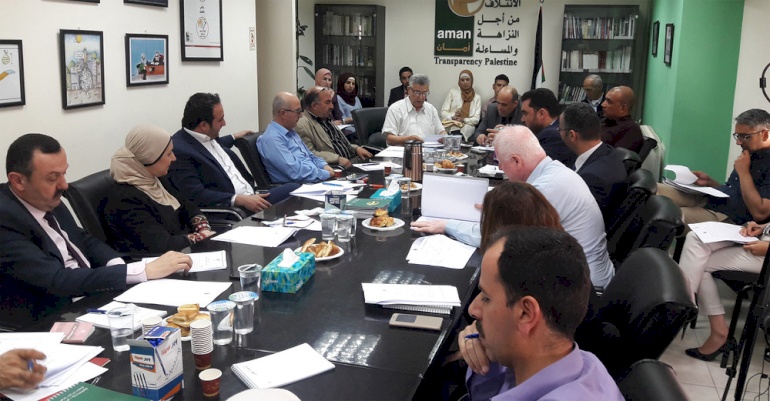
The meeting held by the Coalition for Integrity and Accountability (AMAN) on a Draft Amended Decree Law of Public Retirement Law No. (7) of 2005, which is being recently discussed by the Council of Ministers in preparation for its issuance, recommended that the Palestinian government should be careful in any amendments it may make to the Public Retirement Law that may lead to conflicts of interest.
The meeting, attended by representatives of governmental and non-governmental organizations in various sectors as well as representatives of civil society organizations, trade unions and retirees’ committees, stressed the importance of opening a thorough discussion of the draft amendments, specifically on the allegedly proposed articles. Such amendments are being in the making without any societal discussions and without any consideration for those who are primarily affected by the law who represent the vast majority of public sector employees.
During the panel opening and moderating, Advisor of AMAN Coalition’s Board of Directors, Dr. Azmi Shuaibi, has stressed the importance of making amendments to the Public Retirement Law which would contribute to organizing the Palestinian Pension Authority work, enhancing the Pension Fund sustainability and ensuring its guarantor. Shuaibi highlighted the importance of avoiding the adoption of any amendments to the aforesaid law that are related to the salaries of the Prime Minister, Ministers or even the Head of the Pension Authority as such amendments fall within the cases of conflict of interest and they constitute a relevant legislative violation since modifying the salaries of ministers and prime minister must be stated in another law.
The participants in the meeting raised a number of remarks on the articles of the draft law, the most prominent of which is the mechanism to be followed in adopting any amendments that affect public retirement. The attendees unanimously agreed that it is necessary to have a feasibility study, develop the amendments financial and economic impact document as well as publishing the explanatory memo that explains those amendments and answers the questions about the purpose of modifying the pension benefits of the Head of Pension Authority and the actual- non-retirement- benefits of the Prime Minister and Ministers.
The participants also stressed the necessary engagement of public servants in discussing any amendments to the public retirement regulations in light of recent amendments and decisions that affected public officials. Participants indicated that it is necessary to re-activate the legislative plan, develop the legislations within a specific time frame in all sectors and to make amendments to retirement laws based on dialogue and discussion between the government and employees with emphasis on the importance of engaging civil society organizations, the private sector and all stakeholders in all issued legislations.
The participants talked about discrimination between the security sector employees and civil servants in terms of pensions and calculation transactions. The participants also stressed the need to study the articles that stipulate the decease of the employee and the salary inheritance especially that these benefits are the contribution of the employee. On the other hand, some participants said that the amendment to the salaries the Council of Ministers members is also part of the discrimination policy that is out of time and place. They also pointed out that it is necessary to motivate the employees and improve their salaries, especially in light of continuous rise in the standard of living. Representatives of the Retired Teachers Committee have raised the issue of former retirees and the need to consider them in fair amendments to address their situation and not to exclude them.