Calls to Amend the Cybercrime Law to Safeguard Privacy and Freedom of Opinion and Expression and Regulate Search and Blocking Powers
AMAN Discusses the Impact of the Cybercrime Law on Civic Space in Palestine
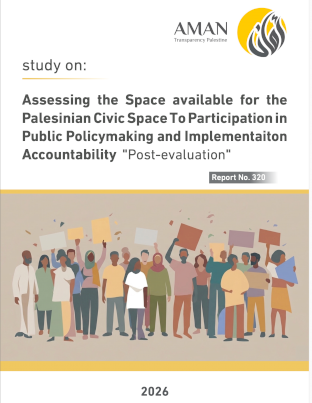
Ramallah - The Coalition for Integrity and Accountability (AMAN) held a discussion session on a research paper entitled “Law by Decree No. 10 of 2018 on Cybercrime, as amended, and Its Impact on Civic Space in Palestine.” The session examined the main issues arising from the law’s application and its implications for privacy, freedom of opinion and expression, and civic action, with representatives of official institutions, civil society organizations, human rights organizations, and relevant media organizations in attendance.
Participants stressed the importance of effective legislation to combat cybercrime while also providing clear safeguards to prevent its use to restrict freedom of opinion and expression or broaden powers of search, surveillance, and blocking. They called for vague provisions to be reviewed, judicial oversight to be strengthened, and personal data and journalists’ sources to be protected.

Balancing the Fight Against Cybercrime with the Protection of Civic Space
AMAN Executive Director Issam Haj Hussein noted that the rapid development of information and communications technology and artificial intelligence has created broad opportunities for communication, participation, and access to information. At the same time, however, it has created new challenges related to cybercrime, the misuse of modern technologies, and threats to privacy and digital security.
He stressed the importance of developing legislation to keep pace with these changes and close legal gaps, while maintaining a balance between combating cybercrime and protecting freedom of opinion and expression and the right to criticize and seek accountability. This balance is essential to ensure that laws governing the digital space do not become tools for restricting civic space.
Haj Hussein said AMAN has directly experienced the impact of the Cybercrime Law on the space available for civil society work, citing the case filed against the Coalition over its reporting on the laundering and passing off of settlement-produced dates, which was brought under the Cybercrime Law.
He emphasized that the law should be applied in a way that protects society from cybercrime without limiting civil society organizations’ ability to perform their role in oversight and accountability and to expose matters of public interest.

Vague Provisions and Broad Discretionary Powers
Researcher Anan Jabeiti presented the main findings of the research paper, which examined the evolution of the digital environment and its impact on civic participation and freedom of opinion and expression, as well as the challenges associated with combating cybercrime and protecting privacy, rights, and public freedoms.
The paper noted that digital transformation has made the online space a central arena for civic participation, expression, and oversight activities. This makes it necessary to establish legislative frameworks that balance digital security requirements with the protection of rights and freedoms.
The paper identified problems in several provisions of the Law by Decree, including the use of broad terms such as “public order” and “civil peace,” which, according to the paper, leave considerable room for discretion in applying the law.
It also identified concerns relating to fair-trial guarantees, privacy, communications surveillance, data retention, and website blocking, as well as the absence of comprehensive legislation protecting personal data.
The paper warned that prosecuting activists and citizens for online expression may create a climate of self-censorship, affecting the ability of civil society and the public to exercise oversight and hold decision-makers accountable on issues involving corruption and the management of public affairs.

Strengthening Judicial Oversight and Protecting Data and Privacy
The paper called on the Council of Ministers and the Ministry of Justice to align Law by Decree No. 10 of 2018 on Cybercrime, as amended, with international conventions and standards relating to freedom of opinion and expression, media freedoms, digital rights, and the right to privacy.
Its recommendations included reconsidering a number of provisions of the Law by Decree, strengthening judicial oversight of access to data, digital searches, and communications surveillance, and clearly defining the scope and duration of surveillance and data-preservation measures.
The paper also recommended protecting data unrelated to an alleged offense, particularly data belonging to journalists and human rights defenders; prohibiting general or blanket surveillance orders; providing safeguards for legal challenge and judicial review; and reconsidering provisions relating to publication offenses and freedom of opinion and expression.
It further called for a review of mechanisms for blocking websites and media and human rights platforms, and for building the capacity of civil society organizations in digital security, monitoring, documentation, and legal advocacy.

Government Amendments to the Law and Continued Consultation with Civil Society
Areej Alsheikh, Legal Advisor at the Ministry of Justice, said the Ministry is working to amend the Cybercrime Law at the direction of the Council of Ministers and as part of the reform process. She stressed that the Ministry is open to making the necessary amendments and correcting any provision that may violate rights or be open to abuse.
She said the Ministry is seeking to draft clear provisions that leave no room for ambiguous interpretation and that strike a balance between protecting rights and freedoms and meeting the operational requirements of public authorities, while ensuring that the law is aligned with relevant legislation and international conventions.
She added that the Ministry has received comments and proposed amendments from a broad range of civil society actors, and that work on the current draft has taken place within this consultative process with the aim of reaching a clearer and more broadly agreed law.

Limiting Search and Investigation Powers
Lawyer Firas Karajeh said the need for a cybercrime law must be accompanied by a clear objective of protecting individuals and citizens rather than restricting their freedoms. He noted that journalists have, in some cases, faced legal proceedings under the Cybercrime Law.
He stressed that law-enforcement and investigative actions should be limited to bodies legally authorized to carry them out. Searching phones and other private devices, he said, interferes with privacy and must therefore be subject to clear legal safeguards and authorizations, in accordance with the principles of necessity and proportionality.

The Need for a Precise Definition of Cybercrime
Uhoud Mraqtan, Public Policies Officer at MIFTAH, said civil society organizations had participated in extensive discussions on the law and prepared comments and proposed amendments that were discussed with the Ministry of Justice and the Palestinian Anti-Corruption Commission. She called for the points agreed upon through those discussions to be incorporated into the final version.
She warned that combining cybercrime offenses with telecommunications and information offenses without a precise definition could broaden the scope of criminalization. The mere use of an electronic medium for expression, she stressed, does not necessarily mean that the act constitutes a cybercrime.
She also emphasized the importance of protecting privacy, restricting judicial police powers in cybercrime cases to the Palestinian Civil Police, and clearly identifying the bodies authorized to exercise those powers.

Blocking and Searches Require Effective Judicial Oversight
Ammar Jamous, Legal Researcher at the Independent Commission for Human Rights (ICHR), said that assigning judicial police powers exclusively to the police under the draft amended law is an important step, but does not address all of the concerns raised about the law, particularly those relating to privacy and searches.
He warned against allowing searches of electronic devices to shift from seeking evidence of a specific offense to searching for possible offenses, which would undermine safeguards relating to privacy, surveillance, and searches.
He also argued that blocking websites should not become a form of punishment imposed before a final judicial ruling. He called for stronger judicial oversight of search and blocking procedures and warned against expanding the concept of cybercrime to cover every act committed using an electronic medium.

Protecting Journalists’ Sources and Personal Data
Journalist Fatima Abdel Karim expressed concern about certain aspects of the Cybercrime Law, particularly the protection of journalists’ sources. She said that expanding powers to require disclosure of sources could adversely affect journalism and pluralism.
Ahmad Qadi, Monitoring and Documentation Manager at 7amleh - The Arab Center for the Advancement of Social Media, pointed to a growing number of cases involving defamation, account hacking, and online extortion, particularly cases targeting women journalists and activists.
He stressed that evaluating the law should not be limited to the wording of its provisions, but should also examine how it is applied and the results it has produced. He also emphasized the importance of protecting personal data and developing the technical capacities required to address cybercrime.

Evaluating the Law in Light of Practical Experience
Majed Al-Arouri, Executive Director of the Civil Commission for the Independence of the Judiciary and the Rule of Law (ISTIQLAL), stressed the importance of assessing the impact of the Cybercrime Law and the safeguards it provides based on practical experience since its implementation began.
He called for offenses to be classified according to their nature and the act committed, rather than solely according to the means used to commit them, so that the penalty corresponds to the nature of the offense itself. He also called for the required amendments to be determined on the basis of facts and practical experience in order to strike a balance between combating crime and protecting public freedoms.

Review the Substance of the Law, Not Just Make Cosmetic Amendments
At the close of the session, Dr. Azmi Al-Shuaibi, Advisor to AMAN’s Board of Directors for Anti-Corruption Affairs, stressed that reviewing the Cybercrime Law should not be limited to cosmetic amendments, but should address the core problems revealed by practical experience, particularly those relating to searches, blocking, and the protection of privacy.
He warned against broadening the definition of cybercrime simply because an electronic medium was used. Protecting privacy, rights, and freedoms, alongside combating genuine crimes in the digital space, he said, is essential to building trust in public institutions.