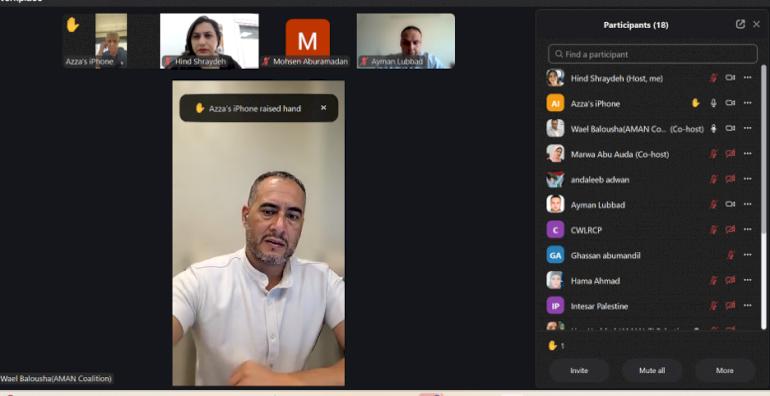
Following a discussion session on transparency and accountability in the relationship between nonprofit companies in the Gaza Strip and the government authorities responsible for overseeing them
AMAN Calls for a Standardized Procedures Manual and an Online Portal for Nonprofit Company Funding Applications Proposal Also Calls for a Network to Give Nonprofit Companies a Unified Voice Before Government Authorities
Ramallah/Gaza - The Coalition for Integrity and Accountability (AMAN) held a discussion session via Zoom on a draft research paper titled “Transparency and Accountability in the Relationship Between Nonprofit Companies in the Gaza Strip and the Government Authorities Responsible for Overseeing Them.” The paper examined the legislative framework and administrative procedures governing the work of these companies, as well as the key challenges they face, particularly under the current conditions in the Gaza Strip.
Opening the session, Wa’el Baalousha, Director of AMAN’s Gaza Office, explained that the paper aims to assess how the legal and administrative framework affects the operating environment for nonprofit companies and to identify gaps between legal provisions and their implementation in practice, as well as the implications of those gaps for transparency and accountability.
Multiple Authorities and Unclear Procedures
The paper concluded that the central challenge is not the principle of oversight of nonprofit companies itself, but rather the lack of clarity surrounding procedures and how they are applied. Clear procedures are essential to striking a balance between funding oversight requirements and the right of these companies to operate effectively and independently.
The paper found that approval requests must pass through multiple authorities, with no clear criteria or timelines for decisions. Combined with the absence of an effective mechanism for challenging rejections or delays, this makes the process less clear and predictable. These challenges are particularly acute for companies operating in the Gaza Strip because of the difficulty of communicating with the relevant authorities and following up on their applications.
A Standardized Procedures Manual and Unified Online Portal
The paper recommended developing a clear, publicly available procedures manual setting out the process for funding applications, the authorities responsible, decision-making timelines, and grievance mechanisms. It also recommended limiting the approval process to the authorities specified by law and ensuring that applications are not subject to additional approvals or referrals that are not legally required.
The paper also called for a review of the funding oversight system and reconsideration of the 25% cap on salaries and operating expenses as a share of a company’s total budget, taking into account the nature of human rights and research organizations. It further recommended establishing a unified online platform at the Ministry of National Economy that would allow companies to track the progress of their applications, identify the authority responsible, and see the reasons for any delays.
Calls for a Single Responsible Authority and Simpler Procedures
During the discussion, Zainab Al-Ghonaimi, Director of the Center for Women’s Legal Research and Consulting and Protection, said that the involvement of multiple authorities and procedures directly affects the ability of organizations in Gaza to follow up on their applications and secure funding. She stressed the need for a clear process through which the various approval stages can be tracked and the responsible authority identified.
Dr. Sabreen Abu Labda, representing the National Commission for the Independence of the Judiciary and the Rule of Law (Istiqlal), called for a procedures manual that clearly sets out approval timelines and procedures, along with the digitization of the approval process. She also called for a risk-based approach to oversight that safeguards the independence of nonprofit companies.
For his part, Mohsen Abu Ramadan, representing the Palestinian NGOs Network, called for designating a single government authority as the responsible body and reducing the number of approvals and procedures required, in order to protect the independence of civil society organizations and their oversight role. He also stressed the need for broader structural action to address restrictions on civil society work, preserve civic space, and strengthen the ability of civil society organizations to fulfill their oversight and human rights roles.
Economic researcher Ghassan Abu Mandil proposed forming a technical team to review a sample of company applications from the past 12 months and identify obstacles and response times. He also called for establishing a network of nonprofit companies that could speak with a unified voice in their dealings with government authorities.
Andaleeb Adwan, Director of the Community Media Center, also proposed appointing a representative of the Ministry of National Economy in the Gaza Strip to facilitate communication, follow up on applications, and expedite responses.
At the close of the session, Dr. Azmi Al-Shuaibi, Anti-Corruption Advisor to AMAN’s Board of Directors, stressed the importance of reaching practical solutions agreed upon by civil society organizations and government authorities, designating a single institutional authority, developing a clear and publicly available procedures manual, and enabling applications to be tracked electronically.
He also proposed holding a closed-door meeting bringing together AMAN, nonprofit companies in Gaza, the Ministry of National Economy, and a representative of the Palestinian NGOs Network to discuss the obstacles and agree on practical solutions that would mitigate their impact on the work of organizations and on citizens.