Position Paper
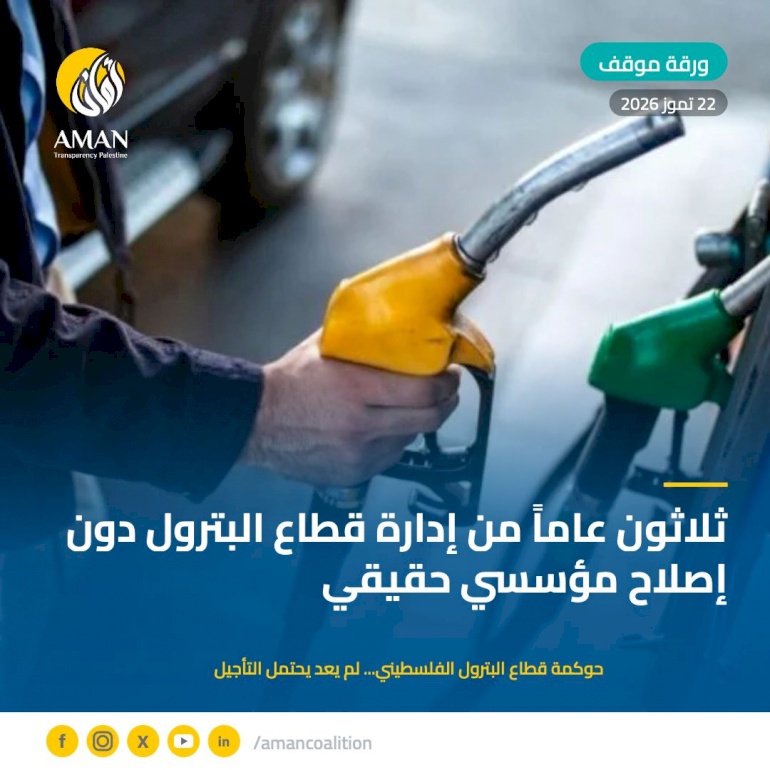
Governance of the Palestinian Petroleum Sector Can No Longer Be Delayed
The recent fuel crisis in the West Bank has once again exposed the fragility of the governance system overseeing the Palestinian petroleum sector. It has also brought long-neglected fundamental questions back to the forefront: How is this strategic sector managed? Who monitors its performance? Have successive governments established the institutional and legal framework necessary to protect public funds, safeguard energy security, and prevent the abuse of authority to advance private interests at the expense of the public good?
The Coalition for Integrity and Accountability (AMAN) believes that the disruption experienced in the Palestinian market should not be viewed merely as a crisis caused by temporary circumstances. Rather, it is the natural outcome of years of hesitation in establishing an effective governance system. This has delayed institutional reforms and allowed one of the most important economic sectors to remain under the administration of the Ministry of Finance, which combines policymaking, follow-up, oversight, and implementation functions. This model has failed to firmly establish the principles of transparency and accountability or ensure a clear separation between regulatory, executive, and oversight powers. This is precisely the central concern raised in AMAN’s reports over previous years.
The crisis has demonstrated that continuing to manage the petroleum sector using the same mechanisms that have governed it for decades is no longer acceptable. Reform is no longer an option, but a national imperative to protect public funds, prevent corruption in all its forms, including corruption within the private sector, and strengthen the resilience of the Palestinian economy.
Thirty Years of Managing the Petroleum Sector Without Genuine Institutional Reform
Since the establishment of the Palestinian National Authority, the petroleum sector has been managed for decades without a comprehensive legal framework. The Palestinian General Petroleum Corporation continued to exercise broad powers until the first law regulating its operations was enacted in 2023, following more than a quarter-century of legislative vacuum.
This prolonged state of indecision impeded the development of an effective governance system. Powers remained concentrated, with no clear separation between policymaking, supervision, oversight, and implementation. This weakened oversight mechanisms and delayed the establishment of a modern system for managing risks and crises.
In this context, the Cabinet’s decision of 25 May 2026 approving the formation of a founding board of directors for the “National Fuel Company,” a state-owned company intended to promote investment in the sector, regulate the market, and diversify sources of supply, signals a government move to restructure the sector. This step necessarily requires clearly defining the respective roles of and relationships between the company and the Palestinian General Petroleum Corporation, on the one hand, and between the company and the private sector, on the other.
Commercial operations involving the procurement and storage of fuel should be handled by a state-owned company that is institutionally separate from the Petroleum Corporation, whose mandate would focus on regulating the sector. This arrangement must not undermine the private sector’s role in fuel distribution or investment in this vital sector. Rather, it should promote competition and improve the efficiency of services. It must also strengthen disclosure and transparency in fuel supply contracts and agreements and ensure that the tenders and contracts the state may conclude with private companies, particularly international firms, comply with standards of integrity and transparency.
Weak Governance Opens the Door to Corruption and Entrenches Centers of Influence
Corruption does not arise in a vacuum. It flourishes in environments where good governance is absent, as the concentration of power weakens accountability and creates opportunities for corruption.
The case involving Harbi Sarsour, the former head of the Palestinian General Petroleum Corporation, and the subsequent corruption cases within the Corporation provided some of the clearest warnings of the risks posed by weak institutional oversight in the management of this sector. The case should have marked a turning point toward fundamental reform of the governance system. Addressing cases of corruption only after they occur is no substitute for reforming the environment that allowed them to emerge in the first place.
The persistent shortcomings in the management of the petroleum sector have gradually increased the influence of certain economic actors operating within it, creating an imbalance in the relationship between the state and the market.
AMAN does not oppose the role of the private sector or investment in the fuel sector. On the contrary, it affirms that the national economy needs a strong and competitive private sector. The problem arises, however, when the power of certain economic actors stems from weak regulation, the absence of fair competition, or fragile public institutions, enabling them to influence public decision-making or impose realities that are inconsistent with the public interest.
A state that lacks strong institutions, clear governance rules, and effective oversight mechanisms is more vulnerable to the influence of powerful economic interests. Public decision-making then becomes subject to the prevailing balance of power rather than the rule of law.
The Crisis as a Test of Political Will for Reform
AMAN believes that the current crisis must not be considered over once the lines of vehicles outside fuel stations disappear. Rather, it should serve as a starting point for comprehensive institutional reform that addresses the root causes of the problem, not merely its symptoms.
The petroleum sector must be managed in accordance with the principles of good governance. This requires a clear separation between policymaking, regulation, and implementation; stronger and more independent oversight; broader disclosure requirements; the prevention of conflicts of interest; fair competition; and risk management based on clear institutional standards.
The Current Case: A New Test of the Rule of Law
The allegations currently being raised in connection with a case involving a businessman operating in the fuel sector should constitute a genuine test of the state’s commitment to the principles of the rule of law.
AMAN emphasizes that corruption cannot be combated through media campaigns or the circulation of rumors, nor through settlements or understandings reached outside the judicial system.
Where there are suspicions that acts amounting to economic crimes, corruption, or the misappropriation of public funds have been committed, the only legitimate course of action is to enable the Public Prosecution and the judiciary to exercise their full mandates, free from interference or parallel arrangements. This must be done in a manner that also ensures accountability for anyone proven to have violated the law.
Any alternative to the judicial process would not only harm the case in question, but would also undermine public confidence in the justice system and erode one of the fundamental pillars of the fight against corruption: equality before the law.
AMAN’s Position
In fulfillment of its responsibility to promote integrity, transparency, and accountability, AMAN calls for:
Conclusion
Protecting the petroleum sector is not merely about safeguarding an economic commodity. It is also about protecting public funds, preserving citizens’ trust in public institutions, and strengthening the state’s ability to manage one of its most sensitive and strategically important sectors. Genuine reform begins when governance and the rule of law become the sole foundations for managing this sector, free from personalization, narrow interests, and temporary solutions.
States are built on strong institutions, not powerful individuals. The petroleum sector will remain vulnerable to crises unless the governance reforms delayed for decades are finally completed.