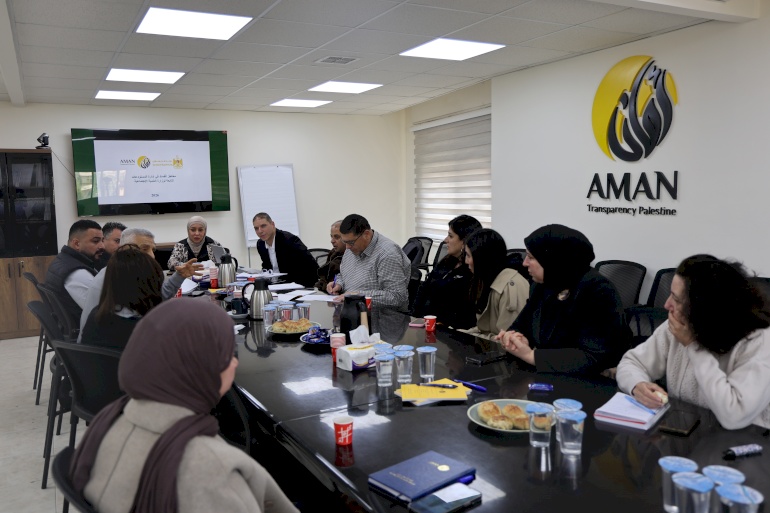
Ramallah – The Coalition for Integrity and Accountability (AMAN) held a focus group meeting to discuss a draft study titled: “Management of Corruption Risks in the Warehouses Administration of the Ministry of Social Development,” with the participation of representatives from relevant entities, including the Ministry of Social Development, the Ministry of Telecommunications, and the Council of Ministers, in addition to a number of public institutions and civil society institutions.
The session was opened by the Operations Director at AMAN Coalition, Hama Zeidan, who explained that the report comes within the framework of a memorandum of cooperation with the Ministry of Social Development, which defined areas of work in risk studies and capacity building for staff. She noted that the preparation of the study came at the request of the Ministry, with the aim of reducing corruption risks and strengthening an environment of transparency and integrity, in preparation for adopting its recommendations and applying them in practice.
The researcher and author of the study, Dr. Fadi Rabaia, presented the content and findings of the study in detail, explaining that its objective is to examine and investigate potential corruption risks in warehouse management by assessing the likelihood of these risks occurring and the scale of their impact, leading to recommendations that contribute to reducing or mitigating their effects. He emphasized that the study does not claim the existence of corruption cases in warehouse management, but rather focuses on analyzing risks from a preventive perspective to enhance integrity and transparency.
The study indicated that the warehouses affiliated with the Directorates of Social Development constitute a fundamental component in the system of relief services, particularly in light of the distribution of in-kind assistance worth millions of shekels during emergency periods, such as the COVID-19 pandemic. It also pointed to a noticeable development in attention to warehouse management since 2024, in terms of strengthening oversight and supervision and improving procedures.
The study reviewed the reality of warehouse operations, noting a variation in their effectiveness across governorates, where the warehouses in Nablus and Hebron are among the most active, while other warehouses remain inactive due to reasons related to available resources or intervention priorities. It also addressed the mechanisms for receiving, storing, and dispatching goods, which rely heavily on traditional paper-based procedures.
In its assessment of corruption risks, the study indicated a high likelihood of deviations in certain stages of work, particularly in the receipt, storage, and dispatch of goods, as a result of the absence of computerized systems, weak oversight, and overlap of tasks among employees. It further noted that the impact of such deviations may be significant, whether in terms of financial waste or the deprivation of beneficiaries of their rights.
The study presented a set of recommendations, most notably the need to establish an integrated electronic inventory management system, strengthen the physical security of warehouses through monitoring systems and improved storage organization, and activate internal control mechanisms along with regular, systematic inventory. It concluded that improving warehouse management requires comprehensive preventive measures that combine technical and oversight tools, thereby enhancing the efficiency of resource use and ensuring that assistance reaches its rightful beneficiaries with transparency and fairness.
For his part, the Assistant Undersecretary for Administrative Development and Planning at the Ministry of Social Development, Ashraf Barghouthi, confirmed that the Ministry has already begun developing the warehouse sector, including work on a specific electronic system that will be launched soon. He stressed that the Ministry will take the study’s observations into account and work to address them, with plans to extend the experience to other ministries. He also emphasized the importance of partnership with AMAN Coalition and integrating the study’s outputs into development plans.
For his part, the Head of the Control Unit at the Council of Ministers, Abdel Hadi Daoud, recommended preparing systematic reports prior to the disposal of materials to assess the possibility of utilizing them before destruction. He also stressed the importance of developing a comprehensive procedures manual that defines authorities and responsibilities and paves the way for the implementation of an integrated computerized system, drawing on the experience of pharmaceutical companies in modern storage systems that comply with international standards.
On his part, the Advisor to the Board of Directors of AMAN Coalition for Anti-Corruption Affairs, Dr. Azmi Shuaibi, affirmed that the Coalition adopts the principle that “prevention is better than cure,” through strengthening integrity, transparency, and accountability. He noted the development of work toward analyzing opportunities for the occurrence of corruption within institutions and reviewing procedures and decisions to ensure oversight that limits potential loopholes, even if limited. He also emphasized the importance of assessing risk levels and their impact, in a way that helps institutions strengthen their capacities and implement effective anti-corruption measures.