In a Discussion Session on Community Oversight as an Entry Point for Strengthening Prevention of Corruption Risks in the Health Sector in the Gaza Strip
AMAN: Civil Society Is a Key Oversight Partner for Improving Health Services and Enhancing Integrity in the Context of Early Recovery in Gaza
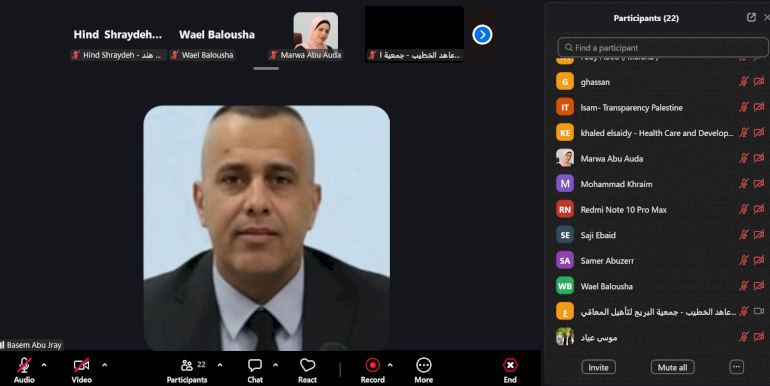
Gaza Strip – With the participation of health sector stakeholders and representatives of civil society organizations working in monitoring and oversight, AMAN Coalition held a virtual session via Zoom on “Community Oversight as an Entry Point for Strengthening the Prevention of Corruption Risks in the Health Sector in the Gaza Strip and Enhancing Integrity and Justice in the Management of Health Services in the Context of Early Recovery.” The session focused on the importance of strengthening the role of civil society organizations in monitoring and accountability, and building effective community networks that help bridge oversight gaps and enhance transparency in the management of public services, particularly in light of the difficult conditions facing the health sector.
The session was opened by the Director of AMAN’s office in Gaza, Wael Baalousha, who explained that the situation in the Gaza Strip is extremely difficult under the current exceptional circumstances, and the increasing challenges facing the health sector in Gaza, accompanied by weak transparency, multiple actors, and complex service delivery procedures. He stated that approximately 21,500 citizens are in need of medical evacuation outside the Strip, amid ambiguity in the management of this file and a clear lack of information, which has led to a rise in complaints among citizens.
Balousha explained that the limited number of hospitals and weak capacities, compared to the high demand for health services, are deepening the crisis. He stressed the need to ensure integrity and transparency to guarantee fairness in handling cases. He added that the strict blockade and the prevention of entry of medical equipment are negatively affecting the level of services provided, in light of nearly non-existent resources, in addition to the targeting of medical staff. He emphasized the importance of coordinating internal efforts to reach an acceptable level of citizen satisfaction despite the complexity of the situation.
In an analytical commentary on the reality of the health sector, Marwa Abu Odeh, Community Advocacy Coordinator in the Gaza Strip, presented a working paper prepared by AMAN Coalition, highlighting the “problematic absence of oversight amid multiple actors and weak official reference frameworks.” Abu Odeh explained that this oversight gap is attributed to resource scarcity and rising demand, which has created a fertile environment for practices such as favoritism (wasta) and bribery in order to obtain basic services.
The paper drew on alarming figures from AMAN’s 2025 survey, where 20.4% of citizens classified the health sector as one of the sectors most prone to corruption. This reflects a sharp decline in public trust as a result of the “war economy” and feeble rule of law. Despite emphasizing the importance of community oversight, she acknowledged the existence of major challenges that hinder this role, most notably security restrictions, the large number of international aid organizations that fragment responsibility, and the absence of legal protection for whistleblowers reporting corruption.
At the conclusion of the presentation, the paper put forward recommendations to strengthen oversight mechanisms, most notably the need to establish a unified national framework for community oversight and a transparent digital data system. It also called for the establishment of an independent national observatory equipped with early warning tools, and urged the international community and donor entities to fully disclose funding data and resource allocations, in order to ensure fair and transparent health management during the recovery phase.
Dr. Basem Abu Jeri: Civil health sector institutions are key partners in monitoring and developing the health situation in Gaza
Researcher at Al Mezan Center for Human Rights, Dr. Basem Abu Jeri, emphasized the important role of civil health sector institutions and civil society organizations in monitoring the health situation, contributing to its development, and holding relevant authorities accountable, amid the growing challenges facing the Gaza Strip.
In his remarks on the role of civil health sector institutions in monitoring, participation, and accountability in relation to the health situation and its development prospects, Abu Jeri explained that the Ministry of Health remains the official body forming the backbone of the health system and is responsible for ensuring access to health services for all citizens in accordance with international standards. He stressed that any shortcoming in this regard constitutes a violation of the right to health and of legal and humanitarian obligations.
Abu Jeri also called for strengthening partnership between the government, private, and civil sectors, noting that civil society institutions possess accumulated experience and the capacity to monitor, document, and analyze data, thereby contributing to the identification of shortcomings and providing an objective assessment of health policies and services.
He concluded by emphasizing that there is a real opportunity for civil society organizations to play a pivotal role in supporting early recovery and reconstruction plans, and in improving the health situation in the Gaza Strip through monitoring, participation, and accountability.
Rafaat Al-Majdalawi: The war of extermination has deepened the collapse of the health system and exposed challenges in integrity and oversight
In comments by the Director of Al-Awda Health and Community Association, Ra’fat Al-Majdalawi, he stated that the health situation in the Gaza Strip was already suffering from accumulated crises prior to the war of extermination, under a siege that lasted more than 15 years. This had resulted in weak funding, shortages of medicines, the absence of comprehensive health coverage, and restrictions on the entry and maintenance of medical equipment, which placed a heavy burden on the Ministry of Health as the backbone of the health system.
In a further statement, Al-Majdalawi stressed the importance of strengthening integrity and oversight within health and civil society institutions, affirming that conditions of war and emergency do not justify the absence of law or the suspension of oversight systems, but rather require clear and transparent exceptional procedures, including emergency laws and regulations, rather than chaos or the justification of administrative and financial violations.
He pointed out that some forms of corruption and administrative and financial violations emerged during the war period, whether in relation to supplies and procurement or the misuse of services. He stressed the need for strict accountability for anyone proven to be involved, alongside strengthening the role of citizens and beneficiaries in reporting any abuses through complaint channels and community oversight mechanisms.
Al-Majdalawi concluded by emphasizing the need for a national coalition that strengthens accountability, integrity, and transparency within the health sector and civil society work, while restoring a sound system of values and institutional conduct, in order to help protect health resources and services under the exceptional circumstances facing the Gaza Strip.
Wael Balousha: Civil society is a key oversight partner for improving health services and enhancing integrity in Gaza
At the conclusion of the meeting, Balousha affirmed that civil society is a key oversight partner for improving policies, stressing that addressing corruption in crises requires collective coordination between local and international institutions. He also emphasized the importance of sustained pressure to ensure that Palestinian citizens are not burdened with the cost of shortcomings in this vital file, and that their health rights are protected as a top priority.