Following a Session to Discuss the Report on Governance in the Water Sector Regulatory Council
AMAN Calls for Clearer and More Integrated Roles Among Relevant Water Sector Institutions
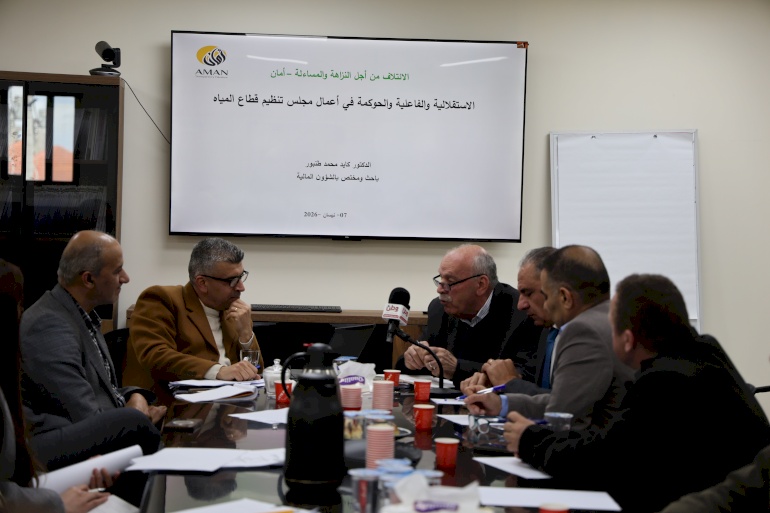
Ramallah – The Coalition for Integrity and Accountability (AMAN) held a discussion session to present and deliberate on a report titled: “Independence and Governance in the Work of the Water Sector Regulatory Council,” with the participation of relevant entities, including the Water Authority, the Water Sector Regulatory Council, representatives of municipalities and civil society, as well as the concerned ministries and oversight institutions.
The session was opened by the Executive Director of the Coalition for Integrity and Accountability (AMAN), Issam Haj Hussein, who noted that the report constitutes a contribution by the Coalition to supporting government efforts toward reforming various sectors, including the water sector, which faces increasing challenges as a result of the occupation’s control over its resources. He stressed the need to provide the necessary financial and human resources for vital sectors to enhance the steadfastness of the Palestinian people.
The report’s author, researcher Kaid Tanbour, presented the main findings, which focused on assessing the levels of independence, integrity, transparency, and accountability in the work of the Water Sector Regulatory Council, within the legal and institutional framework governing its functions.
Tanbour explained that the government has adopted an indirect management model in the water sector, pursuant to Decree-Law No. 14 of 2014, to promote good governance by clearly separating roles among three entities, which are: the Palestinian Water Authority, responsible for policy-making and strategic planning; the Water Sector Regulatory Council, an independent body tasked with regulation, oversight, and consumer protection; and the regional water utilities and local authorities, which are responsible for operations and service delivery. He added that structural overlap persists among these bodies, alongside a slow transition toward regional water utilities, the absence of a unified national database, and weak binding institutional coordination.
A Solid Legal Framework and Relative Independence
The report findings showed that the Water Sector Regulatory Council operates within a clear legal framework that guarantees its legal, administrative, and financial independence, with direct regulatory and oversight powers. They also indicated a functional separation between the Water Council and the Council of Ministers, whereby the latter’s role is limited to final approval of tariffs and the issuance of licenses based on the Council’s recommendations.
Despite the policy direction to enhance self-financing beginning in 2026, the report noted that financial independence remains limited due to continued dependence on external funding.
With regard to integrity, the report indicated the existence of a legal framework that includes provisions to prevent conflicts of interest, the submission of financial disclosure statements, and an approved code of conduct. However, it pointed to the absence of a comprehensive institutional policy for managing corruption risks and the need to strengthen specialized awareness programs.
According to the report, the Water Sector Regulatory Council is subject to a multi-level oversight system, and no cases of corruption have been recorded in its work, which is a positive indicator. At the same time, the report highlighted weak public accountability and limited awareness programs related to the complaints system.
Recommendations to Enhance Governance, Transparency, and Financial Independence in the Water Sector
The report recommended undertaking a comprehensive review of the legal framework governing the water sector to help clearly define accountability lines and institutional roles. It also called for accelerating the completion of the transition toward regional water utilities to enhance governance efficiency. In the area of integrity, the report stressed the importance of adopting noted that the report constitutes a contribution by the Coalition to supporting government efforts toward reforming various sectors
The recommendations further stressed the need to strengthen transparency by adopting a written disclosure and publication policy that ensures regulatory decisions, financial and administrative reports, and budgets are made clearly accessible, with the involvement of civil society organizations and representatives of beneficiaries.
The report also recommended developing a mid-term financial plan aimed at strengthening the financial independence of the Water Sector Regulatory Council, and gradually transitioning toward self-financing to ensure the sustainability of its operations.
In the minutes of the Water Sector Regulatory Council’s response to the report’s findings, the Council’s Executive Director, Engineer Mohammed Al-Hamidi, stated that the report aligns with government directions and supports them, affirming that the Council’s role is regulatory rather than executive, as it is limited to submitting recommendations directly to the Council of Ministers.
Al-Hamidi explained that, by law, the Council is the authority responsible for addressing tariff matters, with no ambiguity in this regard. He noted that tariff reviews are usually conducted in prior coordination with the Water Authority, which is responsible for licensing construction projects, within a framework of complementary roles between both sides. He added that there is no overlap in responsibilities among the three entities, as their responsibilities are clearly defined in law. However, he acknowledged that some aspects remain incomplete and are being identified and addressed through internal memoranda that regulate such issues, including rainwater allocation and irrigation mechanisms, as well as the need to strengthen oversight of distributors.
He further noted that all Council data is published and publicly accessible, while some data is shared with the Water Authority, such as quantities of water sold. He explained that there are 11 joint committees that meet regularly to coordinate between the relevant entities. He added that each body maintains its own data, while the Water Authority also has access to the Council’s data, in the absence of a unified national database. He also said that the Council enjoys financial independence, despite its current reliance on donor funding that is transferred directly to its account. He noted that the Council is currently developing a plan to achieve financial self-sufficiency and has an operational written and computerized complaints system through which all complaints are recorded and monitored.
For his part, Adel Yassin, Director General of Planning and Policies at the Water Authority, stated that service providers do not give sufficient attention to the Regulatory Council due to the absence of effective tools that enable it to perform its role effectively. He added that the Council’s recommendations, although based on quantitative data, do not provide the Water Authority with what it needs to adjust its policies, nor do they offer service providers practical, actionable tools they can rely on.
Adviser to the Board of the Coalition for Integrity and Accountability (AMAN) for Anti-Corruption Affairs, Dr. Azmi Shuaibi, concluded by noting that the water sector has historically suffered from unclear roles and weak operational coordination. However, the adoption of the relevant law has contributed to improving this situation. He stressed, nevertheless, that addressing the remaining gaps requires stronger integration and coordination among all relevant entities.