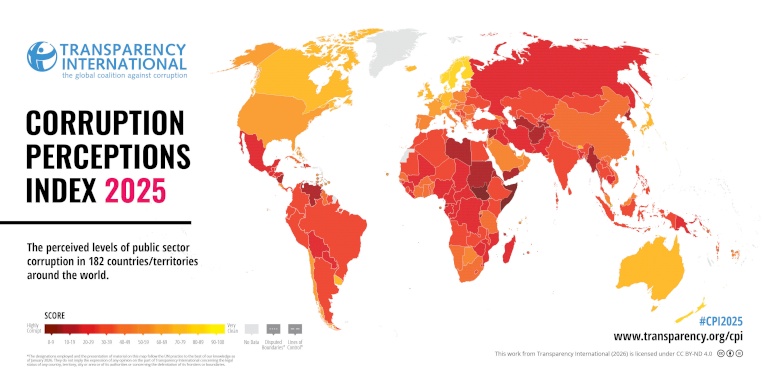
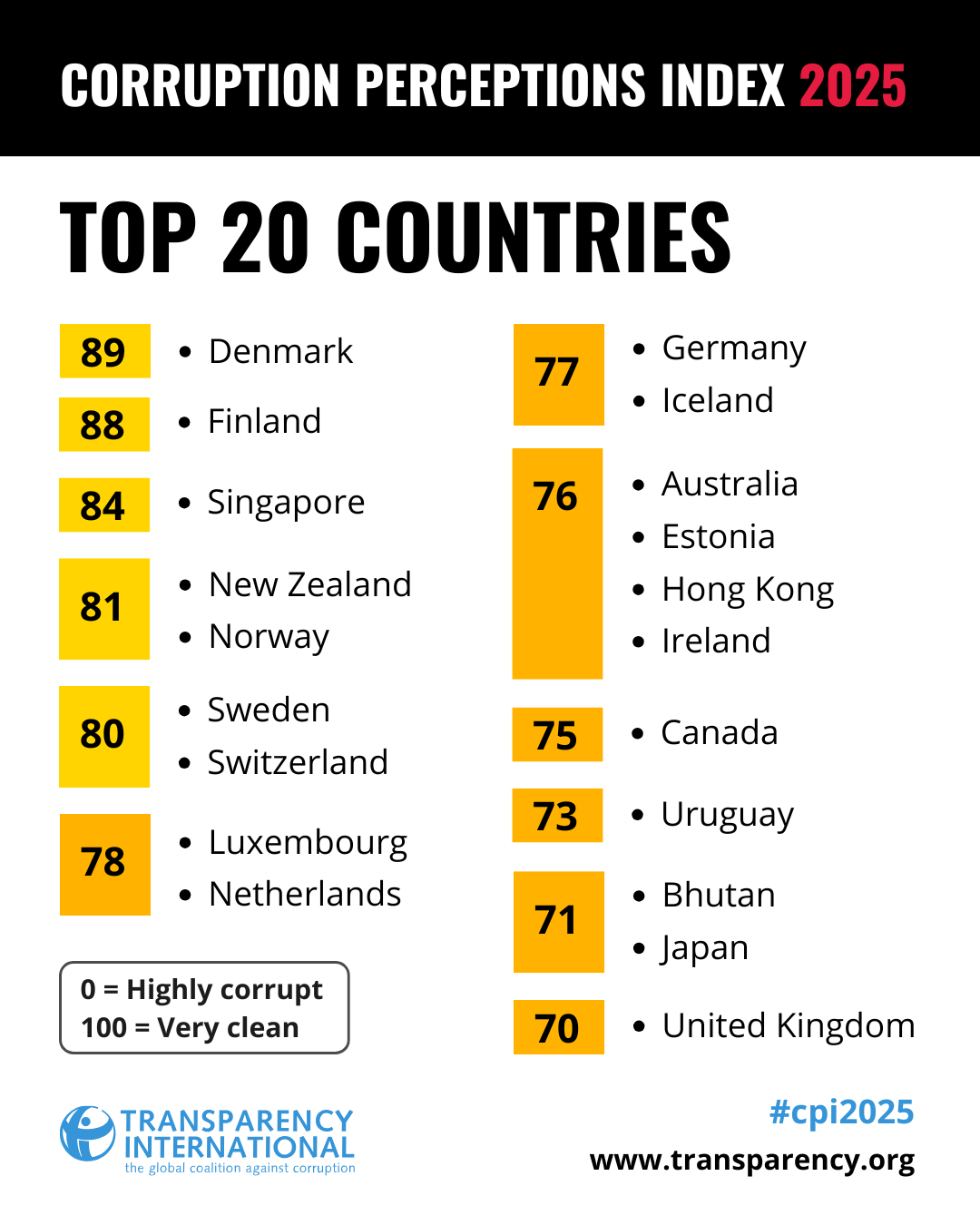
Berlin/Ramallah – Transparency International has released the results of the Corruption Perceptions Index (CPI) for 2025, which measures levels of corruption in countries worldwide, including Arab countries. The index results show that the top-performing countries globally in terms of integrity and anti-corruption efforts were Denmark, Finland, Singapore, New Zealand, Norway, Sweden, Switzerland, Luxembourg, the Netherlands, Germany, and Iceland.
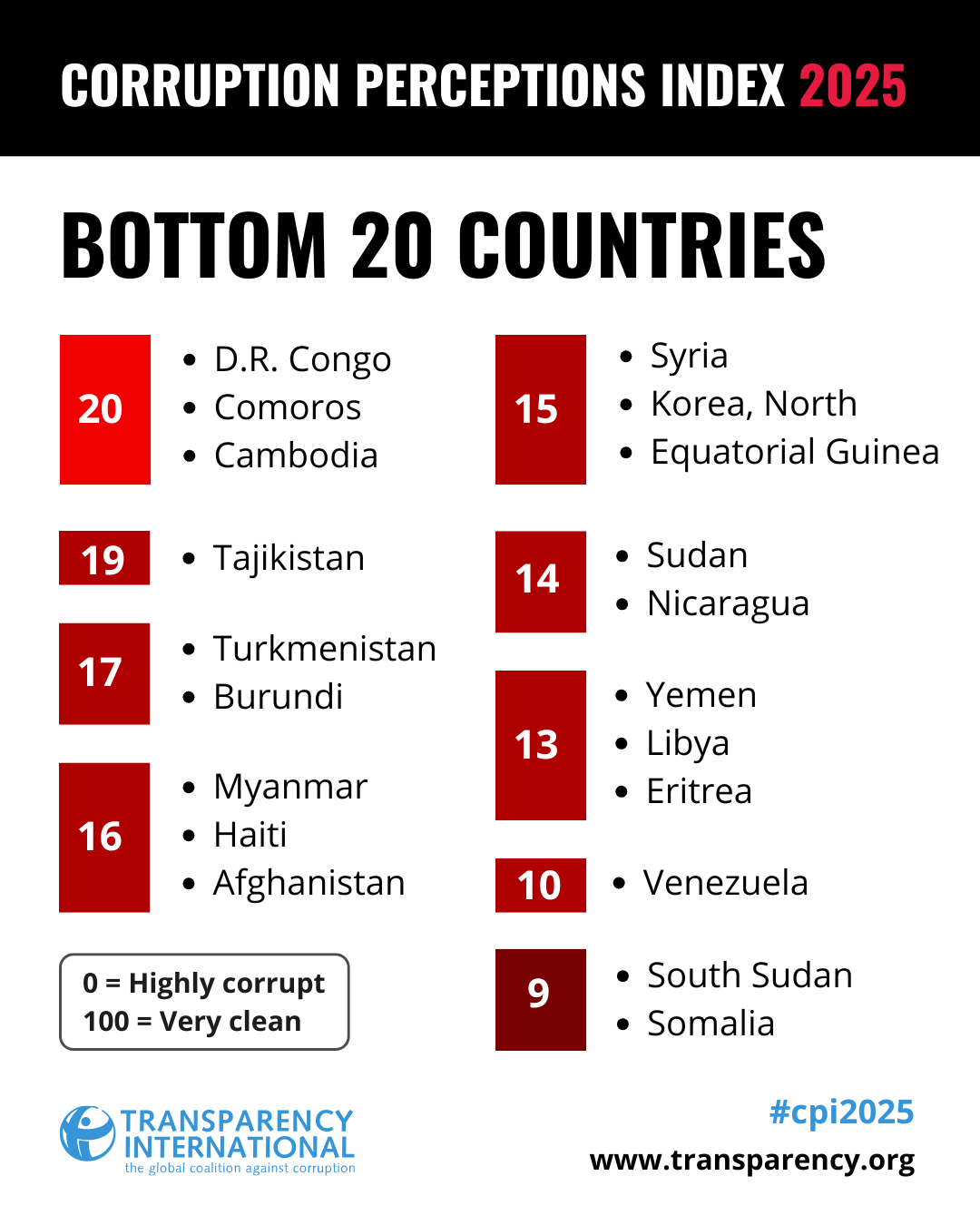
In contrast, the lowest-ranked countries globally according to the index, including five Arab countries, were Equatorial Guinea, North Korea, Syria, Nicaragua, Sudan, Eritrea, Libya, Yemen, Venezuela, and Somalia.
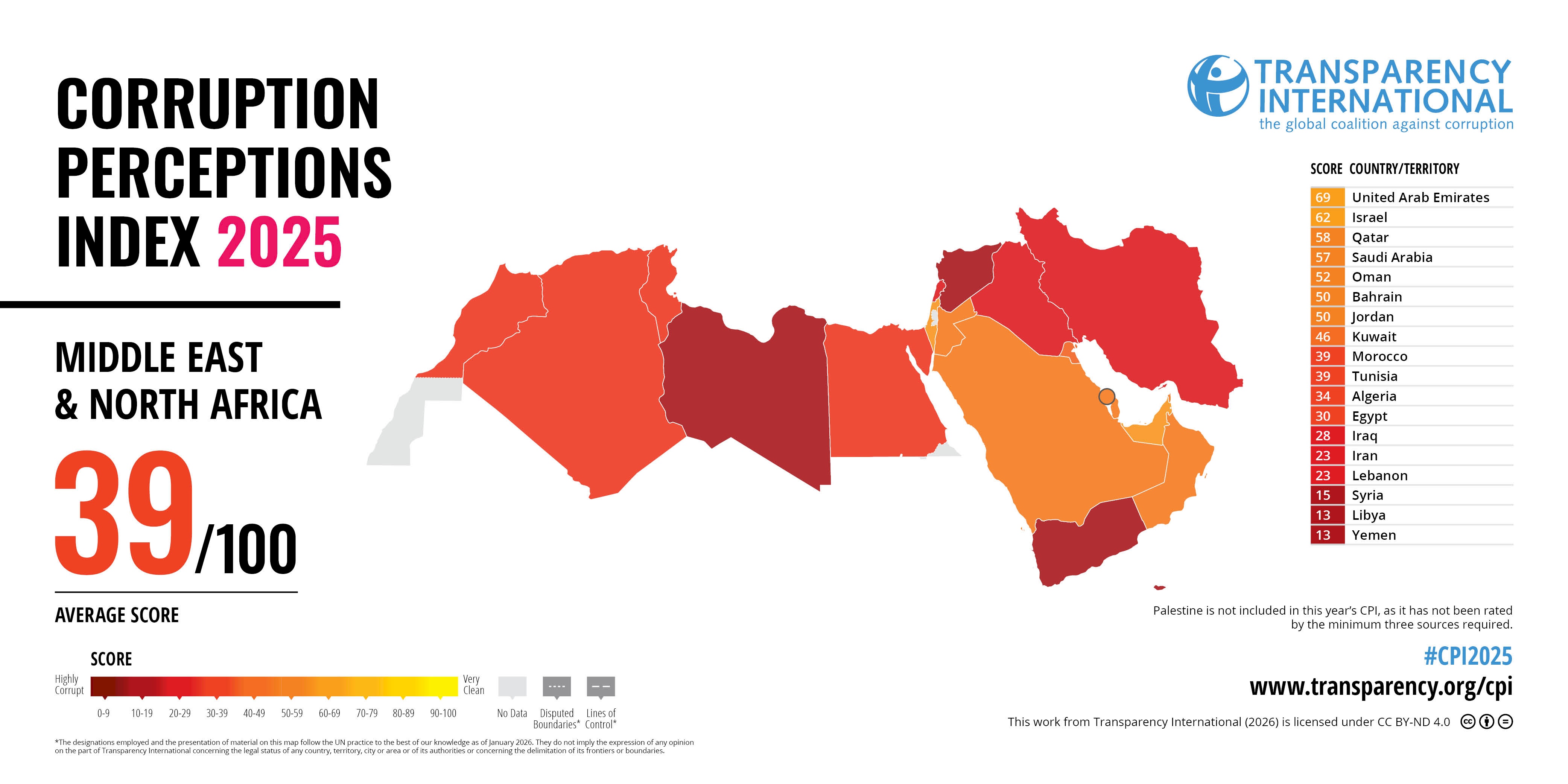
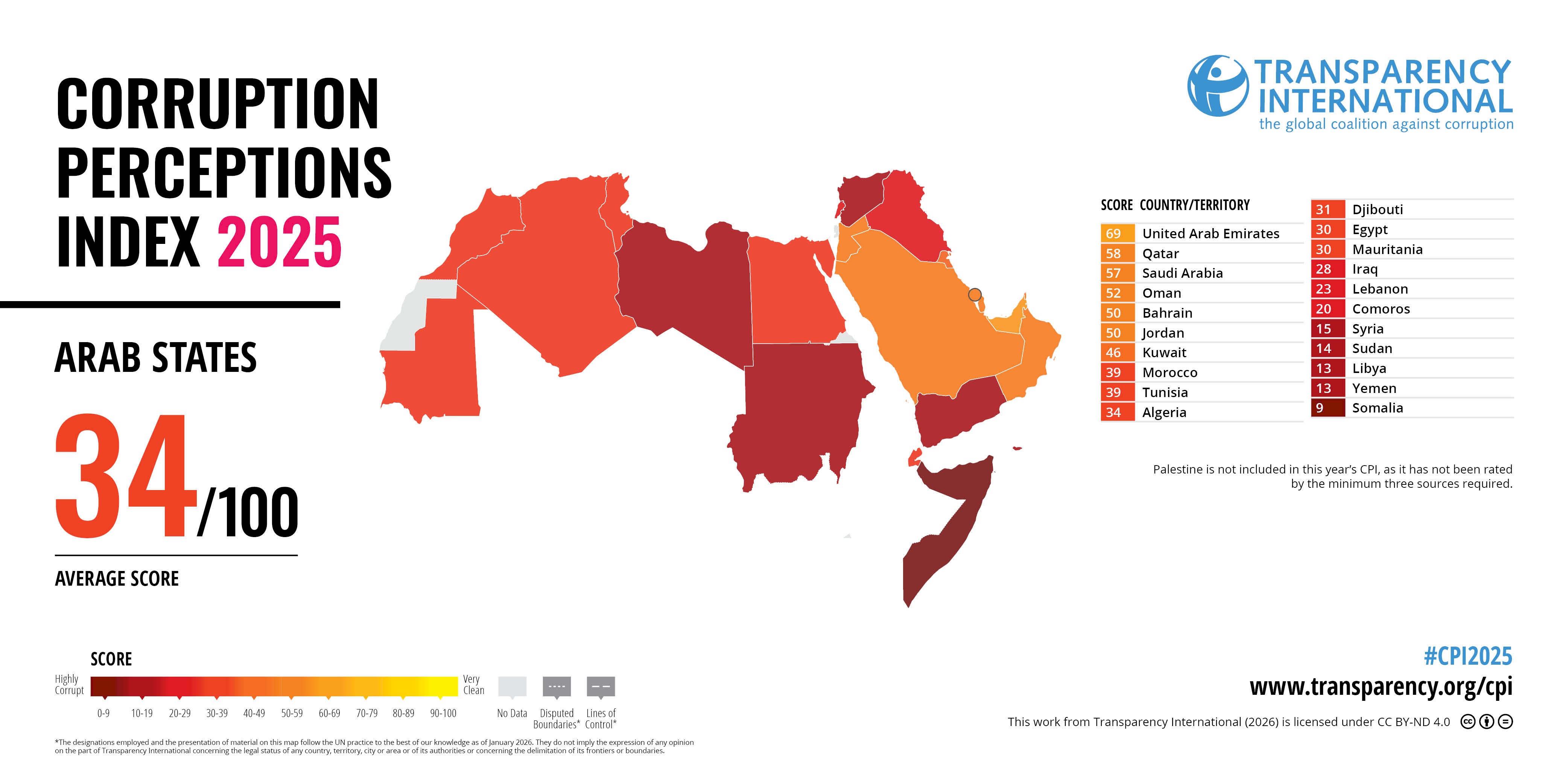
According to the index results, six Arab countries scored above the 50 percent threshold: the United Arab Emirates, Qatar, Saudi Arabia, the Sultanate of Oman, Bahrain, and Jordan. Meanwhile, thirteen Arab countries scored below 50 percent: Kuwait, Morocco, Tunisia, Algeria, Egypt, Mauritania, Iraq, Lebanon, Syria, Sudan, Libya, Yemen, and Somalia.

The Decline of Leadership Undermines Global Anti-Corruption Efforts
At a time when the global arena is witnessing widespread protests led by Generation Z, those under the age of 25, against corruption and the dangerous disregard for international standards by some governments, the thirty-first edition of the Corruption Perceptions Index issued by Transparency International reveals a deeply concerning picture. It points to a long-term decline in the role of leadership in combating corruption, alongside only limited indications of progress.
Corruption is worsening worldwide, even in established democracies that are experiencing rising levels of corruption amid a weakening of leadership. According to the Corruption Perceptions Index (CPI) 2025 issued by Transparency International and published in 10 February 2026, the annual index shows a sharp contraction in the number of countries scoring above 80 points, falling from 12 countries a decade ago to only five countries this year.
Democratic systems, which are typically stronger in combating corruption than authoritarian regimes or weak democracies, are also witnessing a troubling decline in performance. This trend extends to countries such as the United States (64), Canada (75), and New Zealand (81t), as well as to various parts of Europe, including the United Kingdom (70), France (66), and Sweden (80).
Another equally alarming pattern is the growing restrictions imposed by many countries on freedom of expression, freedom of assembly, and freedom of association. Since 2012, 36 out of the 50 countries that have experienced significant declines in their Corruption Perceptions Index scores have also seen a contraction of civic space.
In 2025, a wave of anti-corruption protests led by Generation Z swept across many countries, with most of these protests concentrated in states ranked in the lower half of the Corruption Perceptions Index. These countries have seen their scores stagnate or decline significantly over the past decade. Young people in countries such as Nepal (34) and Madagascar (25) took to the streets to criticize leaders for abusing power, failing to deliver services that ensure a decent standard of living, and for not providing economic opportunities.
In its statement accompanying the index, Transparency International warned of the alarming situation resulting from the absence of bold leadership in combating corruption globally. This weakens international anti-corruption efforts and limits progress, while risking a reduction in the pressure needed to advance reforms in many countries around the world.
In that regard, François Valérian, Chair of Transparency International, stated, “Corruption is not inevitable or unavoidable. Our research and experience as a global anti-corruption movement show a clear blueprint for holding power to account in the service of the public good, from democratic processes and independent oversight to a free and open civil society. At a time when some countries are flagrantly disregarding international standards, we call on governments and leaders to act with integrity and fulfill their responsibilities to provide a better future for people worldwide.”
In its statement, Transparency International called for the revitalization of political leadership in combating corruption, including full enforcement of laws, implementation of international commitments, and reforms that strengthen transparency, oversight, and accountability. It also emphasized protecting civic space by halting attacks on journalists, NGOs, and whistleblowers, and stopping efforts to restrict the work of independent civil society. Additionally, the organization urged closing secret loopholes that allow corrupt funds to cross borders, including regulating professional intermediaries and ensuring transparency in disclosing the ultimate beneficial owners of companies, trusts, and assets.
Decline of Leadership in Combating Corruption
In many European countries, anti-corruption efforts have stagnated significantly over the past decade. Since 2012, thirteen countries in Western Europe and the European Union have experienced major setbacks in this area, while only seven countries have shown notable improvements. In December 2025, the European Union adopted its first Anti-Corruption Directive aimed at aligning criminal laws related to corruption. However, what could have been a strict, zero-tolerance framework was weakened by some member states, including Italy (53), which blocked the criminalization of public officials’ abuse of office. The result is a framework deficient in ambition, clarity, and enforceability.
Meanwhile, the United States (64) continued its downward trajectory, recording its lowest-ever score. Although the developments of 2025 are not yet fully reflected, actions targeting independent voices and undermining judicial independence raise serious concerns. Beyond the CPI results, the temporary suspension of the Foreign Corrupt Practices Act and the weakening of its enforcement signal tolerance for corrupt business practices. At the same time, cuts to U.S. funding for civil society abroad have undermined global anti-corruption efforts. Political leaders elsewhere have interpreted this as a signal to impose further restrictions on NGOs, journalists, and other independent voices.
Achieving high scores on the Corruption Perceptions Index does not guarantee that a country is free from corruption. Many of the highest-scoring countries contribute to enabling corruption in other states by facilitating the laundering and cross-border transfer of corrupt proceeds, an aspect not covered by the index. For example, Switzerland (80) and Singapore (84) are among the top-scoring countries, yet both have come under scrutiny for facilitating the movement of illicit funds.
Shrinking Civic Space Undermines Anti-Corruption Efforts
Over the past decade, political interference in the operations of NGOs has increased in countries such as Georgia (50), Indonesia (34), and Peru (30). Governments in these countries have introduced new laws to restrict access to funding or to weaken organizations that monitor and criticize government performance. These laws are often accompanied by campaigns of intimidation and smear.
In countries like Tunisia (39), civic space has contracted through administrative, judicial, and financial pressures that restrict NGO operations, even without the enactment of new restrictive laws. In such contexts, it becomes increasingly difficult for independent journalists, civil society organizations, and whistleblowers to confront corruption, while corrupt officials are more likely to continue abusing their power. Branches of Transparency International in Russia (22) and Venezuela (10) have been forced to operate from exile due to repression targeting civil society.
These restrictive environments do not merely silence critics and oversight bodies; they create real risks for anyone who dares to expose wrongdoing. Since 2012, 150 journalists covering corruption-related issues in non-conflict areas have been killed, with nearly all of these assassinations occurring in countries with high levels of corruption. It is also worth noting that, according to the International Federation of Journalists (IFJ), the Israeli occupation has killed more than 230 journalists as part of a systematic targeting of Palestinian journalists who play a central role in exposing corruption, conducting investigative reporting, and documenting crimes perpetrated by the Israeli occupation’s forces in the Gaza Strip.
Key Findings on Global Corruption
The Corruption Perceptions Index ranks 182 countries and territories based on perceived levels of public sector corruption, on a scale from 0 (highly corrupt) to 100 (very clean). The global average is 42 out of 100, the lowest level in over a decade, indicating a concerning long-term downward trend. The average for the Middle East and North Africa is 39 out of 100, while the average for Arab countries in the 2025 CPI is 34 out of 100.
The results show that the vast majority of countries are still failing to control corruption, with more than two-thirds of countries (122 out of 180) scoring below 50 points. For the eighth consecutive year, Denmark topped the index with a score of 89, followed by Finland (88) and Singapore (84). In contrast, the lowest scores were recorded in countries experiencing repression and instability, such as South Sudan (9), Somalia (9), and Venezuela (10).
Since 2012, 50 countries have experienced significant declines in their scores, including Turkey (31), Hungary (40), and Nicaragua (14), reflecting long-term structural weaknesses in integrity systems linked to democratic backsliding, conflict, institutional fragility, and entrenched networks of cronyism. Conversely, 31 countries have shown notable improvements, including Estonia (76), South Korea (63), and Seychelles (68), driven by sustainable reforms, strengthened oversight institutions, expanded digitalization of public services, and improved civil service efficiency.
It should be noted that the Corruption Perceptions Index, established in 1995, is the world’s leading reference for measuring public sector corruption. It relies on data from 13 reputable international sources, reflecting the views of experts and businesspeople, with regular methodological reviews to ensure accuracy, the most recent of which was conducted in 2017. All results since 2012 are fully comparable on an annual basis.
Although Palestine is not Included in the Index: Persistent Weakness in Governance Integrity
Palestine, which is not included in the index for factual practical reasons, has been the subject of reports by the Coalition for Integrity and Accountability (AMAN) and citizen surveys on corruption and anti-corruption efforts conducted in 2025. These sources indicate that, despite the existence of adequate Palestinian legislation to combat corruption and the adoption of a national anti-corruption strategy by the Palestinian government, persistent weaknesses in accountability systems, the absence of the Legislative Council, and the ongoing Israeli occupation practices have all contributed to undermining integrity in governance.
This is reflected in the continued appointments to senior positions without transparency or equal opportunity, as well as the issuance of numerous decisions, particularly those of a legislative nature, that do not serve the public interest. Cases of corruption have also been observed involving influential individuals who obtained substantial funds linked to the provision of public services or trade facilitation, without being part of the productive process. Instead, they exploited their official positions to secure large profits for service or goods providers, which were shared among them at the expense of Palestinian citizens, taking advantage of scarce services and high demand.
In the Gaza Strip, weak or absent accountability has contributed to corruption by influential individuals who obtained large sums with the assistance of Israeli officials overseeing the entry of aid into the territory. This occurred through the granting of permits, licenses, and coordination related to the transport and entry of goods and aid, benefiting specific Palestinian companies or individuals in exchange for financial gains and commissions.
The Coalition for Integrity and Accountability (AMAN) emphasizes that Palestine is not outside the broader conclusions of this year’s index results, which point to a long-term decline in the capacity of leadership to combat corruption, along with only limited indications of progress.
#CPI2025